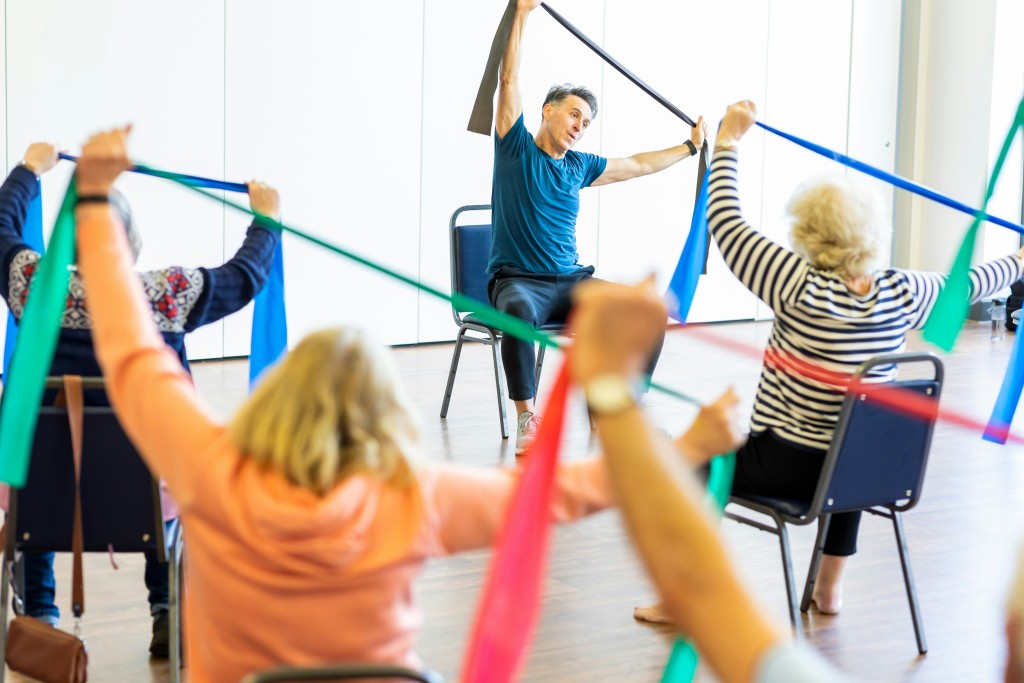
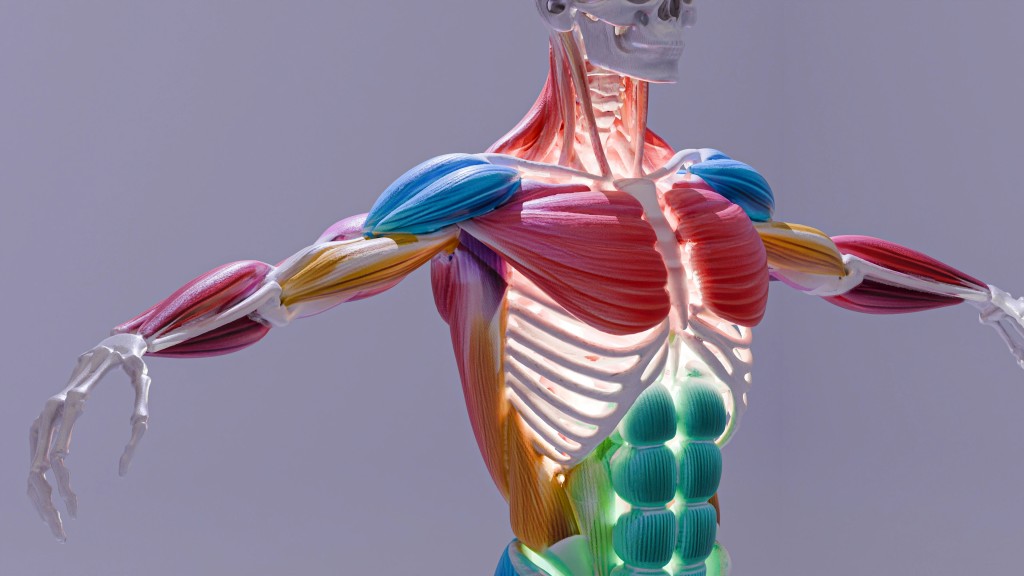
"Do I still need to train muscles when I already walk every day?" Many elderly people have this doubt. Dietitian Tseng Chien-ming explains in a Facebook post that although walking can increase daily activity and strengthen cardiorespiratory function, if you want to have more strength when getting up, climbing stairs, going to the market, and carrying groceries, walking alone is not enough—targeted muscle strength training is still needed. Therefore, elderly people must take care of the five major muscle groups—chest, shoulders, back, legs, and core—so that daily movements become more stable. He states that resistance bands for muscle training at home can freely adjust tension according to individual ability. The movements should first be done steadily and smoothly, then resistance can be gradually increased. He has specifically organized 10 extremely simple introductory movements targeting the 5 major core areas:
1. Chest (More Strength to Push Heavy Objects Away)
Seated resistance band chest press: Loop the resistance band around the upper back, hold both ends with your hands, slowly push forward from both sides of the chest, then slowly return in a controlled manner.
Wall push-up: Place both hands on the wall, keep the body in a straight line, bend the elbows and slowly bring the body closer to the wall, then push back to the original position with force. The closer the feet are to the wall, the lower the difficulty.
2. Shoulders (Easier to Raise Hands to Reach High Objects)
Seated front raise: Sit on a chair, step on the middle of the resistance band with both feet, slowly raise both hands forward to shoulder height, then slowly lower.
Seated lateral raise: Slowly raise both hands horizontally from the sides of the body. If there is joint pain in the shoulders, do not force it.
3. Back (Maintain an Upright Posture and More Strength to Pull Heavy Objects)
Seated row: Loop the resistance band around the soles of the feet, pull both elbows backward, and gently squeeze the shoulder blades on both sides together. Be careful not to shrug or lean the body too far back.
Chest-level horizontal pull-apart: Place the resistance band in front of the chest, bend the elbows slightly, and slowly pull apart to the left and right. The key point of the movement is to feel the back exerting force.
4. Legs + Buttocks (Key to Preventing Falls When Getting Up, Walking, and Climbing Stairs)
Chair sit-to-stand: Sit on the front edge of a stable chair without wheels, place both feet firmly on the ground and slowly stand up, then slowly sit down in a controlled manner. You may lightly hold a stable tabletop for assistance.
Seated knee opening: Place a loop resistance band above the knees, slowly open both knees outward against resistance, then slowly bring them together.
5. Core Muscle Group (Sit Steadily, Stand Steadily)
Seated alternating knee lift: Sit on a chair with the back straight and the abdomen slightly tightened, and lift the left and right feet upward alternately.
Seated hand-knee opposition: Press the right hand downward forcefully against the left knee while the left knee pushes upward at the same time, exerting force against each other but keeping the body still. Hold for 5 to 10 seconds, then switch sides. Do not hold your breath during the process.
Tseng points out that elderly people do not need to do all the movements in one go. It is suggested to divide the movements into groups A and B, and arrange 2 to 3 days a week for alternating training:
Group A: Chest press + front raise + seated row + sit-to-stand + alternating knee lift
Group B: Wall push-up + lateral raise + horizontal pull-apart + seated knee opening + hand-knee opposition
He suggests doing 8 to 12 repetitions of each movement as 1 set, and increasing to 2 sets after the body adapts. The resistance intensity should follow the principle of "feeling a bit strained in the last few repetitions, but still able to maintain a stable posture."
5 Major Safety Rules for Elderly Exercise
Tseng emphasizes that "training steadily" is far more important than "pulling heavy." When elderly people exercise at home, they must remember the following safety points:
-
Carefully check the resistance band for cracks or signs of aging before use.
-
Exhale when exerting force, inhale when relaxing and returning, and never hold your breath.
-
Movements should be slow; if there is obvious sharp pain in the joints, do not force it.
-
If chest tightness, chest pain, shortness of breath, or dizziness occurs during exercise, stop immediately.
-
Those who have recently undergone surgery, have an extremely high risk of falling, or have cardiovascular disease or severe joint degeneration should consult a doctor or exercise professional before starting.
He reminds that daily three meals should be moderately paired with high-quality protein such as soy products, fish, eggs, and lean meat, while also retaining an appropriate amount of staple food and vegetables. Never cut out all starch for the sake of building muscle. Too little calorie and starch intake is not conducive to maintaining muscle mass.
In addition, elderly people who have chronic kidney disease or need to limit protein intake should strictly follow the prescribed diet based on kidney function indicators and their doctor's and dietitian's instructions, and must not blindly eat large amounts of high-protein foods on their own.
Source: Dietitian Tseng Chien-ming