






Read More


Night Recap - November 23, 2026
2 mins ago





Temperatures to drop to 16 degrees on Wed as northeast monsoon nears
22-11-2026 13:10 HKT



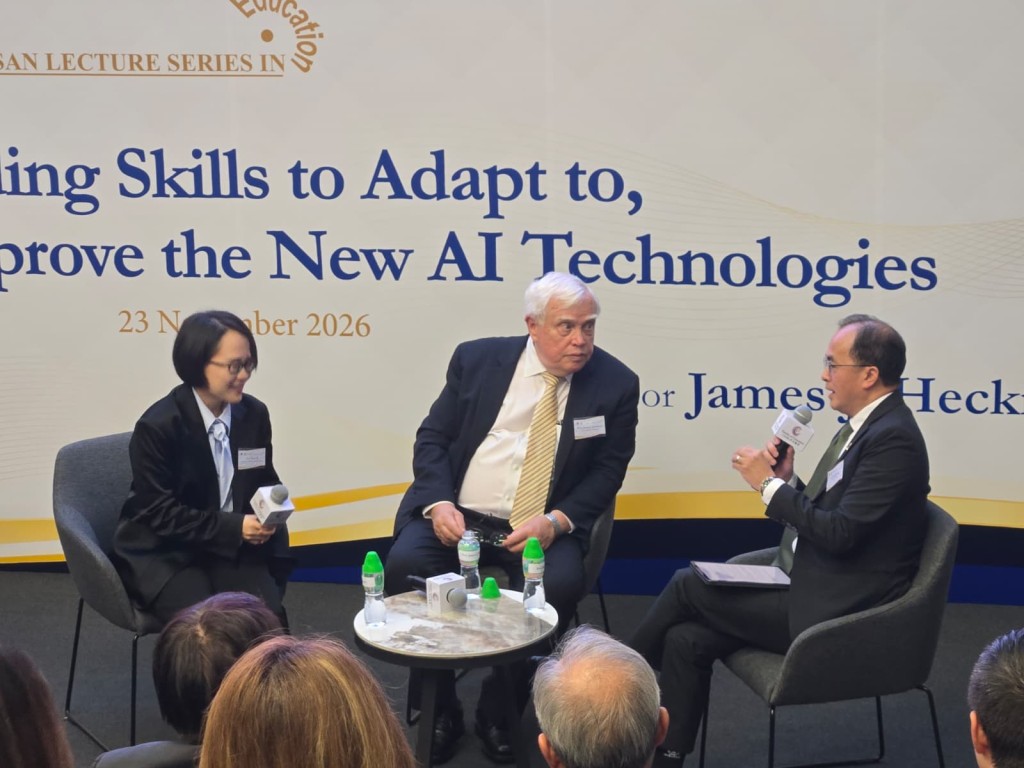
As artificial intelligence continues to reshape classroom instruction and pedagogy, Nobel laureate in economics James J. Heckman emphasized that cultivating logical reasoning and resilience is far more vital than simply teaching technical tools, while condemning uniform standardized testing as an outdated practice.
Professor Heckman, who received the Nobel Memorial Prize in Economic Sciences in 2000, shared his perspective at a public lecture hosted by the Faculty of Education at The Chinese University of Hong Kong (CUHK). The two-hour seminar, titled "Building Skills to Adapt to, Adopt and Improve the New AI Technologies," drew more than 100 educators, researchers, and students.
Addressing the audience, Professor Heckman pointed out that while education plays an indispensable role in raising students' awareness of technological advancements and equipping future generations to adapt flexibly, conventional curricula often fall into the trap of being overly narrow.
He cautioned that simply instructing students on how to operate software or use specific digital tools is inadequate for the transitional demands of the AI revolution.
Instead, curricula must expand beyond mere technical training to prioritize self-directed learning, psychological resilience, and creativity, which he described as equally essential pillars for long-term development.
During the session, several participants voiced growing anxieties that students may become excessively reliant on generative AI models.
Responding to these concerns, Professor Heckman acknowledged the risk, stressing that educators must actively prevent artificial intelligence from becoming a substitute for authentic learning and deep comprehension.
He underlined that young people must build strong foundations in logical thinking so they can thoroughly grasp causality, underlying principles, and how complex mechanisms function in the real world.
Turning to student evaluation, Professor Heckman delivered a sharp critique of standardized examinations.
He stated that using uniform metrics and fixed test scores to gauge individual ability suppresses personal uniqueness and potential, describing traditional testing regimens as a "big mistake" and fundamentally flawed.
Looking ahead, he expressed strong confidence that assessment systems will undergo profound improvements through artificial intelligence, enabling unprecedented methods to evaluate student capabilities comprehensively.
Professor Heckman explained that AI can generate dynamic, personalized scenarios and challenges tailored to individual learners, allowing evaluators to directly observe how candidates solve real-time problems.
He highlighted that the Educational Testing Service (ETS)—the developer behind major standardized exams such as TOEFL and TOEIC—is exploring novel assessment tools for specialized occupations using interactive simulations similar to the urban planning game SimCity.
By introducing interactive, AI-driven environments akin to SimCity, future assessments can more accurately measure a candidate’s practical problem-solving, strategic coordination, and integrative abilities rather than rote memory, he concluded.
