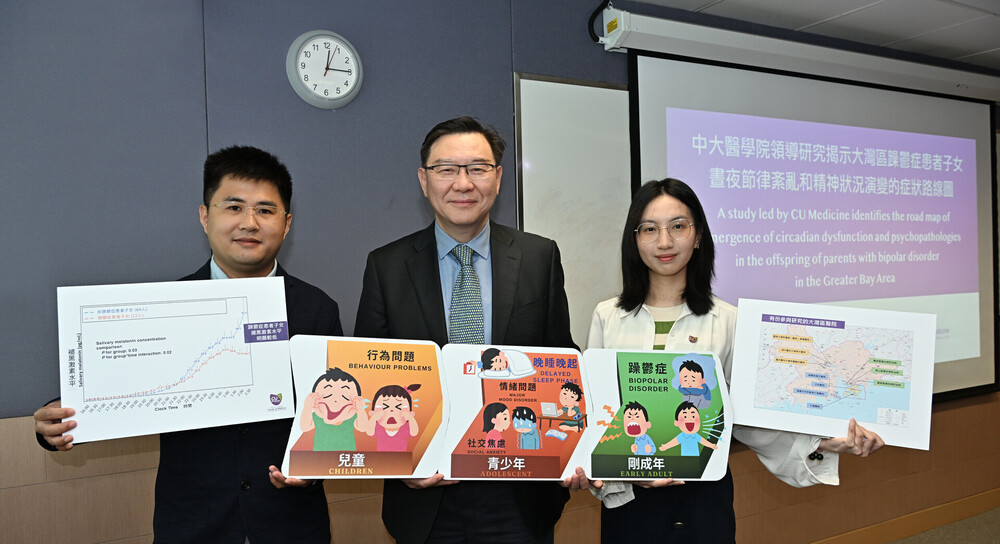
Children of bipolar disorder patients are at a higher risk of developing mental health issues and behavioral problems during childhood, as found by a study conducted by the Chinese University of Hong Kong (CUHK) and ten Greater Bay Area (GBA) hospitals.
The study involved 191 participants aged six to 21 who are children of bipolar disorder patients in GBA, as well as 202 kids whose parents do not have bipolar disorder.
According to the research, the offspring of parents with bipolar disorder have a twofold higher risk of behavioral symptoms in childhood.
As they enter their teenage years, they will have a 7.5 times higher risk of experiencing social anxiety symptoms and disorders.
Their risk of circadian dysfunction -- especially delayed sleep phase symptoms -- will also be four times higher compared to same-age children whose parents do not have bipolar disorder.
Betty Lei Binbin, a postdoctoral fellow from the Department of Psychiatry at CUHK, noted the importance of identifying clinical markers that can develop as early core manifestations of bipolar disorder.
"The findings enhanced our understanding of the preclinical staging model of bipolar disorder, which allows different early clinical intervention and prevention strategies to be developed," she added.
Another study by the research team found that the offspring of bipolar disorder patients have "significantly" lower levels of melatonin -- a hormone that promotes sleep and regulates sleep-wake cycle -- at night.
Vulnerable adolescents may experience disruptions to their sleeping patterns due to the inability to produce sufficient melatonin at night and may therefore result in a disrupted circadian rhythm.
Speaking to The Standard, chairman of the Department of Psychiatry Wing Yun-kwok hopes the research will encourage the communities to address bipolar disorder risks to promote mental health development.
"People project stigmatized imagery to mental illness due to fear, but mental illness is there like other diseases, and society has to accept it."
Bipolar disorder is a severe mental disorder, characterised by recurrent manic or hypomanic and depressive episodes and affects one to four percent of the population worldwide.
The heritability of bipolar disorder may reach up to 83 percent and the common age of onset is about 20 years old.
(Wisley Lau)