





Read More



Can Nvidia afford to lose Jensen Huang? | Zero Shot Inference | Allen Au
19-11-2026 00:01 HKT


Temperatures to drop to 16 degrees on Wed as northeast monsoon nears
22-11-2026 13:10 HKT



We all know there are many aircraft in operation, but not many of us know what happens when they get to their end of life.
The aircraft dismantling and recycling business is huge, and it is estimated that this end-of-life business could be as large as US$2.5 billion (HK$19.5 billion) per year, with an annual growth rate that could be 8 percent.
This type of business is getting sophisticated, and operators are already categorizing it by different types, from single-aisle to twin-aisle, as wide-body fleets begin to reach aging.
Although this business started in the US continent, the Asia-Pacific region is poised for rapid growth, both due to the increasing size of fleets, as well as lower labor costs.
And, in accordance with this modern time, the business activities are focused on recycling and recovery rather than pure scrapping, as there is definitely a high residual value of some of the components.
As an example, the landing gear of an aircraft is made with robust structure and sophisticated machinery. At the time of retirement of a commercial aircraft, engineers often find that the landing gear assembly could be re-used in cargo aircraft, but of course with stringent certification processes to ensure a high safety standard.
Many avionics components can be reused, for example, in flight simulators and many other applications.
The fuselage, mainly made from aluminium, offers excellent value for recycling as the aluminium recovery process is mature.
But hazardous materials such as spent batteries, lubrication oil and hydraulic fluids will need disposal without impacting the environment. Again, careful processes and stringent inspection will be required to ensure safe disposal.
We can now see that the dismantling and recycling processes can be much more complicated than scrapping old cars and a lot of technology and inspections are required to ensure that it can be commercially viable, while meeting all environmental and safety standards to a very high level.
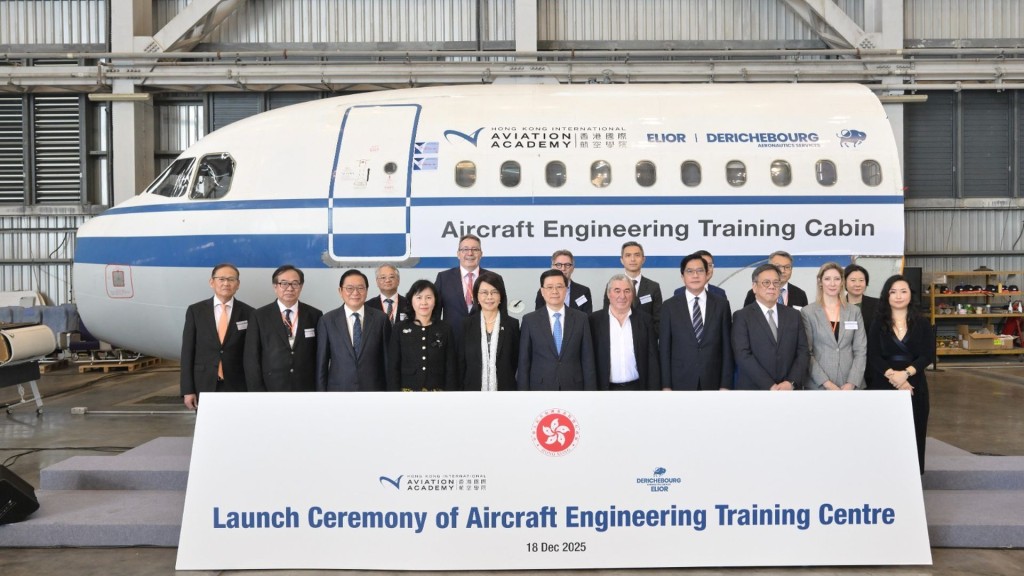
We are therefore so glad to see a French company, Elior Group Derichebourg Aeronautics Services, has chosen to start such a chain of business in Hong Kong, such as aircraft parts processing, certification and trading, with the inauguration ceremony of the training center – in collaboration with the Hong Kong International Aviation Academy – taking place last week. Additionally, the Airport Authority Hong Kong has signed a Memorandum of Understanding with Elior to explore their operation in Hong Kong.
Their first site will be an aircraft hangar at the Chek Lap Kok Airport. It will be used as a classroom for training specialist technicians. They also have plans for the second and third sites, to bring the business up to sustainable commercial operation, which can include aircraft dismantling and parts storage, and the associated processing, certification and trading activities.
The aircraft dismantling business has a huge potential for growth and will mark Hong Kong as the pioneer and leader in this region.
Industry sectors that can benefit from this new initiative will include not only the technical front for engineers and technicians, but also provide more openings for the labor market, and the financial and insurance sectors which invariably will be involved.
At a time when Hong Kong is going through a business recovery trend, such collaboration on a project would appear most welcome, and represent the continued confidence of European businessmen’s confidence in us.
Let us hope this will be the first of a long series of new business collaborations to bring Hong Kong to the world front.
Veteran engineer Edmund Leung Kwong-ho casts an expert eye over features of modern life
