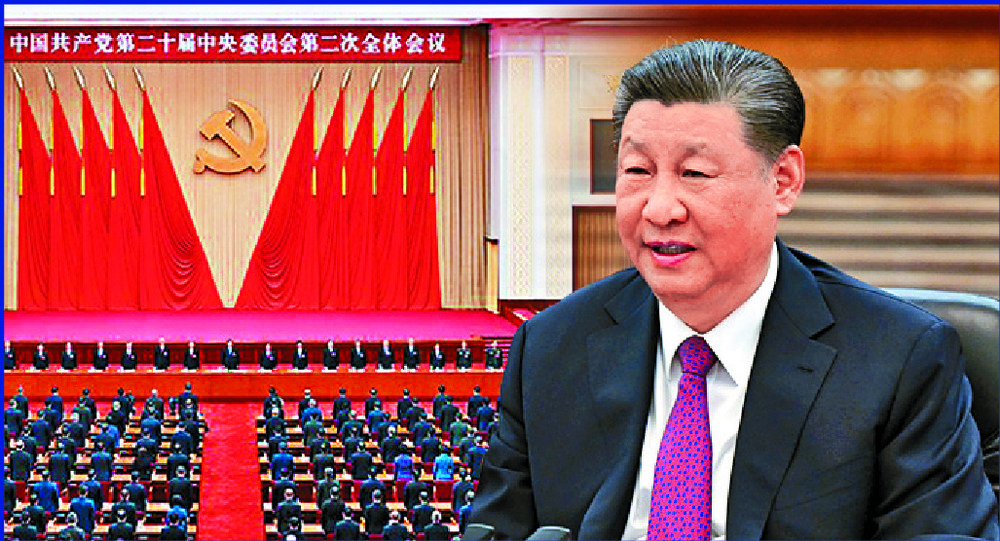
The third plenary session of the 20th central committee of the Communist Party will be held in July to "further comprehensively deepen reform and advance Chinese modernization."
The third plenums over the years have mostly been used by Beijing to make major decisions on the economy.
At the third plenum of the central committee in 1978, then-paramount leader Deng Xiaoping paved the way for China's economic take-off.
The upcoming session is being held later than normal as the third plenary sessions have been typically held a year after a leader assumed power.
President Xi Jinping secured a third term at the 20th party congress in October 2022.
The delay has already aroused speculation that economic policies bigger than thought will be decided and announced at this session to set the direction for the country's economic development in the medium term.
The Politburo statement carried by Xinhua did not provide an explanation for the meeting delay. However, it is believed to be related to the stringent internal and external situations facing the leadership in Beijing.
Internally, the country is experiencing difficulties in recovery after the pandemic, a meltdown in the property sector, stratospheric local government debt, a lack of private investment and weak consumer confidence.
Externally, confrontations with the US and neighboring countries have intensified.
Putting it simply, the country is at a crossroads.
Although it remains to be seen what the major policies will be, the Xinhua dispatch did offer many clues.
In addition to the Politburo's work report, the session will be committed to "comprehensively deepening reform and advancing Chinese modernization."
It also referenced in a relatively high position a "document" to advance high-quality integrated development in the Yangtze River Delta.
And the release was not short of key words.
"Reform" is mentioned numerous times. The statement largely says that deepening reform is essential to upholding the socialist system, modernizing governance and building a stronger Marxist party.
In other words, it is politically significant.
On the economy, the Xinhua release says further reform should be led by that of the economic system, with more attention being paid to "system integration" to provide an "institutional guarantee for Chinese modernization."
In particular, it mentions a "new mechanism" which will be implemented to facilitate "cooperation between the government and private capital" while stimulating private investment.
To assist local governments to cope with debts and meet fiscal needs, it says ultra-long special treasury bonds will be issued at an early - rather than late - stage. Issuance of special-purpose bonds will also be expedited.
The property sector is also expected to undergo major reform, with "a new model of the real estate sector" implemented to promote high-quality development.
Policies due to be discussed at the upcoming plenum will likely be far-reaching.
If Deng set the stage for China's take-off in 1978, Xi will prepare the country for its next stage of challenges.
Xi Jinping