
Read More
As the Chinese Communist Party concluded its Fifth Plenum in Beijing yesterday, the core agenda was unmistakable: implementing “full and rigorous party self-governance.”
ADVERTISEMENT
SCROLL TO CONTINUE WITH CONTENT
Recognizing that institutional discipline is vital to navigating complex geopolitical and economic headwinds, the national leadership is aggressively targeting administrative complacency and systemic loopholes. The closed-door meeting focused heavily on refining institutional regulations and ensuring that major decisions translate into concrete action rather than symbolic rhetoric.
By directly addressing the administrative inertia that plagues governance, the plenum reinforced the necessity of diligent execution. As the mainland reinforces its internal oversight to safeguard the fruits of national development, Hong Kong must recognize that it, too, requires continuous self-purification to meet new era challenges.
On the surface, Hong Kong’s anti-corruption framework remains a global gold standard. According to the latest Annual Survey released by the Independent Commission Against Corruption in mid-October, a record-high 99.2 percent of residents reported no personal encounters with corruption over the past year. Furthermore, 97.9 percent of respondents consider maintaining a corruption-free society crucial to the city’s ongoing development.
These statistics rightfully cement Hong Kong’s reputation as one of the cleanest jurisdictions globally, having recently ranked 12th out of 182 territories in the Corruption Perceptions Index. To maintain this edge, the ICAC actively utilizes its three-pronged approach of rigorous enforcement, systemic prevention, and robust public education.
Beyond street-level bribery
However, the absence of everyday street-level bribery does not equate to a flawless administrative system. The devastating Wang Fuk Court fire served as a tragic wake-up call, exposing hidden systemic failures that are highly vulnerable to illicit practices. The deadly blaze laid bare the city’s long-neglected wai biu – bid-rigging – networks within the building maintenance sector.
For years, organized syndicates have monopolized lucrative renovation and fire safety upgrade contracts, inflating costs for property owners while severely compromising structural safety, leaving vulnerable residents at profound risk. This localized, sophisticated corruption thrives in the regulatory blind spots of private property management, proving that institutional rot can still fester beneath a pristine statistical surface.
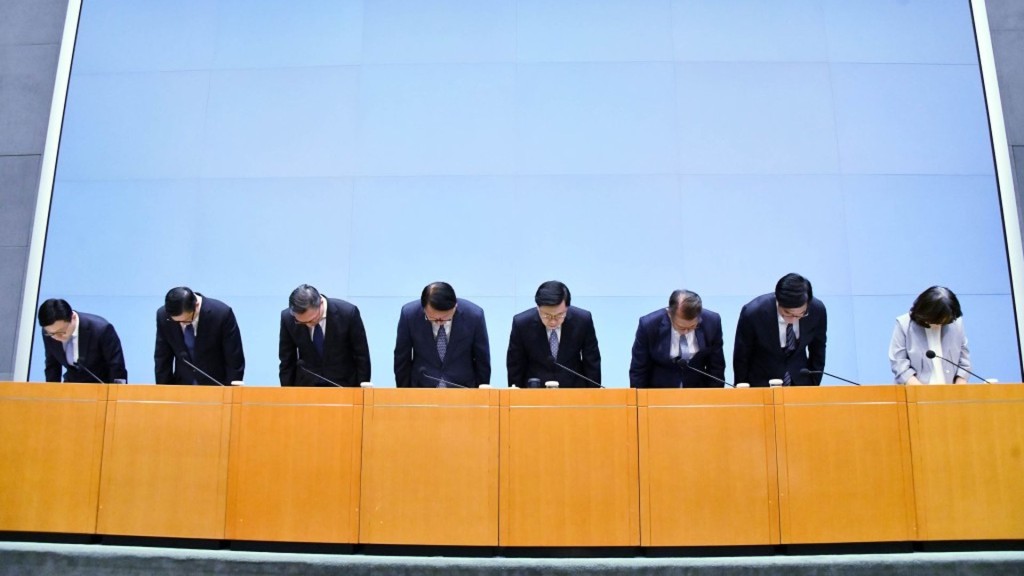
Fortunately, the administration is pivoting from passive regulation to active intervention. As previewed in Chief Executive John Lee Ka-chiu’s press conference yesterday regarding the recently submitted Independent Commission report, the government is preparing concrete, sweeping measures to dismantle these bid-rigging syndicates and overhaul building management oversight. By elevating regulatory scrutiny on maintenance tenders, closing legal loopholes, and empowering cross-departmental law enforcement to dismantle these deep-rooted networks, the government acknowledges that systemic vulnerabilities must be aggressively targeted before they exact another fatal toll.
Aligning with the national mandate
The parallels between Hong Kong’s local challenges and the national agenda are striking. The Fifth Plenum’s emphasis on continuous self-supervision and the eradication of bureaucratic blind spots is a mandate Hong Kong’s civil service must fully internalize. A stellar ICAC ranking is a baseline, not a finish line. To truly protect the city’s economic prosperity and the safety of its citizens, the government must relentlessly institutionalize rigorous self-governance.
Only by continuously identifying hidden systemic flaws and proactively reforming its regulatory models can Hong Kong build a sustainable, resilient future in lockstep with the nation’s broader developmental trajectory.