The UK parliament will be recalled from its Christmas break tomorrow to pass the Brexit deal that some - including the Scottish National Party and a handful in the opposition Labour Party - have vowed to fiercely oppose.
The threats raised many eyebrows, given that the Christmas Eve deal is considered safe and will no doubt be passed.
The agreement , covering hundreds of pages, is a personal victory for Prime Minister Boris Johnson. It is anticipated that its passage will strengthen his hands post-Brexit while weakening the cause of the opposition, particularly the SNP.
The party, led by Scottish First Minister Nicola Sturgeon, has been at pains to spin the Brexit agreement into a bad deal.
It had been betting on a no-deal or a bad-deal outcome to support a vigorous independence push for Scotland during the Holyrood - the Scottish parliament - election next year.
With fears of an economic apocalypse evaporating, that particular bet has evaporated. Will the SNP suffer in the Holyrood vote? This is of interest not only to10 Downing Street, but also to anyone who intends to move to the UK.
The Brexit deal, which is better than expected, has put
so-called Remainers in an awkward position.
If Brexit uncertainty had provided Remainers - both in the opposition and within the Tories - with a political anchor since the 2016 referendum, that anchor is now removed.
Across the English Channel, the trade agreement has also helped save the European Union from squabbling between member states in the event of a no-deal scenario.
French President Emmanuel Macron is believed to have come under immense pressure from his EU peers to support the deal.
Brexit was a gamble in the first place - risky in every aspect - but, four and a half years later, the gamble is paying off.
Free of EU regulatory shackles, London has reached at least 60 trade agreements in the past year.
It is clear that, after the EU, Johnson's next major target is to join the major trading bloc of the Comprehensive Progressive Agreement for Trans-Pacific Partnership formed by Australia, Brunei, Canada, Chile, Japan, Malaysia, Mexico, New Zealand, Peru, Singapore and Vietnam.
As I have commented before, fisheries is a tiny, but highly political, subject. The agreement to phase out the EU's quotas in UK waters over five years and then replace them with annually negotiated quotas falls short of what both the Brits and the French had wanted. It was a middle-ground compromise.
Predictably, fishermen's grumbles will soon become a thing of the past.
The EU's concession to allow the UK to stay outside the jurisdiction of the European Court of Justice is a major gain for Johnson. It will pave the way for any disputes over competing on a level-playing field to be resolved by third-party arbitration.
Britain does lose certain rights. For example, financial service passporting - a pre-Brexit arrangement allowing cross-border services within the EU - will stop.
Apparently, Johnson is confident this will not undermine London's significance internationally. He may be right since English is the main language of the financial world.
The deal comes as a timely lift from the pandemic depressive mood.
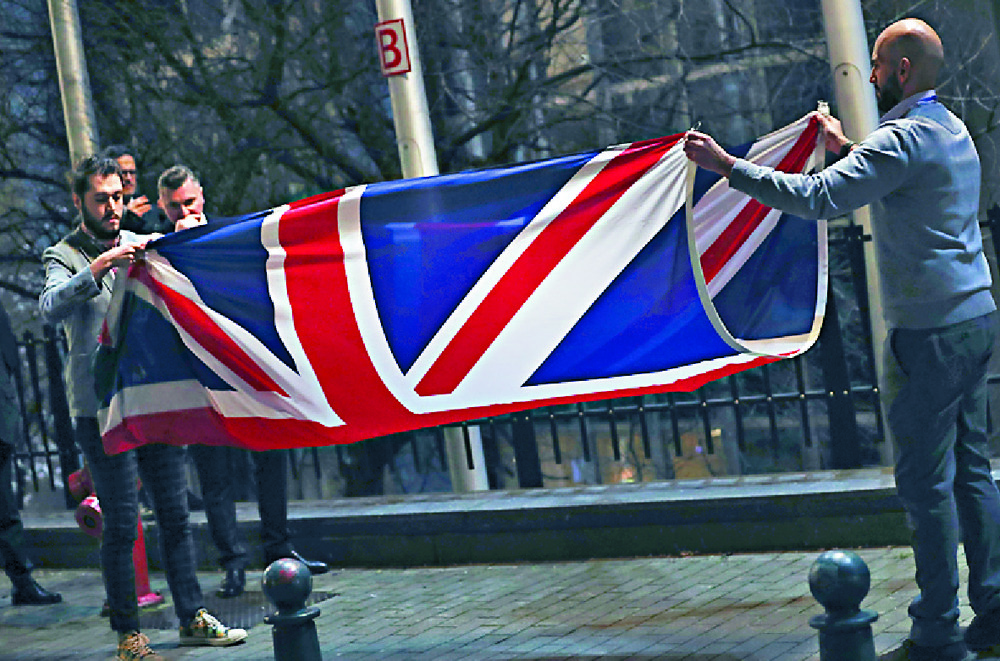
The Union flag is folded and removed after being lowered from outside of the European Parliament in Brussels. AP