Read More

When HSBC's top Asia executive Peter Wong Tung-shun signed a petition in support of Beijing's move to enact the national security law in Hong Kong, the British bank was trying to struggle out of the narrow space it found itself in between a rock and a hard place.
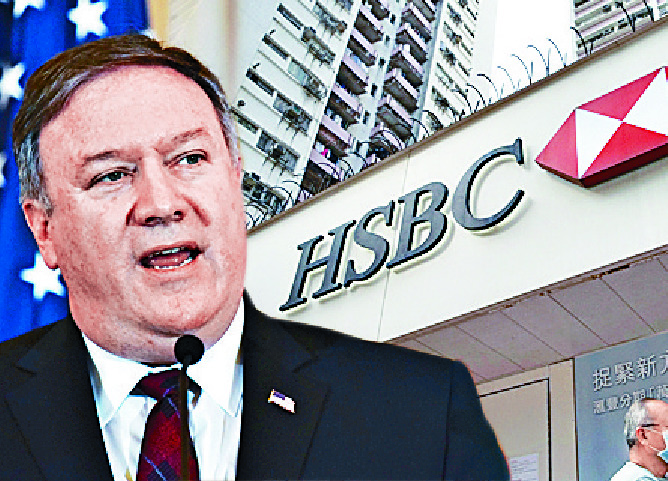
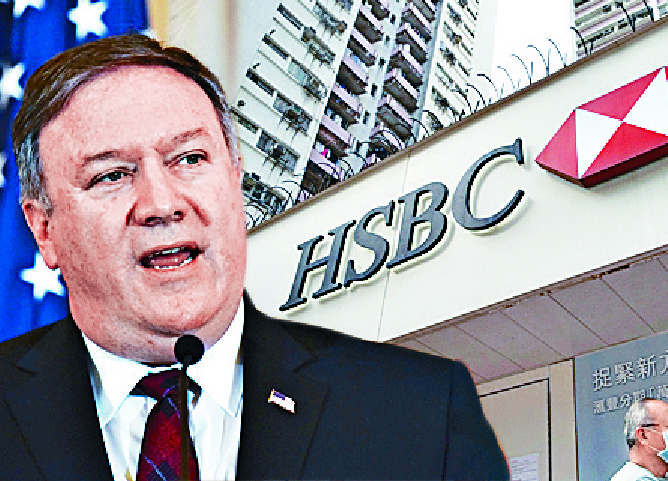
To HSBC's disappointment, its attempt was complicated by US Secretary of State Mike Pompeo's criticism calling Wong's gesture a "show of fealty" to Beijing.
Wong's gesture was predictable. After all, HSBC earns more money in the SAR than anywhere in the world. Hong Kong and the mainland are the markets HSBC cannot give up readily even during a Sino-US conflict.
Other venerable British firms are in the same position, including Standard Chartered Bank, Swire and Jardine Matheson, which have also declared their backing for the security law.
This is despite the fact that their government in London is a member of an international alliance led by Washington that opposes the legislation.
A consensus is clear among these old British businesses that it would be more important to protect their market shares than gambling with politics along with their government.
By walking a tightrope, they hope to maintain the best of both worlds.
It's interesting to note that - via former SAR chief executive Leung Chun-ying - Beijing singled out British interests to bash and not American firms in Hong Kong.
Although Leung's rhetorical criticism was focused on HSBC, it was aimed at all British companies doing business in Hong Kong and the mainland.
Britain is arguably the most vulnerable member of the Five Eyes security alliance between major Western nations as it desperately needs the Chinese market following Brexit. If it can be broken first, a crack would be created in the anti-China alliance. The vast British business interests in Hong Kong give Beijing the lever it needs.
The choice for HSBC should have been simple - where to make the most money.
Its future lies in Asia after the failure of its expansion in America, with major setbacks involving huge fines by the US government.
The danger facing HSBC is that it will be difficult to maintain the balance if conflicts between Beijing and Washington continue to escalate.
If Leung's repeated earlier attacks on HSBC were also meant as a warning to other British companies doing business in China, Pompeo's naming and shaming of HSBC serves the same purpose - warning others that, if they don't side with the US, to at least remain neutral.
HSBC was ideal for the purpose because it is a British icon, even though it is far from being the world's largest bank.
Furthermore, in addition to backing the national security law by signing a petition, the group's chairman Mark Tucker was reported to have gone much further than others in proactively lobbying No 10 Downing Street to keep Huawei in Britain's 5G network projects.
Tucker's lobbying conflicted directly with US President Donald Trump's all-out efforts to lock out the Chinese technology company. Will the US target HSBC more pointedly later on if the bank continues to stand in the middle of Washington's anti-Huawei pathway?
As far as HSBC is concerned, it has not yet managed to struggle out of the difficult space between a rock and a hard place.