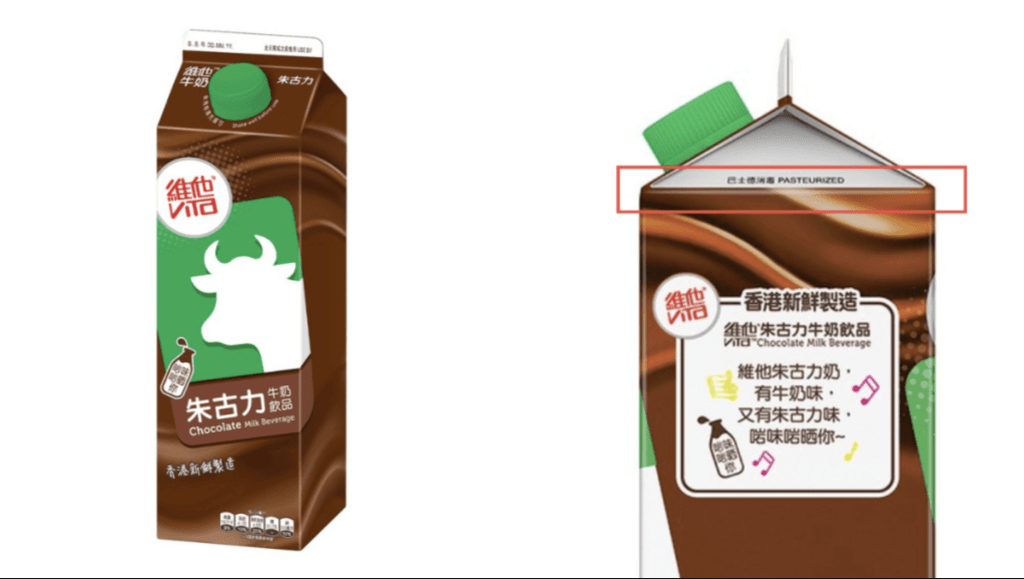
Vita Chocolate Milk has long been a local "zero negative review" beverage, deeply loved for many years and a collective memory for many Hong Kong people. When buying "Vita Chocolate," have you ever noticed that the family-sized bottle caps come in "green" and "white"? It turns out there are hidden food safety tips behind this, related to the beverage's sterilization method and shelf life—buy the wrong one and it could sit until it spoils.
Vita Chocolate Milk
Checking the product packaging of Vita Chocolate Milk, it can be found that the green-cap chocolate milk uses pasteurization, while the white-cap chocolate milk uses ultra-high temperature sterilization (UHT). Both Vita packages also state: once opened, it must be finished within 4 days. The Consumer Council points out that different sterilization methods represent different storage requirements:
Green Cap
Uses pasteurization. Even before opening, it must be refrigerated throughout at 0°C to 4°C. The shelf life is usually shorter, about 2 to 3 weeks.
White Cap
Uses ultra-high temperature sterilization (UHT). Before opening, it can be stored at room temperature, and the shelf life is longer; only after opening does it need to be refrigerated at 0°C to 4°C. This method uses a higher temperature for sterilization, and milk products can be stored for 6 to 9 months.
How Do Sterilization Methods Affect Nutrition and Taste?
There are 4 common sterilization methods for milk and milk beverages on the market, with different effects on the products:
Traditional pasteurization: Shelf life about 2 to 3 weeks, with the smallest impact on nutrition and taste.
Extended shelf life ultra-pasteurization (ESL): Shelf life can reach 30 to 90 days, but because higher heat is used for sterilization, a small portion of water-soluble vitamins will be lost in the process.
Ultra-high temperature sterilization (UHT): Shelf life 6 to 9 months, but the smell, texture, and taste can be altered, and the loss rate of water-soluble vitamins is about 10% to 15%.
In-container sterilization: Can likewise be stored for 6 to 9 months, but the loss rate of water-soluble vitamins is even higher, reaching 40%.
When purchasing, consumers can pay attention to whether the packaging states words such as "pasteurized" or "UHT." Green caps must be refrigerated throughout and should be put in the fridge as soon as possible after purchase; white caps can be stored at room temperature before opening, and must be refrigerated after opening.
Labeling Laws Do Not Regulate the Listing of Sterilization Methods
Gilly Wong Fung-han, Chief Executive of the Consumer Council, points out that current food labeling laws only regulate that prepackaged foods need to indicate important information such as food ingredients and shelf life. At present, the law indeed does not mandate that the specific sterilization method used for milk or milk beverages must be listed on the packaging. It is difficult for citizens to know the detailed sterilization method, and it is hoped that the industry will self-regulate and indicate relevant information on products, allowing consumers to make informed choices.
Purchasing and Drinking Tips
When buying dairy products, consumers should pay attention to the following:
-
Brands are not necessarily directly related to place of origin, and the color of the packaging is not necessarily related to the type of milk. Do not purchase based solely on impressions and perceptions of the brand.
-
Generally speaking, pasteurized products are treated at lower temperatures, have less impact on taste and nutrition, and have a shorter shelf life than products treated with ultra-high temperature sterilization, making them more likely to be more recently produced. However, although milk or milk beverages treated with ESL or sterilization methods lose some vitamins, if generally healthy children and adults eat a balanced diet, the impact on the body's nutritional status is not great.
-
Check whether the packaging is intact, pay attention to the expiration date, ensure the milk and milk beverages are not expired, and store them properly according to the recommendations on the packaging. Drink as soon as possible after opening. After taking milk out of the fridge, drink it as soon as possible and avoid refrigerating it again.
-
Choose according to personal needs. For example, adults and the elderly can choose products with lower fat content and high calcium. People with special needs should first consult a doctor or dietitian.
Source: Consumer Council