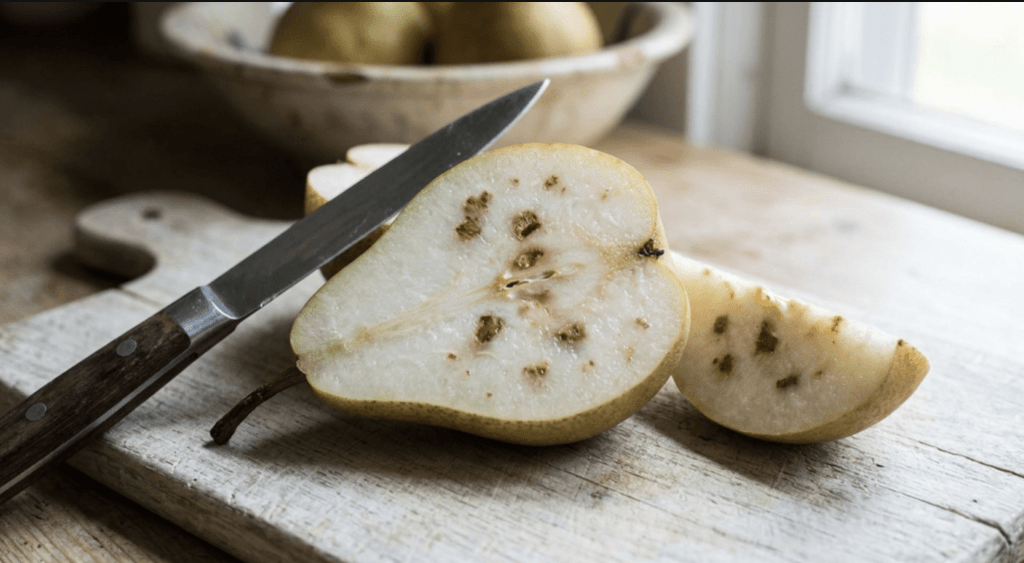
Pears are in season and have become a staple fruit in many households. However, some consumers have cut open a pear only to find brown spots in the flesh, an unappealing appearance, and a rough, sometimes bitter texture in the browned areas. They worry it might be spoiled or contain pesticide residue. In fact, this condition, known as "corking," occurs during pear season. It is neither spoilage nor pesticide residue.
What Are the Brown Spots? Understanding Fruit "Corking"
According to Taiwanese media reports, if a pear's flesh shows localized dark brown, hard, wood-like areas but has no off-odor or mold, it is likely "corking" (also called lignification). This is a physiological disorder during growth, unrelated to pathogens or pesticides. Pear trees absorb calcium from the soil and transport it to the fruit via water. If high temperatures, drought, dense foliage, or root damage obstruct water transport, localized calcium deficiency in the fruit can lead to corky spots. Susceptibility also varies by variety.
Even if the soil contains calcium, it doesn't mean the fruit can distribute it evenly. Nutrient transport is an internal issue affected by multiple factors like heat or rain—not simply "growing too fast."
Unrelated to Rot or Pesticide Residue
Corking is an internal physiological disorder. The pear's skin looks the same as a normal pear. It cannot be detected before cutting—only after cutting can you see brown cavities, wood-like hardening, or yellowed, loose areas in the flesh. Corking is a physiological mechanism the tree uses to protect the fruit. It mainly affects texture and taste—it may be slightly coarse—but it is not spoilage, nor is it bacterial or mold infection. There are no food safety concerns or pesticide contamination.
How to Handle It: Cut Away the Hardened Parts
If a pear shows localized corking after cutting, remove the abnormal hardened tissue—the rest of the flesh is still edible. However, if there is extensive rotting, off-odor, mold, or other obvious abnormalities, do not eat it. Appearance alone cannot judge a pear's quality. Here are shopping and handling tips:
-
Observe after cutting: Localized brown spots, hard texture, no off-odor—cut away and eat.
-
If soft, mushy, leaking, slimy, moldy, or smelling of alcohol or sourness—it has spoiled; discard the whole fruit.
-
Store in a cool, ventilated place. Eat soon after cutting.
Pears in Season in Autumn – TCM Practitioner Explains 4 Groups Who Should Eat Less
Registered TCM practitioner Ng Wing-mui notes that Hong Kong has many pear varieties, such as Hosui, Golden, Shuugetsu, and Korean Shin Go. Compared to Ya pears, newer varieties are rounder, with finer flesh and higher sweetness. In TCM, the pear flesh is not used medicinally, but the peel is. The formula "Sang Xing Tang" for dry cough uses pear peel, which clears the heart, moistens the lungs, reduces internal heat, and promotes fluid production—especially good for dry throat, cough, and yellow phlegm. When making pear soup, include the peel for stronger effects.
Autumn dryness and low humidity easily cause lung dryness, dehydrated skin, irritability, dry mouth, and dry cough with itchy throat—making it the best time to eat pears. The following 8 groups benefit from eating pears:
-
Prone to dry mouth
-
Sticky or yellow phlegm that's hard to expectorate
-
Dry throat, mild sore throat
-
Dry cough
-
Frequently eat fried or spicy foods
-
Love meat and often feel bloated
-
Excessive smoking and drinking
-
Frequently stay up late
4 Groups Who Should Not Eat Too Many Pears
-
Prone to diarrhea—diarrhea after eating cold/raw foods
-
Sensitive to cold, cold hands and feet
-
Blood deficiency, anemia
-
Breastfeeding women who are fatigued and have insufficient milk supply
How Much Fruit Should You Eat Daily?
Fruit is nutritious, but both overeating and undereating are harmful. The Hong Kong Department of Health encourages at least 2 servings of fruit and 3 servings of vegetables daily for a balanced diet.
What Is One Serving of Fruit?
-
2 small fruits (e.g., plums, kiwis)
-
1 medium fruit (e.g., orange, apple)
-
½ large fruit (e.g., banana, grapefruit, starfruit)
-
½ bowl of fruit chunks (e.g., watermelon, cantaloupe, honeydew)
-
½ bowl of small fruits (e.g., grapes, lychees, cherries, strawberries)
-
1 tablespoon of dried fruit with no added sugar or salt (e.g., raisins, prunes)
Sources: TTV, Ming Guo