
Read More
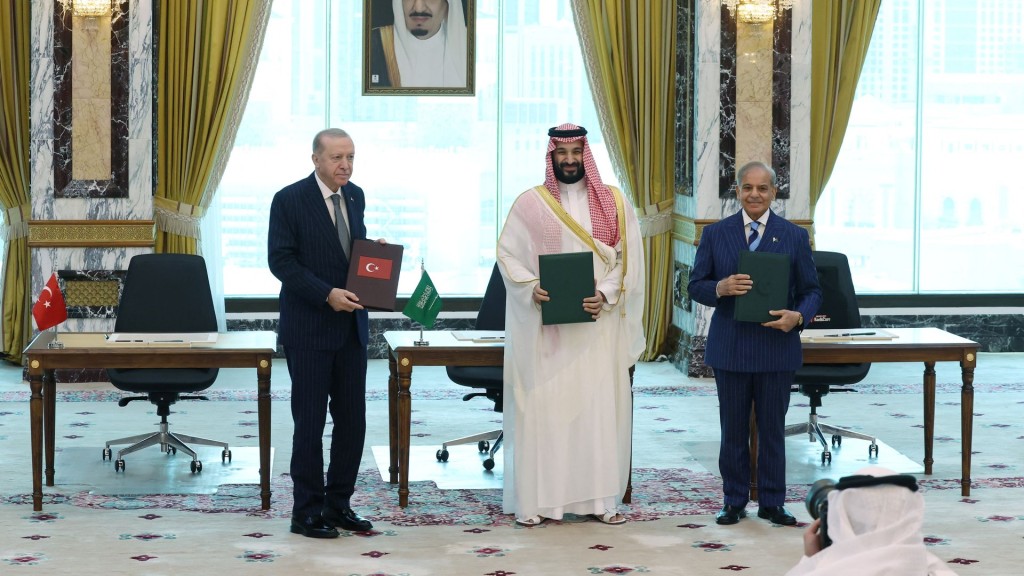
The balance of power in the Middle East has reached a historic inflection point. On August 7, Saudi Arabia, Turkey, and Pakistan signed a landmark mutual defense pact in Mecca against the backdrop of an ongoing stalemate in the war between the United States, Israel, and Iran. Stipulating that an armed attack against any single signatory will be legally treated as an attack against all three, the trilateral agreement establishes a formidable new regional security architecture. This pact emerges directly from the continuing decline of US strategic influence, an increasingly assertive Israeli military posture, and the renewed regional dominance of the Iranian regime.
ADVERTISEMENT
SCROLL TO CONTINUE WITH CONTENT
The Mecca agreement represents a significant expansion of the initial Saudi-Pakistan mutual defense pact signed in September 2025 following a provocative Israeli airstrike on Qatar that threatened to drag the broader Gulf into the expanding Gaza conflict. Under this strategic arrangement, Pakistan – the Islamic world's sole nuclear-armed state – extends an umbrella of nuclear deterrence to Saudi Arabia.
In return, Riyadh leverages its vast energy wealth and deep financial reserves to stabilize Islamabad's fragile economy. Meanwhile, as diplomatic and military friction between Turkey and Israel escalated over the newly established, Ankara-backed Syrian administration, Turkey also urgently sought powerful regional allies to counterbalance Israeli military influence.
Decline of Pax Americana
Beyond serving as a collective deterrent against Israeli military overreach, the trilateral alliance provides an essential layer of security for Gulf states caught in the dangerous crossfire of the conflict in the US and Israeli war against Iran. Washington has proven increasingly incapable of shielding its Gulf partners from Iranian missile strikes or guaranteeing safe passage through the Strait of Hormuz – the critical maritime energy export channel for the Gulf states. As Pax Americana erodes across the region, local powers are compelled to construct autonomous security mechanisms to balance an emboldened Tehran regime that maintains a firm, aggressive grip on vital maritime transit corridors.
However, while the Mecca pact creates a self-reliant security framework post-US dominance, it also introduces the distinct risk of dangerous, polarized bloc confrontation. Israel has actively cultivated deeper strategic, intelligence, and military ties with alternative regional players, notably the United Arab Emirates and India. This alignment threatens to merge the simmering Saudi-UAE rivalry and the enduring India-Pakistan conflict into a broader bloc confrontation across the Middle East and South Asia.
Ultimately, the long-term geopolitical impact of the Mecca pact will depend on its operational execution and formal military integration.
China's delicate balancing act
For China, this shifting security landscape presents both operational friction and structural opportunities. As a relative newcomer to Middle Eastern security diplomacy, Beijing faces a complex balancing act between Tehran and Riyadh. A Saudi Arabia militarily reinforced by Turkish defense manufacturing and Pakistani nuclear deterrence will act with far greater confidence in countering Iranian pressure and Houthi threats in the south. Furthermore, Turkey's rapidly expanding defense-industrial sector poses direct commercial competition to Chinese defense exporters seeking to capture lucrative regional arms markets. Nevertheless, as Middle Eastern states assert strategic autonomy from Washington, the structural decline of American influence provides Beijing with unprecedented space to expand its economic, diplomatic, and security footprint in the region.