Read More
China's Covid-zero pivot cost lives and the trust of the nation. After imposing three years of sacrifice, Xi Jinping’s government let Covid tear through the population in two months. Moving on won’t be easy.
ADVERTISEMENT
SCROLL TO CONTINUE WITH CONTENT
Families in Chenghe, a village of 4,000 people in eastern China, bury the ashes of their dead in little mounds near the fields they till. In early January, more than 100 new piles appeared between bright green rows of garlic sprouts. The sound of suo na, a double-reed horn villagers play to commemorate the deceased, cut through the quiet.
A-Peng was planning to add another grave there for his father, who’d died the day before. But first he needed to stand in line to get a time slot for cremation, behind more than 200 others. He was used to waiting. Whenever the government had implemented strict lockdowns to prevent the spread of Covid-19, A-Peng—who asked to go by his nickname because he feared repercussions for talking about China’s pandemic response—had struggled to support his household as factories shut down and customer traffic to the store he runs slowed. Then, when the policies to eliminate Covid ended abruptly in early December, the virus ripped through the whole country, including everyone in A-Peng’s family. More than 80 percent of the population was infected, according to the Chinese Center for Disease Control and Prevention. His 75-year-old father started having trouble breathing, then suffered two episodes of brain bleeding. The small county hospital didn’t have room for him in intensive care. He died there four days later.
President Xi Jinping’s Covid Zero policy was an historic experiment in control over the nation’s 1.4 billion people. Citizens’ movements were monitored with location-tracking apps, China’s external borders were sealed and a recent negative test was required to do almost anything. But Xi reversed course shortly after the economically crippling restrictions sparked a wave of protest in November—a rare display of public anger, and for the Communist Party, a risky one.
The policy shift exposed how Xi’s controls had inadvertently created the conditions for mass death and chaos, by leaving the country unprepared for the coming spike. Despite having ample time to vaccinate elderly Chinese and expand hospital capacity, officials had done neither, leaving the virus to run rampant through a population with little previous exposure. According to government estimates, nearly 60,000 people died in hospitals between Dec. 8, when Covid Zero was officially dismantled, and Jan. 12—numbers the World Health Organization and others view as a severe undercount. Foreign epidemiologists estimate that the true death count is, conservatively, in the hundreds of thousands.
The scale of suffering has rattled public faith in Xi, the most dominant Chinese leader in a generation. After listening to three years of propaganda boasting that China was protecting its people far more effectively than Western countries, many citizens looking for Covid treatment had to wait for hours in the cold outside overwhelmed hospitals. Doctors and nurses battled their own infections while trying to help patients. Pharmacies ran short of basic medicines such as acetaminophen, while workers hired to conduct mass testing and enforce quarantines found themselves abruptly unemployed, leaving no system to reliably test and quantify the surge.
Just as suddenly, the messaging of state media flipped, emphasizing the benefits of opening up and urging people to take responsibility for their own health. “With official reports downplaying the scale of deaths or severity of the health crisis facing the country, people are more likely to lose trust in the government,” says Sarah Cook, senior advisor for China at advocacy group Freedom House. Even as officials trumpet the benefits of moving on, China’s pandemic response remains a sensitive topic; while reporters for Bloomberg Businessweek traveled the country to speak with dozens of citizens for this story, government minders trailed from a distance, often spooking interview subjects.
The official death count doesn’t include victims such as A-Peng’s father who never got access to Covid tests. “Whether he got Covid or not doesn’t matter,” A-Peng says. “He was left to die without getting his place in the ICU.” Other elderly people in Chenghe chose to die at home, residents say, rather than pass away in the undignified atmosphere of local hospitals, where body bags were left in some patients’ rooms for days.
In the two weeks after his father’s death, A-Peng attended seven funerals. Then, he went back to the store. With two kids to raise, he needed to make up for the losses of the Covid years.
There’s no doubt China suffered under Covid Zero. In its final year, many citizens were forced to stay indoors or risk being quarantined in state-run facilities under the watch of enforcers in hazmat suits, known as dabai or “ Big Whites.” With factories, travel and property investment stalled, economic growth slumped to 3 percent, the second-slowest pace since the 1970s. Much of everyday life was controlled or limited by the government—whether it was access to food, movement or speech.
Faced with limited prospects, many people joined the dabai. Li Hanhua signed up after losing money on a jade jewelry business. During the two-month lockdown of Shanghai last spring, the 50-year-old earned twice as much as she would have as a waitress. Li and her co-workers, zipped up in their suffocating white suits, monitored more than 1,000 patients with mild symptoms at a pop-up hospital. Discomfort aside, she knew she could trust a government job to help repay her debts.
When the lockdown ended, Li got a contract to swab throats at a testing booth. With tests required to get into workplaces, shopping malls and even some parks, millions of people were lining up at outdoor stations such as hers multiple times a week. “When we were applying for the job, the recruiters said, ‘It’s a government project—very safe,’” Li says.
But as popular support for Covid restrictions waned and the measures became increasingly difficult and expensive to maintain, local officials started to shift priorities. Li’s paychecks, backed by the government but delivered by a third-party contractor, began to come later than expected, and then not at all. Li says she still hasn’t been paid for testing booth work in the last two months of 2022. She was ashamed to go home for Lunar New Year without the money and had to sell her scooter for 400 yuan (US$58) to buy food. “We have contributed to the Covid fight, but how come nobody is taking care of us now?” she says. In February, Li and other dabai sought help from local authorities in Shanghai. They sat at the gates of a government complex for days and still weren’t paid.
In late November, protests broke out in a number of major cities across China, including Beijing, Shanghai and Wuhan, where the virus first emerged. They were triggered by concern Covid restrictions had delayed rescuers from a deadly apartment-block fire in the Xinjiang region of western China, but quickly snowballed. Protesters broke down lockdown barricades, demanded an end to pandemic measures and in some cases called for Xi to step down. The Covid Zero mandates, already weakened by their unsustainable costs, ended shortly after.
When the policies ended, citizens had to immediately change their mindsets. The Communist Party’s presence in everyday life, once a constant, became a conspicuous absence, unsettling to even the most loyal supporters. Everyone was forced to rethink their relationship with the state and what it could accomplish for its people in the aftermath. For some, the shift felt like a betrayal.
In Shenzhen, the southern city that’s the heart of China’s tech industry, Chloe Yang had fully supported Covid Zero. A 34-year-old banker, she grew up hearing her father explain how the government could be trusted to make better decisions than ordinary people. He was always nagging her to get a state job and teaching his grandson songs praising the party.
The family listened to media broadcasts applauding Xi for steering the country clear of the disastrous waves of infection in the US and elsewhere. In China for much of the pandemic, Covid was so rare that a single case—where it was traced to, how long after exposure the person tested positive—was news to obsess over and reason enough to shut down a whole city. What many Western governments were doing was inept, or “lying flat,” as Xi described it, while China actively quashed flareups out of a duty to protect its citizens.
Yang and other supporters assumed that the government would maintain a more cautious approach before letting people return to normal life. It would make sure everyone had booster shots. Hospitals would prepare extra beds, and families would be taught how to identify and treat infection.
Instead, whiplash. Citizens were left in the dark, unsure whether they had Covid and then unsure what to do when they fell ill. The government stopped mass testing in early December, leaving people scrambling for hard-to-find rapid antigen tests. The daily infections number, once closely monitored, quickly became a gross undercount. Authorities quietly narrowed the definition of a Covid death, counting only virus-induced respiratory failures and excluding instances where the virus accelerated other ailments, such as heart attacks. In the first five weeks after the pivot, the government logged only 37 deaths, a number that those interacting with hospitals and crematoriums could see firsthand was impossible. Only after pressure from outside governments and the World Health Organization did China’s National Health Commission update its count to the still-dubious figure of 60,000 on Jan. 14.
“It’s like among all the options, the government hurried onto the worst path,” Yang says. Her 70-year-old father couldn’t obtain antivirals after falling ill and was then forced to wait too long for a hospital bed as his disease became severe. When Yang called him to explain the situation, he breathed a deep sigh and said, “How could the reopening end up like this?”
Yet the government’s rhetoric remained congratulatory. Authorities published data suggesting the number of Covid deaths in China were decreasing rapidly. State media emphasized the benefits of opening back up, depicting jubilant citizens finally able to reunite with their families, eat out and travel, the virus now behind them.
Charlie Parton, a former British diplomat who has done stints in China, and a fellow at the think tank Council on Geostrategy, says the gambit didn’t work: “Propaganda is persuasive but becomes counterproductive when it so obviously contradicts the people’s own personal experience.”
One of the things no one could fail to notice as illness spread was the dearth of fever medications and antivirals. In rural areas, especially, fever medicines ran out quickly. Wang Jian, who operates a clinic out of his home in a village of about 1,000 in Luyi County, Henan province, said that within weeks of Beijing’s policy pivot, almost every family had someone come in for treatment. Unable to get common fever drugs like ibuprofen and acetaminophen, he administered analgin and aminopyrine, medications that have been banned by other countries because they have potentially dangerous side effects. By late December, even those were hard to come by. Even so, his village fared better than the next one over, where many elderly people died without intervention. “Rural clinics can’t rival big city hospitals in hardware, but prescribing timely medicine can still save a lot of lives,” he says. “It was such a pity.”
The shortages hit cities, too. In early January, Huang Li, a sales manager from Shanghai, drove one and a half hours to bring fever medicine to her 80-year-old mother at a nursing home in Jiaxing. When Huang arrived, she wasn’t allowed in because the facility was in lockdown. In the five days after the home’s Covid outbreak started on Dec. 29, more than 90 percent of its residents became infected. The sole uninfected staff member was in charge of 70 patients, and a nurse with mild symptoms handled a few dozen others, Huang was told.
When she noticed that other people were going in and out of the building, she lobbied to be allowed in as well. But she stopped asking when she realized that the others were there to collect their parents’ bodies. Five people had died the day before. As Huang left, someone explained that even the cleaning staff had come down with Covid. The floor was a mess, with piles of garbage being navigated by people too feeble to pick them up.
Huang didn’t have any better options for her mother. Shanghai’s hospitals were overwhelmed. She tried to get Pfizer Inc.’s antiviral, Paxlovid, from a local clinic, but the doctor wouldn’t give it to her—supplies were short, and they insisted on seeing her mother first. “I almost snapped,” Huang says. She ended up buying the drug online at an exorbitant price, gambling on its authenticity. “I’m not sure if she might need this drug to survive next time and if the government can supply it,” she says. “We have only ourselves to count on.”
Some say that it was all intentional: to let Covid run its course during the coldest months of the year, so it would touch the highest number of people in the shortest time frame and let the government shift quickly from controlling Covid to improving economic growth. China’s outgoing vice premier for economic affairs, Liu He, said at the World Economic Forum in Davos, Switzerland, on Jan. 17 that life has been “restored to normal” and that the economy will “most likely” return to pre-pandemic growth rates of almost 6 percent.
By the time the Lunar New Year holiday started five days later, with the initial wave of infections appearing to ebb, many traveled to celebrate with family for the first time in three years. Yet in the days and weeks that followed, there were signs that the Covid pivot had seeded a sense of resistance to Beijing’s pervading power. During the New Year festivities, people pushed back against the government’s longstanding ban on fireworks. One protest in Henan turned violent, with demonstrators swarming a police car and flipping it. Local officials everywhere, fearful of unrest, started lifting fireworks bans. Protests over unpaid wages, stalled real estate projects and reforms to the national health insurance scheme have followed in recent months. The incidents provide “a small window into people’s thinking—that they don’t always have to comply with the government policy if it’s not sensible,” says Hanzhang Liu, a specialist in Chinese politics at Pitzer College in Claremont, California. After so much sacrifice to prevent Covid based on government demands, and then seeing mass infection anyway, “there are definitely some impacts on the psyche. Some people will reevaluate the government and the individual-state relationship.”
In Guangzhou, home to factories for clothing makers including fast-fashion giant Shein, employers are following the government’s cues, operating as if Covid is over and productivity is the priority. But the task of getting people back to work has been complicated by the legacy of a November omicron flareup that plunged entire districts into lockdown. Garment factory workers who’d migrated from other cities were confined to dorms for weeks with no income and insufficient food supplies. Many grew so frustrated they broke the barricade sealing off their urban village and clashed with police.
In February, Tang Ning, a migrant worker herself, spent a week trying to recruit others for her boss’s factory. She stood on Datang Village’s main street, canvassing people as they walked by. A man stopped to check out the pants she held out as a sample, but he decided the work was too complicated. “If you are interested, we can offer you a free ride to take a closer look at the factory!” she shouted after him. But he walked away.
Tang didn’t begrudge the man, and she said she understood the protesters, too. “For young workers who only came in the past three years, Guangzhou only gave them the experience of living in tiny rooms, being locked down and failing to make any savings,” she says. There was no reason to trust that it wouldn’t happen again.
Still, in February, nationwide factory activity saw its biggest increase in more than a decade, and with the threat of lockdowns gone, Chinese are dining out and shopping again. Economic prosperity—the glue that binds China’s government and its people—is returning, helping put memories of the lethal reopening in the past. That’s how it went after the deadly Tiananmen Square crackdown in 1989. In the following decade, China’s economy went on an unprecedented run of growth, with millions elevated into the middle class.
Then again, Tiananmen didn’t directly affect the whole country the same way Covid did. This time, the government’s haste to move on and its intolerance for open discussion of its pandemic policies have left many citizens wondering what it was all for. Zhang, a cancer specialist in Shanghai who asked to be identified by her surname only, says she regularly avoided eating, drinking and going to the bathroom at work to limit her chances of getting Covid—then got it in December anyway. Xiong Fei, a restaurant owner in Wuhan, had to close 7 of his 10 restaurants with almost no profits in the past few years. Then he didn’t have enough people to run the restaurants when the reopening suddenly occurred.
Jason Wu, a prison officer in northern Guangdong province, had a breakdown last year when he wasn’t allowed to leave the 14-day quarantine required before starting a stint at the jail to help his sick, pregnant wife. Post Covid Zero, he expects pay cuts; the local government is strapped because of the money it spent implementing mass testing and other Covid Zero policies. “I’m always on the verge of collapse,” Wu says. “I think everyone wants to leave.”
Wang, the doctor in Henan, says he’s already stocking medicine for a potential second wave. Nobody else wants to talk about it. “They’ve got to get back to work,” he says. But when the next wave happens, they might not get help from anyone else.
(Bloomberg)
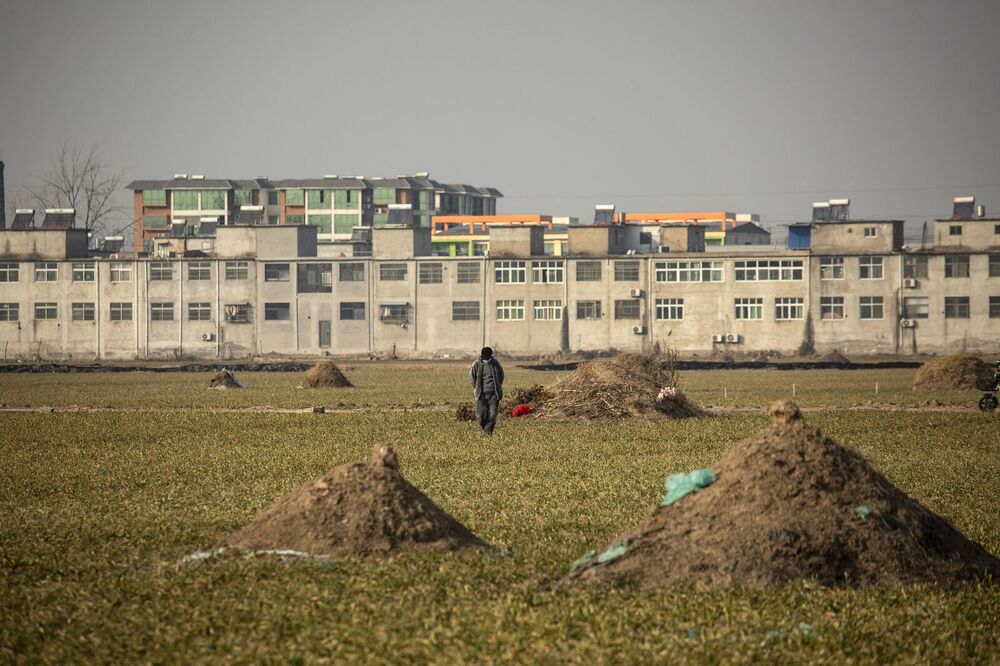
A garlic field dotted with graves in the village of Chenghe, Jiangsu. (Bloomberg)