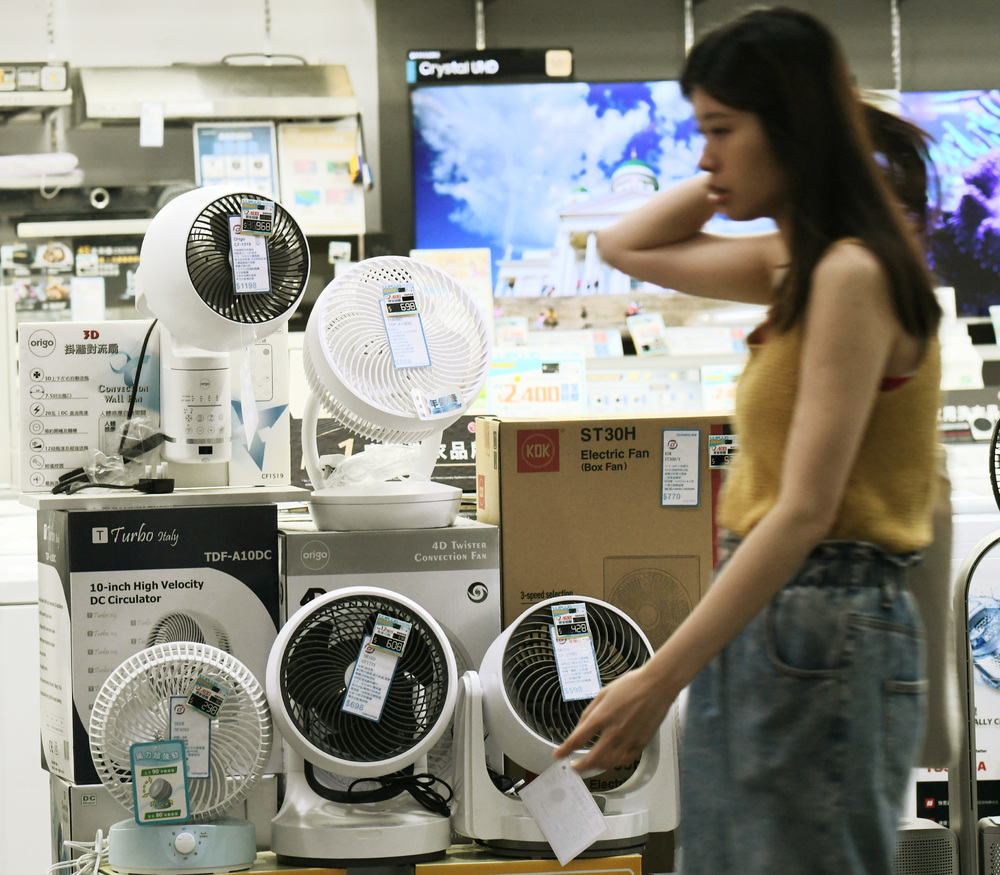
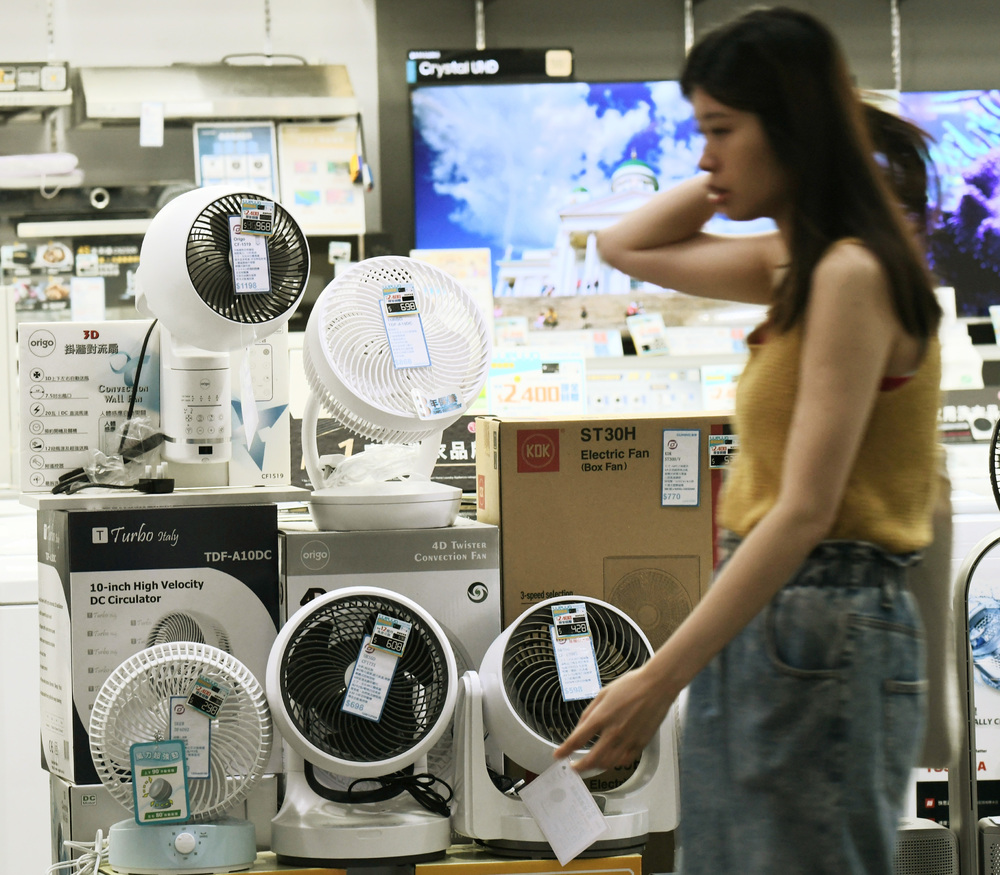
Eight of 12 air circulator fans tested by the Consumer Council were found to be hazardous because they could deliver electric shocks or in one case trap children's fingers.
Circulator fans are generally smaller than traditional models, and the shape of the head is usually cylindrical.
Traditional fans blow cool air in a single direction while circulator types help to accelerate indoor convection by circulating air. They can be used with air conditioners to keep a room cool.
Costs for both types are similar.
Thomson, Turbo Italy, JNC and Sanshin fans failed a council test on insulation distance between an internal live part and the motor shaft, which could be accessible to a user after removing the guard and fan blade for cleaning purposes.
The failed models have an insulation distance 2.8 to 4.3 millimeters less than the standard required insulation distance of 8mm.
Users risk an electric shock if they remove the guards and blades without disconnecting the power.
The watchdog also found the Iris Ohyama fan could catch children's fingers when oscillating in an up-and-down direction.
Council chief executive Gilly Wong Fung-han said: "Parents should pay attention to the issue of catching children's fingers because children like to play and touch items."
Testing also measured the temperature rise of Proluxury's motor winder at 93.1 Kelvin when operating at a high voltage. That exceeded the standard maximum limit by 3.1K, which increased the risk of overheating.
In terms of resistance to fire, Imarflex and Sanshin failed to meet a standard requirement.
An Imarflex internal plastic component and a Sanshin external plastic component failed a needle-flame test, failing to self-extinguish within 30 seconds of catching fire.
The Electrical and Mechanical Services Department on Wednesday urged people to stop using Imarflex and Sanshin circulator fans, pointing to a manufacturing defect in their failures to meet fire resistance standards.
Wong noted: "From a safety perspective these are basic tests that all electrical appliances should pass."
The council had in 2019 started by testing 14 air circulator fans, and found only four passed all safety tests.
"Despite the differences in test criteria we could see from both sets of tests that at least half of the samples failed safety tests," Wong said.
"We believe manufacturers have an obligation and a capacity to make further improvements on the safety of the air circulator fans."
The Consumer Council began testing fans in 2019. Manufacturers have an obligation to make safety improvements, according to the council.