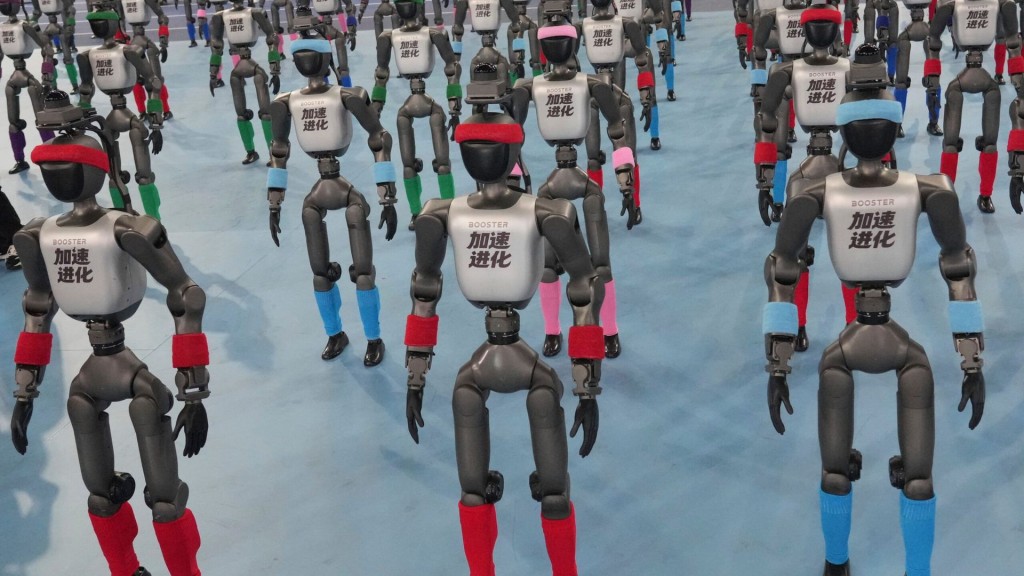
The staging of the Asia-Pacific Broadcasting Union Robocon in Hong Kong, co-hosted by RTHK and the Hong Kong Science and Technology Parks Corporation and featuring dynamic demonstrations by Unitree Robotics, provides a vivid window into a profound technological transformation. Coinciding with the World Robot Conference in Beijing and landmark humanoid athletics exhibitions, the event underscores China's accelerating transition from digital artificial intelligence into physical, "embodied AI." As quadruped and bipedal machines step out of academic laboratories into industrial production lines, logistics hubs, and construction sites, general-purpose robotics has emerged as the decisive next battlefield in the broader technology and industrial rivalry between China and the United States.
'ChatGPT moment' of hardware
China's dramatic ascendancy in the robotics sector is underpinned by a structural advantage that foreign competitors struggle to replicate: complete domestic supply-chain integration. From harmonic reducers, planetary rollers, and high-torque actuators to lightweight composite materials and lithium-ion power packs, the industrial ecosystems across the Yangtze and Pearl River Deltas enable Chinese roboticists to iterate hardware at unprecedented speed and fraction-of-the-cost scale. Domestic pioneers such as Unitree, AgiBot, Fourier Intelligence, and Ubtech have rapidly transitioned from proof-of-concept prototypes to mass production, commanding the vast majority of global commercial shipments for entry-level quadruped and humanoid platforms.
This industrial capability is now converging with rapid advances in neural-network motion control and multimodal foundation models. As industry leaders note that robotics is approaching its own "ChatGPT moment" for embodied physical intelligence, Chinese firms are leveraging massive real-world deployment data from domestic smart factories to train physical foundation models. Unlike digital software models that operate in abstract code, embodied AI requires extensive interaction with messy physical environments. China's vast manufacturing apparatus serves as an unmatched, real-world training ground, allowing domestic algorithms to close the gap between software perception and mechanical dexterity with extraordinary velocity.
The new geopolitical race
This technological divergence has redefined the contours of the China-US strategic competition. While the US continues to hold a distinct edge in high-performance semiconductor design, sovereign cloud compute, and frontier foundation models – championed by ventures like Tesla's Optimus, Boston Dynamics, and Figure AI – its domestic manufacturing base remains hollowed out. Developing sophisticated robotic brains is meaningless without the capacity to build, scale, and cost-reduce the physical bodies that house them. Consequently, the robotics race has evolved into an asymmetric contest: American algorithmic innovation versus China's formidable hardware scaling and rapid commercialization. Washington has increasingly viewed Chinese robotics through a national security lens, contemplating supply chain restrictions and export controls on advanced actuation components and sensor arrays. Yet, unlike pure semiconductor manufacturing, physical robotics is deeply integrated into global supply chains where China commands core raw materials, rare-earth permanent magnets, and specialized assembly infrastructure.
Ultimately, general robotics is not merely an engineering showcase; it represents the primary demographic and industrial hedge for 21st-century economic dominance. By combining rapid hardware commoditization with localized AI deployment, China is cementing its position as the indispensable powerhouse of the intelligent machine age.