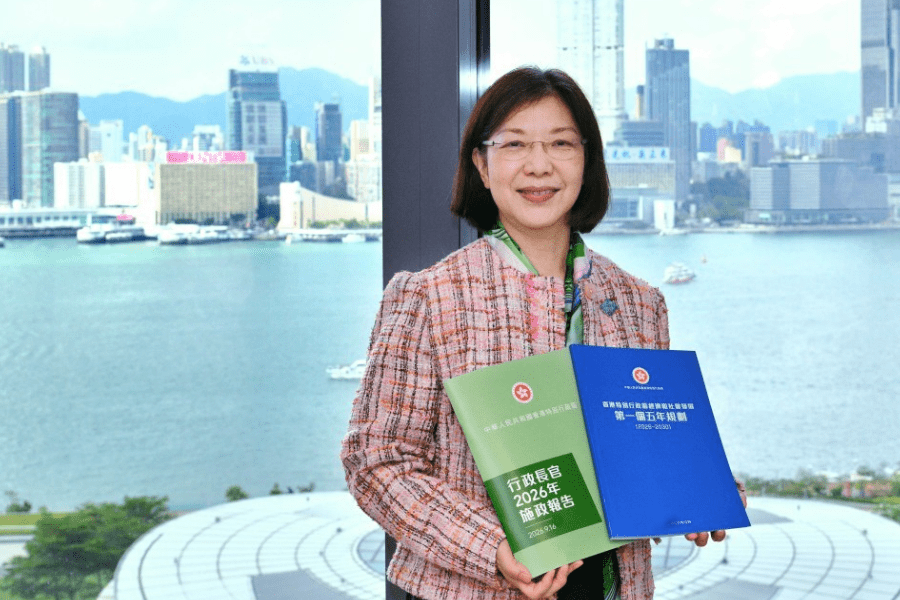
Hong Kong's first Five-Year Plan should stay the course but be reviewed each year through the Policy Address, Secretary for Constitutional and Mainland Affairs Janice Tse Siu-wah said.
Tse made the remarks in an interview with Sing Tao Daily, the sister publication of The Standard, in which she discussed the blueprint for the city's future development.
"Frequent changes to a development plan will cost market and investor confidence," she said, adding that the Policy Address was the best occasion to review progress when the overall direction is right.
The plan, which Tse took charge of after taking office in late March, drew more than 17,000 submissions, with over 80 percent from individuals — a response she believes showed a shared wish for a better Hong Kong. She stressed the plan would put people first and aim to make the city more liveable and business-friendly, bringing happiness and a sense of gain to all.
Citing Song dynasty philosopher Zhu Xi, Tse emphasized the importance of having a clear target, hoping the document would offer the city a direction and strategies going forward.
Most submissions were filed through a designated webpage and sorted using AI, she said. She recalled one resident who suggested the city should not only invite European football clubs, joking that "South American football is good to watch too."
Among the submissions were also letters written on the back of old calendars and almanac paper, and others from Hong Kong emigrants who had left years ago but still cared about the city, Tse said.
Turning to Macau's move to explore third-party evaluation in their third Five-Year Plan, she said Hong Kong had yet to decide, but that scrutiny from residents, media, civil groups and professional bodies already functioned as one.
When asked why only five of the plan's 22 main indicators are binding, Tse said setting quantitative targets requires careful thought. "If you set them too rigidly, people say we are a planned economy. If you don't set them, people say we lack commitment," she said.
She further indicated that GDP growth is hard to predict because it reflects the performance of all sectors, but indicators are necessary to keep economic growth at a reasonable rate. "If the rest of the world manages a rise of 3 to 4 percent, you have to explain why you cannot do the same under similar conditions."
Addressing concerns over the use of mainland terminology and slogans in the plan, Tse said each term has a precise meaning that cannot be replaced with everyday language if Hong Kong is to align with the national plan.
With less than a year left in the current government's term, Tse brushed off questions about seeking another term. "This is not something on my radar right now. There is so much on hand and it is not something I am thinking about at all," she said.
Tse's latest declaration shows she still holds 22 properties, but she rejected the idea of judging the Northern Metropolis in property terms when asked whether she was interested in buying property there.
She added that the Northern Metropolis was a development project aimed at moving Hong Kong away from its reliance on land appreciation.