Read More










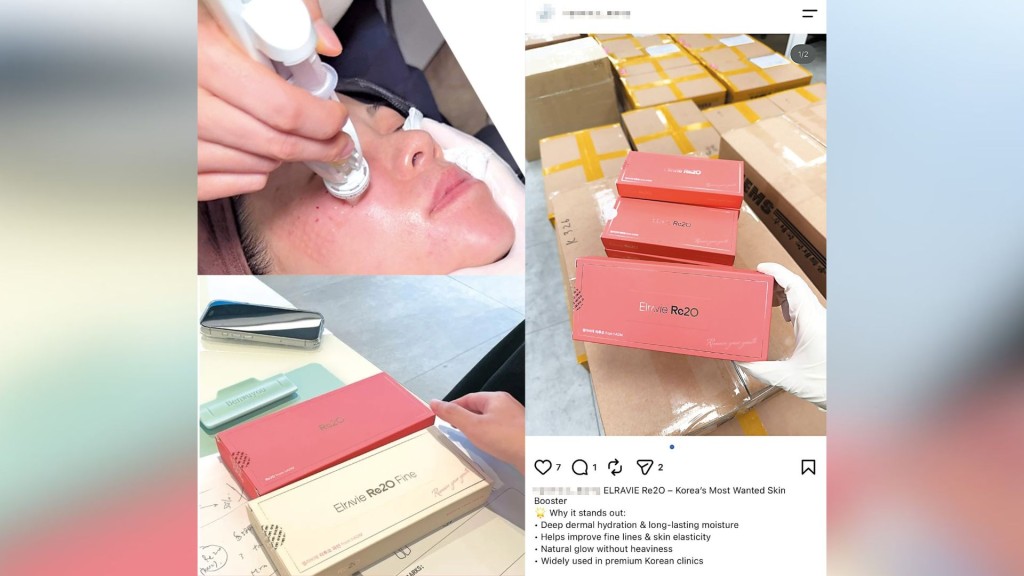
A Korean medical aesthetic product marketed as containing human-derived collagen has raised safety and legal concerns in Hong Kong, with health authorities saying the injectable is subject to regulation under both organ transplant and pharmaceutical laws.
The product, Elravie Re2O, has been dubbed a “cadaver skin injection” because it is promoted as using collagen derived from donated human skin tissue. Experts warned that if residual cellular material remained after processing, injecting it into another person could potentially trigger inflammation, infection or an immune response.
East Week, a sister publication of The Standard, found that the product was being offered in Hong Kong through online sellers, beauty salons and clinics, including premises said to be operated by doctors.
The publication also found that some operators did not clearly disclose that the product involved human-derived tissue or fully explain possible side effects.
At one beauty center in the New Territories, a staff member told a reporter that no doctor was present and that the product would be applied after radiofrequency microneedling, followed by the use of an ion-needle device to aid penetration.
The employee described Re2O as “human collagen.”
“In the past, there were injectables derived from porcine skin tissue, essentially pig collagen, but this particular product consists of human collagen, which is the most compatible with the human body and least likely to trigger rejection,” she said, without referring to cadaveric skin or human remains.
She said the treatment cost HK$3,480 per session and was recommended once a month. Asked about side effects, she only mentioned possible temporary skin redness.
At another clinic in Kowloon that claimed to be doctor-run, a staff member identifying herself as a doctor’s assistant showed the reporter white- and orange-packaged versions of Re2O.
She said the injections consisted mainly of collagen and hyaluronic acid and acknowledged that the product contained human-derived components.
“The ingredients are processed using technology to mimic human DNA and it is the closest possible match to human collagen, resulting in minimal residue,” she said.
She also sought to address concerns about so-called “cadaver-skin injections,” saying the manufacturing process removed human DNA and stressing that “it is simply human collagen.”
The clinic quoted HK$4,800 for the dosage alone, or HK$15,000 for a three-session package that includes injection procedures.
The investigation also found a South Korean wholesaler claiming to represent Re2O, advertising worldwide delivery on social media and inviting clinics, beauty salons and distributors to place orders.
Dermatologist Davis Chan Yung, honorary adviser to Matilda International Hospital, said current decellularization techniques could not completely remove all cellular material.
He warned that if residual cells carrying bacteria or viruses remained in the product, they could trigger an immune response after injection. Chan also said available research was limited.
“This product study only involved twenty people, and the data was only collected over twenty weeks. If there are any side effects, it may not be reflected,” he said.
Beauty industry influencer Angel Tong also urged consumers to exercise caution, saying products involving human dermal tissue were subject to regulation in Hong Kong.
“Beauty is important, but health is even more so! Never sacrifice your health,” she said.
Tong advised consumers to check whether products were genuine and properly sourced, and to distinguish between registered pharmaceutical products and reviewed medical devices. She added that injections should be assessed and administered by qualified registered doctors.
The Department of Health told the publication that Elravie Re2O injections contain human dermis and are therefore regarded as “regulated products” under the Human Organ Transplantation Ordinance and as pharmaceutical products under the Pharmacy and Poisons Ordinance.
Over the past six months, the department has referred six cases involving suspected illegal sales of Elravie Re2O injections to police under the Human Organ Transplantation Ordinance.
Authorities also recently seized a Korean-labeled Elravie Re2O injectable product that claimed to contain human tissue. The case remains under investigation.
The department said products injected into the human body are generally classified as pharmaceutical products unless they fall under another regulated category. Selling or possessing an unregistered pharmaceutical product is a criminal offense punishable by a maximum fine of HK$100,000 and two years in prison for each offense.
It added that injection procedures should only be carried out by locally registered medical or dental practitioners. Anyone selling a regulated product under the Human Organ Transplantation Ordinance must first obtain an exemption from the Director of Health.
The department said it had received exemption applications for such products that were still being processed, but had never received an application to register Elravie Re2O as a pharmaceutical product.
Elravie Re2O is produced by South Korean biotech company L&C Bio, whose business includes processing donated human skin, bone and cartilage using decellularization technology to produce transplant materials.
Apex Boom, which says it is the sole authorized Hong Kong distributor of the product, said Re2O meets international safety standards and undergoes screening and sterilization procedures.
The company said the donated dermis used in its acellular dermal matrix is mainly imported from the United States and sourced through facilities certified by the Association of American Tissue Banks, while the manufacturing facilities have been approved by South Korea’s Ministry of Food and Drug Safety.
The head of Apex Boom, surnamed Wong, said his company had signed an exclusive distribution agreement with L&C Bio and applied to the Department of Health in February for an exemption because the injections contain human skin tissue. The application has yet to be approved.
Wong said counterfeit Re2O products were circulating in the market and that their packaging differed from products sourced directly from the South Korean manufacturer.
He also said that because the required approval had not yet been granted, products currently being sold in Hong Kong were unauthorized.
“Once approved by the DH, the packaging will also have the Department of Health’s approval exemption number and an English description,” he said.
Meanwhile, South Korea’s drug regulator has acknowledged regulatory gaps surrounding products involving human tissue and is studying possible changes to its oversight framework.
The product has not been approved for entry into mainland China or Taiwan, and that it has not received approval from regulators in the United States or Britain.