I have never ceased to be amazed by novel construction methods as applied to our transport infrastructure.
About two years ago, I saw the construction of the Fanling Highway viaduct, built on an empty site adjacent to its designated location and rotated some 90 degrees to its final position on a temporary turntable. This avoided prolonged construction activities in the congested site which may have led to interruptions to railway services and water supplies.
This new bypass is now in service. Commuters may not know that one section of the viaduct was constructed like a machine component, but in gigantic scale, moved to its present position in total safety and efficiency.
Citizens will soon see another landmark project which breaks the tradition of civil engineering work requiring in situ construction activities: the new Hung Shui Kiu Station for the Tuen Ma Line.
Again, its process is different from the conventional approach of closing off a site to allow construction work, often involving extensive wet trades on site, such as concrete pouring and the need to erect reinforcement steel works for the columns and slabs. Not only will such activities be messy, but they may also impose safety risks and inconvenience to others who are using the facilities nearby. For an operating railway line, this will be an even more difficult and involved process, and for safety reasons, work can only be done during the “Golden Two Hours” – approximately between 2am and 4am, depending on the circumstances.
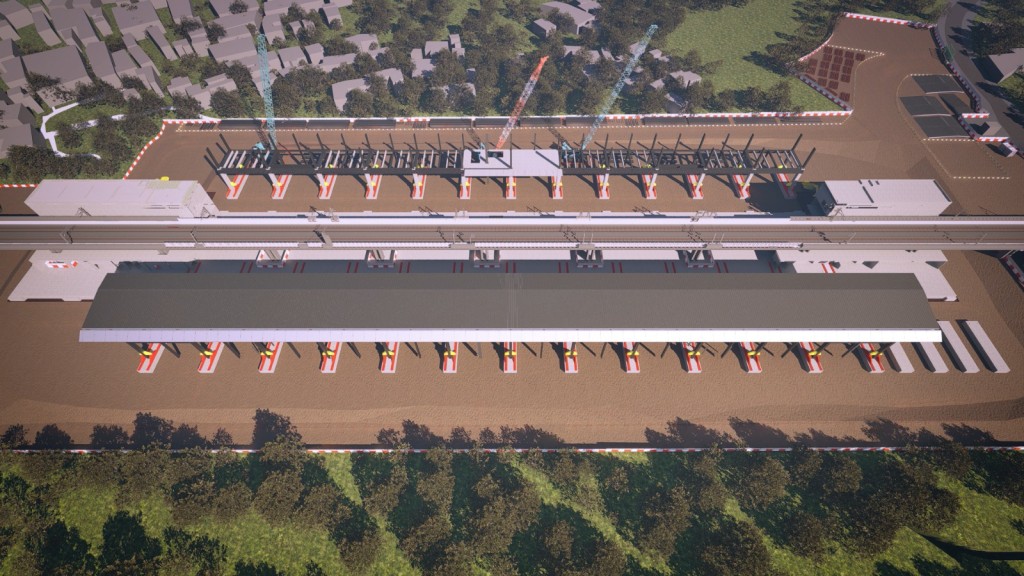
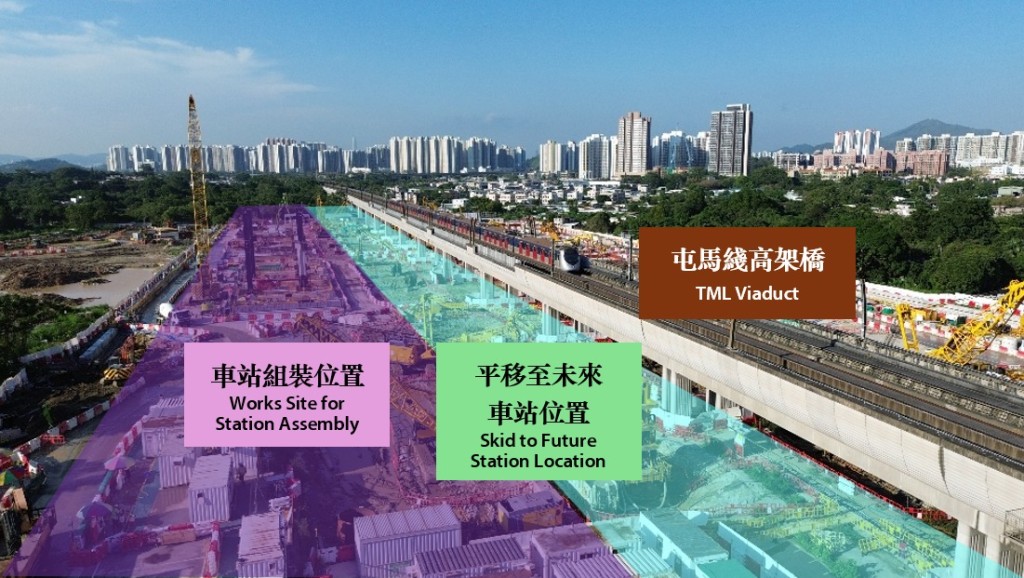
MTR project staff devised a new method to overcome these risks and inconveniences. First, they design the station structure in modular form so it can be fabricated off-site and transported to the final location. But instead of assembling these modules directly onto the existing viaduct piece by piece, the station box halves are assembled on a location about 30 meters away, so it could be done within normal working hours. But the massive half-station structure, which is predominantly of high tensile steel, measures 210 meters long and 15 meters wide and weighs 10,000 tonnes, and still needs to be skidded to the final location.
Such an accurate and detailed assembly process requires comprehensive planning and flawless execution to ensure exceptional precision far beyond traditional civil and building work practices.
Skidding construction methods have been widely adopted in different infrastructure projects around the world. Our construction professionals have quickly learned from them and can now apply the new technology to our projects. Extensive use of such processes will most certainly lift our construction tech to a much higher level.
Hong Kong had been on the forefront of technology a few decades ago and had claimed a leading position among peers in the western world. Although we might have slowly trailed behind our neighbors for some time, it is gratifying to see us adopting new construction methods to retain our competitiveness and effectiveness.
Veteran engineer Edmund Leung Kwong-ho casts an expert eye over features of modern life