The second part of the Hydrogen Week in May, organized by the Electrical and Mechanical Services Department, was a visit to the Yangtze River Delta Region.
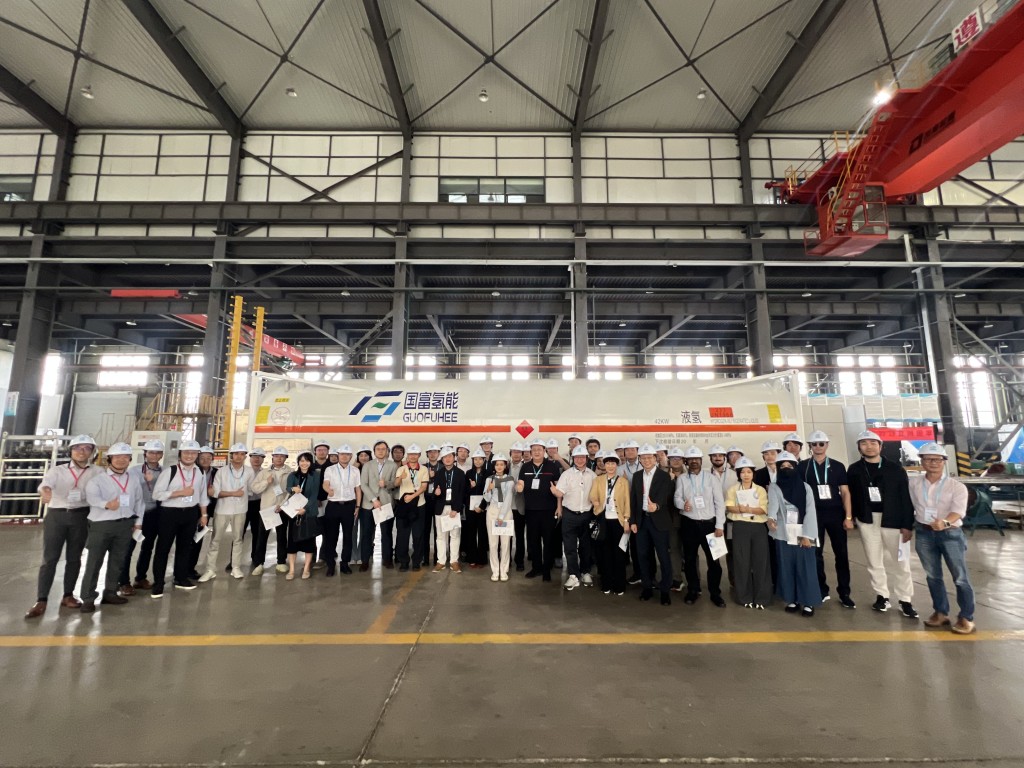
Some 50 delegates – including those from Europe, South Korea, the Association of Southeast Asian Nations, Central Asia, Hong Kong and Macau – joined this delegation.
To describe what we saw as “jaw-dropping” may be an exaggeration, but it was definitely an eye-opener. While other countries lead in hydrogen power, including South Korea which boasts six cities with hydrogen, the Yangtze River Delta Region comprises production, testing and application of hydrogen power all in one area.
Just to recap, hydrogen is an efficient fuel carrier. It has a low molecular weight and its chemical process does not emit carbon when used. But the choke points are the production of green hydrogen itself, as well as the method of transporting it to the place of consumption.
The largest potential source of hydrogen production is from renewable energy. But whether it can be classified as green requires certification. In the aspects of transportation, compressing it to high pressure of 70 MPa requires special containers. Converting it to liquid form requires both pressurization and cooling and the containers need good thermal insulation to ensure it does not evaporate into a gaseous form during transportation. All of these require dedicated production facilities.
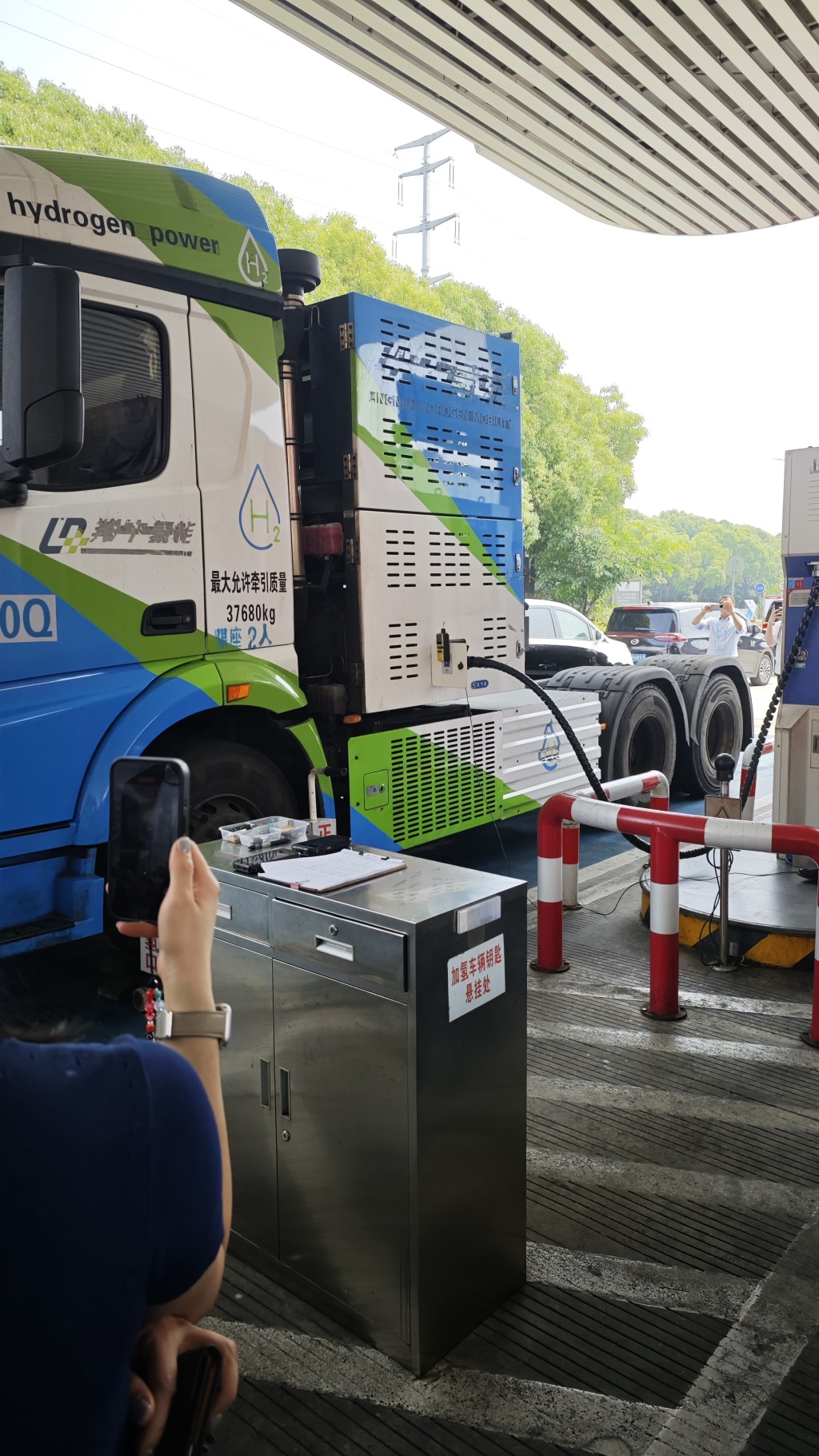
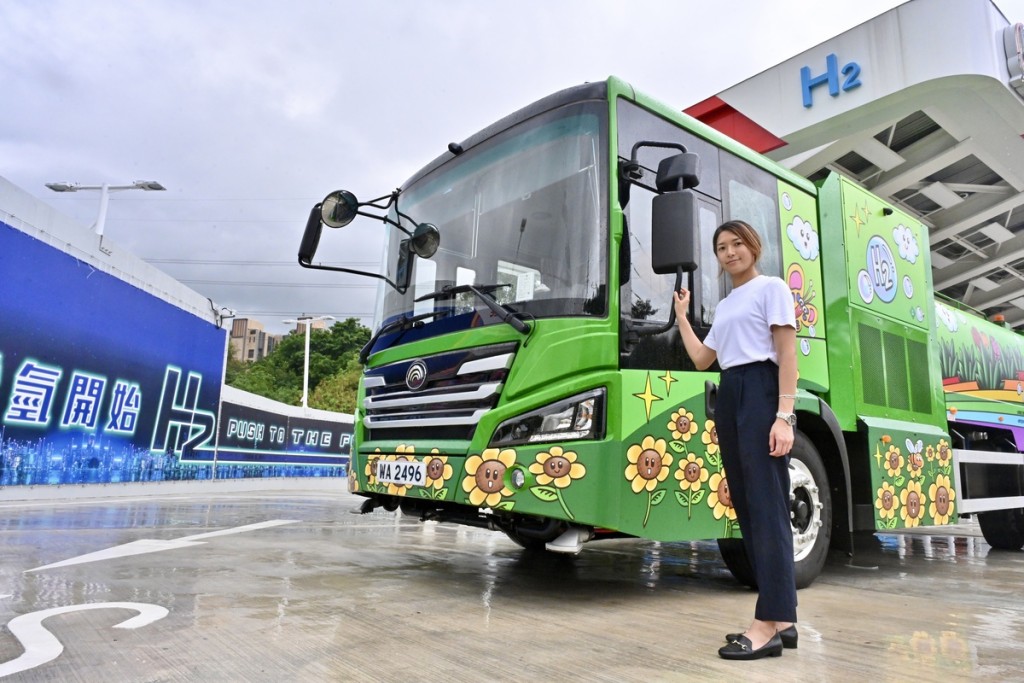
Hydrogen tractor filling up at a station
The delegation at the Guofu Hydrogen factory
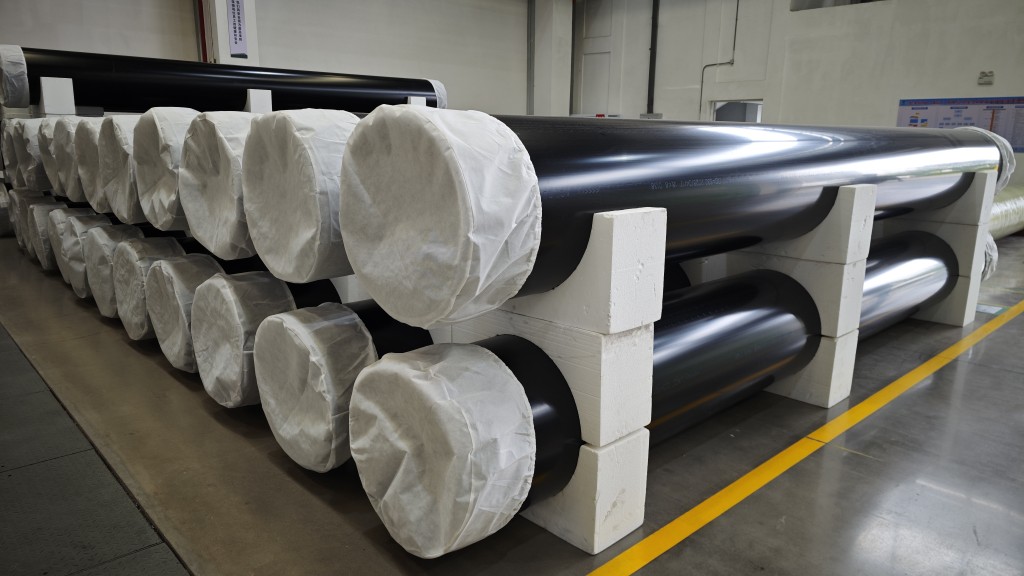
The high pressure hydrogen cylinders
Jiaxing in Zhejiang is a city planned for high-tech manufacturing, and one of its recent developments is hydrogen facilities production. It has developed a series of factories that produce fuel cells, high-pressure cylinders, gaseous and liquefied hydrogen, and appropriate testing facilities to ensure that the products meet the high standard required.
The financial investment is huge and the planning process to set aside a valuable piece of land as a manufacturing base requires foresight and courage. But what we saw was a typical case of successful planning and judicious investment availing the region as a cluster of hydrogen economies for the Yangtze River Delta Region.
The facilities we saw confirmed that they were well-planned, robustly constructed and professionally run. I dare say their facilities are a match to any world-classed factories in efficiency, cleanliness and safety.
Manufacturing of laminates for fuel cells requires clean-rooms and stringent production process to ensure that the seven layers of rigid but thin materials – between 10 to 100 micrometers – can be coated with catalysts and pressed firmly in place by rollers for continuous and reliable operation for many years without failure nor loss in efficiency.
Winding carbon-fiber to form a strong net and binding several layers together as the base material for forming into a cylinder strong enough to hold hydrogen at some 70 MPa and to withstand the shocks and vibration for road transport requires special technology and knowhow. Such technology is not commonly available and is a commendable achievement for a factory anywhere in the world.
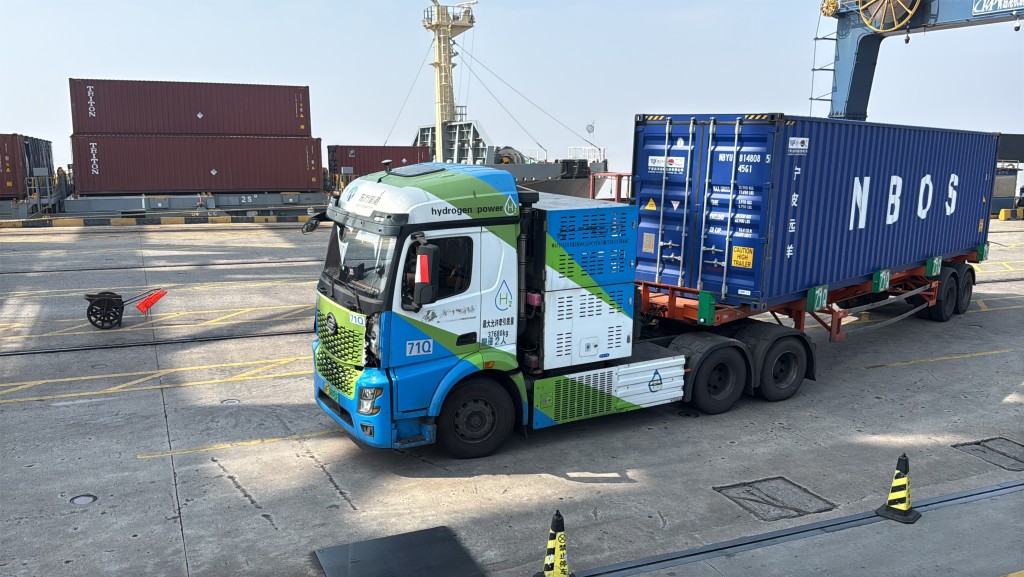
But to top it all, we went to see the Zhapu Port which is a large container terminal for export. The revelation was seeing some 100 hydrogen powered tractors in the port grounds ferrying containers to and from the ocean-going container vessels. It gave us no doubt of the practical application of hydrogen power to the day-to-day operations of a major port. Visitors were allowed to climb up to the driving cab of one of these hydrogen powered tractors to see for themselves that it is a tool for actual day-to-day operations rather than a prototype. This was followed by a visit to an adjacent hydrogen gas filling station with piped supply hydrogen where these tractors are refilled as a routine operation.
If anyone still has doubts that hydrogen power is only a dream for the future, this visit has dispelled any concerns about reliability and safety. As to whether they are economically viable, the huge facilities in Jiaxing have demonstrated the appropriate confidence.
With certification endorsed internationally in the course of time, China will become a world leader in the hydrogen economy. Hong Kong’s role as a certification body on hydrogen standard will help to accelerate this development and it will provide plenty of opportunities to finance and support the full production and distribution chain.
Insightful planning, industrious production facilities and processes are key ingredients for success in promoting new technologies for use, and this visit provided an excellent showcase to professionals worldwide that hydrogen power has already been proven as viable for everyday use.
Veteran engineer Edmund Leung Kwong-ho casts an expert eye over features of modern life