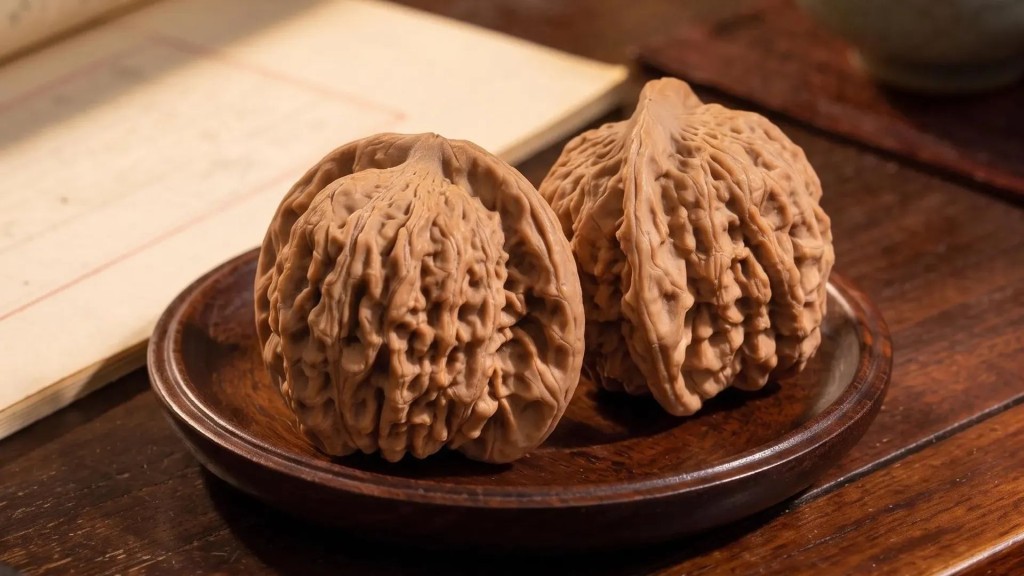
There are objects that announce wealth loudly, and there are objects that speak only to those who understand time. A pair of well-played ornamental walnuts belongs to the second category. In Chinese culture, these walnuts are held and rotated in the hand not for eating, but for patience, health, habit, and quiet pleasure.
After years of collecting watches, cigars, tea, pens, and cameras, I have grown to respect objects that change with use. A watch gathers scratches. A cigar humidor carries scent. A teapot slowly gains a glow from years of brewing. Walnut players belong to this same family of lived-in luxury. They ask for touch, routine, and patience rather than instant admiration.
There are two styles of playing. Wen pan is the gentle style. The walnuts turn silently and smoothly in the palm, almost without sound. It is private, controlled, and elegant, often used at home to avoid disturbing one's family. Wu pan, on the other hand, is more physical. The walnuts knock, press, rub, and move with rhythm. Outside, some players enjoy this louder style as a way to show skill and invite fellow enthusiasts.
The magic happens over time. After months and years of contact, the walnuts absorb natural oils from the hand. Deep brown slowly becomes dark red or maroon, with a glossy finish almost like aged jade. Even the sound changes from a dull thud to a crisp, porcelain-like tone. Some varieties, such as White Lion, Full Sky, and Red Lion, can turn red within half a year. Others, like Chicken Heart or Southern Xinjiang Stone, may require more than five years.
I once saw a very fine pair at a private viewing before an auction. They were not the largest walnuts in the room, nor the most dramatic in shape. Yet they had a quiet power. The surface was dark red, polished by time rather than by a machine. The owner told me they had been played for decades by the same pair of hands before entering the market. That detail changed everything. Suddenly they were not ornaments. They were a record of discipline.
This is why old pairs can become so expensive. A pair handled for decades, or even more than a century, can be worth astonishing sums in the market. But the value is not only in the walnut. It is in the years inside it. The owner's hands, moods, journeys, tea tables, waiting rooms, autumn walks, and private thoughts all become part of the surface.
Now, when I think of walnut players, I do not see an old-fashioned habit. I see meditation in the palm. A cigar burns, shou puerh rests in the cup, and a pair of walnuts turns slowly in the hand. In an age when everything wants to be new, this may be one of the most Chinese forms of refinement left. The walnut begins as nature. The hand turns it into memory.
Dixtionary is a global citizen and seasoned entrepreneur who views luxury through the lens of philosophy and heritage / @dix.tionary