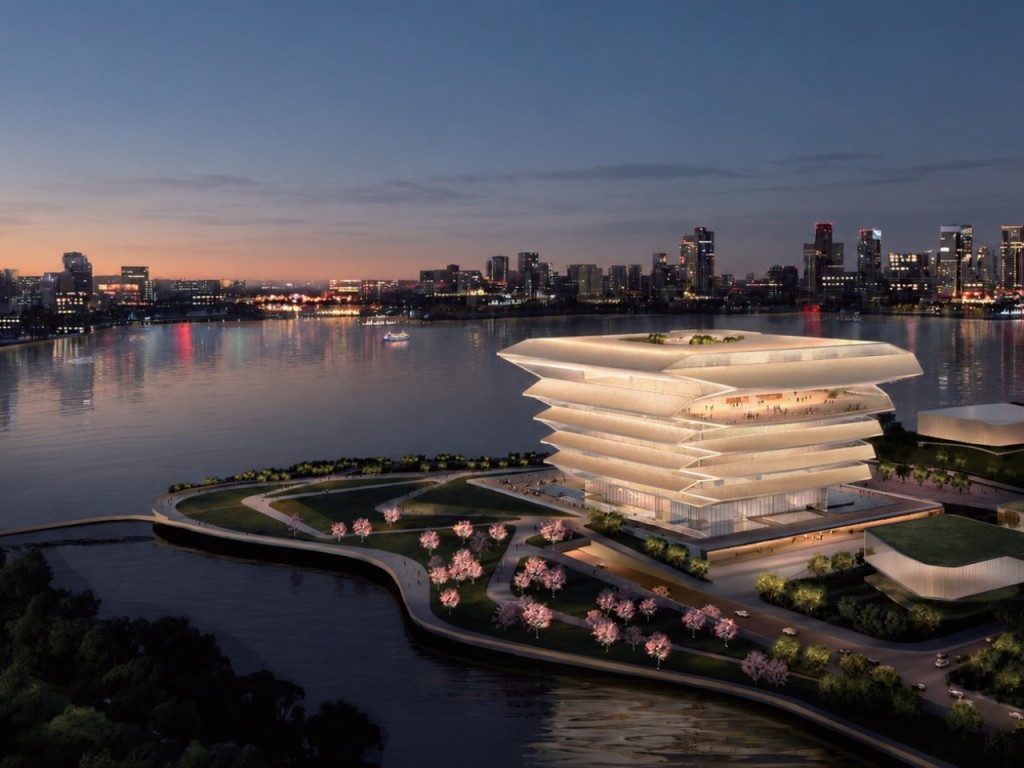
The Qianhai Museum, located in Shenzhen’s Qianhai Cooperation Zone, is scheduled to begin trial operations on October 30, debuting eight flagship exhibitions and showcasing more than 3,000 cultural relics.
The venue will officially open to the public starting at 2pm on the launch day, offering 5,000 reservation slots for its first day, followed by a daily quota of 8,000 reservations thereafter.
Jointly developed by the Shenzhen Municipal Government and the National Museum of China, the complex encompasses a total floor area of 126,000 square meters, including more than 40,000 square meters dedicated to exhibition space.
The building’s architectural framework incorporates a 95-meter concrete-filled steel arch as its central structure, providing expansive, column-free gallery spaces across its north and south wings.
Meanwhile, the museum will feature digital exhibitions showcasing world-class heritage sites and cultural milestones, including the Beijing Central Axis, the Mogao Caves, the oracle bone script, Jingdezhen ceramics, and Sanxingdui.
Leveraging Qianhai’s strategic geographical position and open economic environment, officials stated that the venue aims to evolve into a world-class, comprehensive smart museum.
Leveraging Qianhai’s strategic geographical position and openness to the outside world, the venue aims to develop into a world-class, smart comprehensive museum.
The venue will implement a real-name reservation system with designated time slots, and visitors can book tickets or make reservations through the Qianhai Museum’s official WeChat account.
While access to some exhibitions is free under the real-name reservation system, standard tickets for paid special exhibitions are priced at 80 yuan, with concessionary rates and free admission policies available for eligible visitors.