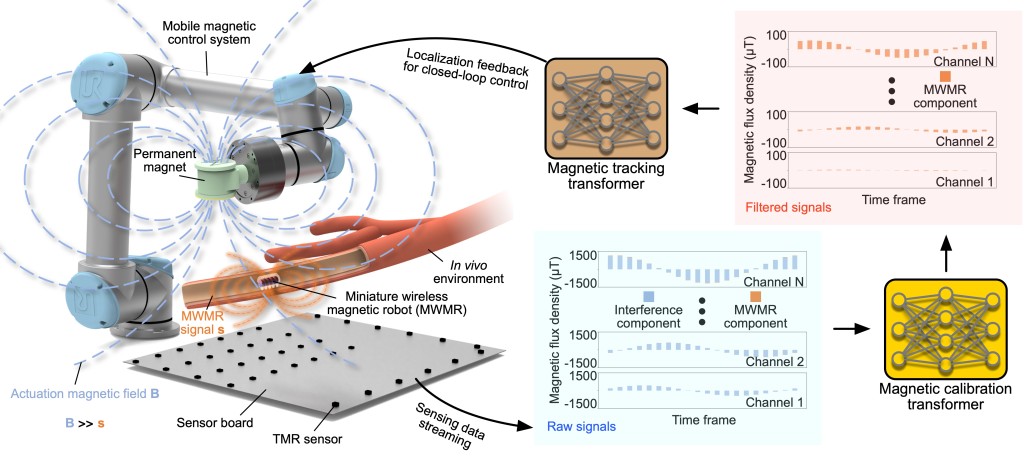
Researchers at The Chinese University of Hong Kong (CUHK) have developed an AI-powered magnetic tracking system that enables real-time localization and navigation of millimeter-scale wireless medical robots. The breakthrough paves the way for minimally invasive procedures by allowing precise guidance of tiny robots inside the body.
Published recently in Science Robotics, the study demonstrates that the technology allows safe and accurate navigation of micro-robots through difficult-to-access regions such as blood vessels and bile ducts.
This could accelerate the clinical adoption of miniature robots for diagnosis and therapy.
Minimally invasive procedures are increasingly important in healthcare, as they help diagnose and treat conditions with less patient trauma. Miniature magnetic robots can be remotely guided into hard-to-reach areas, offering significant potential for future medical treatments. However, clinical use has been limited by challenges in tracking the precise location of the robots inside the body.
The new AI-driven system overcomes this barrier, functioning accurately even in environments with magnetic interference.
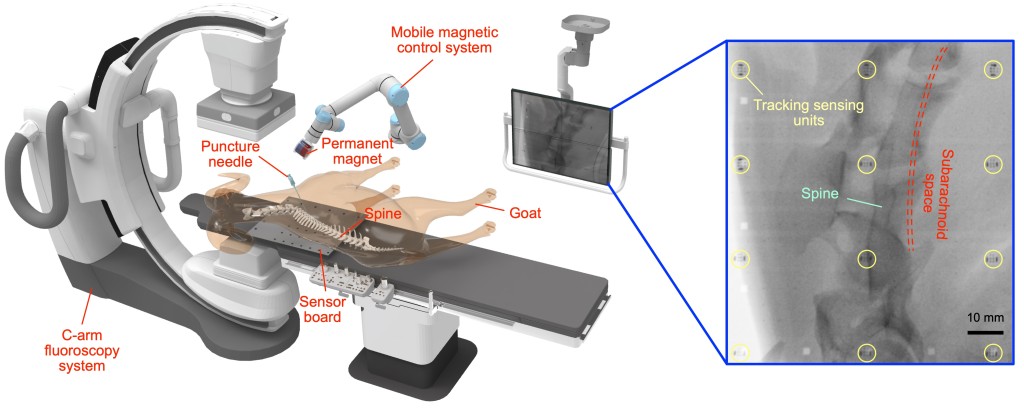
The technology was successfully tested in animal models, where the robots were navigated through complex anatomical regions under real clinical conditions. Trajectories matched X-ray observations, confirming the system’s accuracy.
Professor Zhang Li from the Department of Mechanical and Automation Engineering at CUHK, who led the research, said the platform’s AI-based approach to tracking robots in real time brings miniature medical robots closer to real-world clinical applications in minimally invasive medicine.
Zhang Li