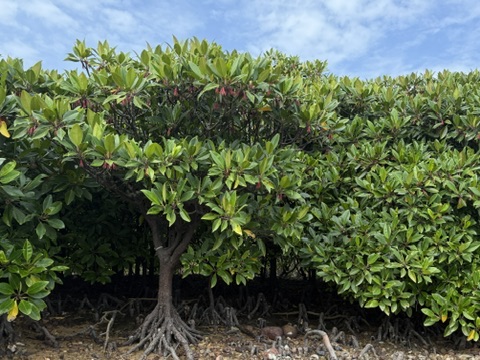
Mangrove forests remove nearly 870,000 metric tons of nitrogen pollutants from coastal waters each year, providing an ecosystem service valued at more than US$8.5 billion (HK$66.6 billion) annually, according to a study led by researchers at the Chinese University of Hong Kong.
The research was led by Benoit Thibodeau, assistant professor in CUHK’s Department of Earth and Environmental Sciences and School of Life Sciences, and PhD candidate Wang Ziyan. The findings were published in the journal Earth’s Future.
The researchers analyzed 51 published studies and unpublished datasets covering 42 mangrove sites worldwide.
Their findings suggest that, under optimal conditions, mangroves could remove as much as five million metric tons of nitrogen annually, equivalent to about 3 percent of global human-generated reactive nitrogen pollution.
Human-caused nitrogen pollution has increased about 50-fold over the past century, contributing to harmful algal blooms, expanding marine dead zones, disruption to fisheries and threats to freshwater supplies.
The study found that mangroves can help address the problem through microbes living in their waterlogged sediments, which convert reactive nitrogen compounds into nitrogen gas and remove them from the ecosystem.
Mangroves are already widely recognized for their ability to capture and store carbon, a function commonly known as “blue carbon.”
The researchers propose extending that concept to “blue nitrogen” to reflect the role of mangrove ecosystems in removing nitrogen pollution from coastal waters.
“Blue carbon gave us a successful model for valuing ecosystem services, and blue nitrogen builds on that foundation to help us better assess and plan coastal conservation,” Wang said.
The study estimated that the economic value of mangroves’ nitrogen-removal function is more than 12 times that of their carbon sequestration credits.
The researchers suggested incorporating “blue nitrogen” credits into existing ecosystem-service frameworks and exploring a combined carbon-and-nitrogen credit mechanism.
Such a system could potentially create additional financial incentives for mangrove conservation by assigning economic value to their role in improving water quality.
The study also found that current nitrogen removal by mangroves is only about 15 percent of their estimated theoretical maximum, suggesting significant untapped potential.