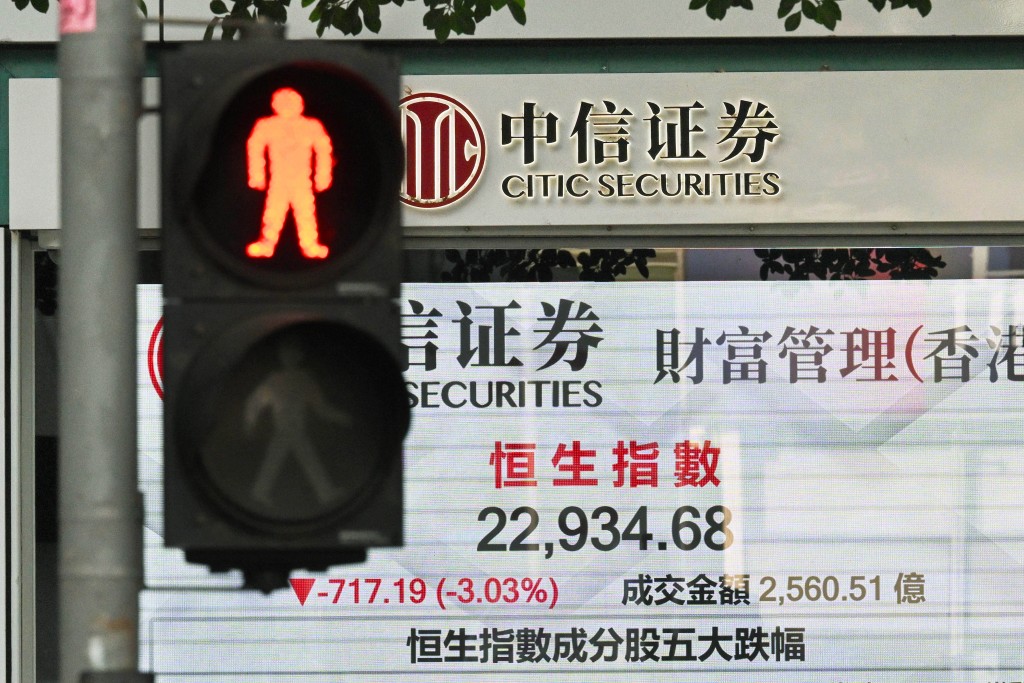
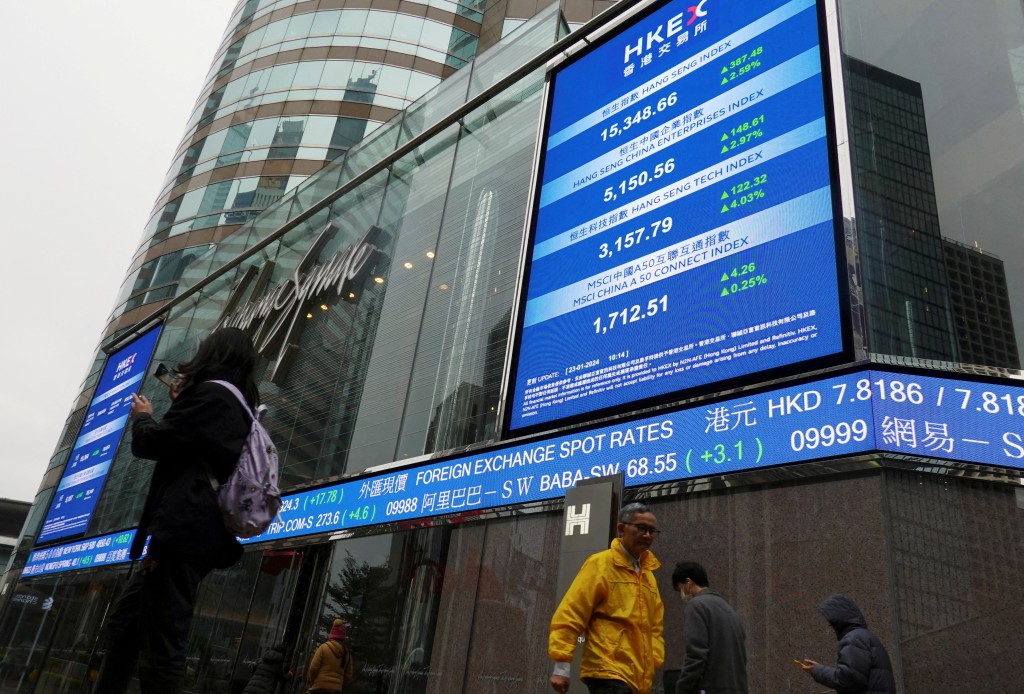
The Hang Seng Index fell below 23,000 points on Thursday, crashing over 700 points to a near four-month low, as rumors that mainland investors need to sell stocks to pay taxes triggered panic selling.
The benchmark Hang Seng Index dropped 3 percent to 22,934 points, bringing the full-day market turnover to HK$256 billion. The index once fell as much as 772 points to 22,879.
Tech gauge also plunged 5 percent to 3,793 points, a two-year low.
Tech heavyweights Alibaba (9988) and Tencent (0700) tumbled 6.1 percent and 2.9 percent as the main indices that dragged down the market. Tencent has completed the issuance of US$1.8 billion and 26 billion yuan in notes, with the market eyeing whether the company will overinvest in artificial intelligence going forward.
Tech heavyweights Alibaba (9988) and Tencent (0700) tumbled 6.1 percent and 2.9 percent, respectively, dragging down the main indices. Tencent has completed the issuance of US$1.8 billion (HK$14 billion) and 26 billion yuan (HK$30.52 billion) in notes, with the market watching whether it will overinvest in artificial intelligence going forward.
Blue chips fell across the main board except for Chinese appliance maker Midea Group (0300), with Lenovo (0992) slumping nearly 11 percent and chipmaker Hua Hong Semiconductor (1347) dropping 9.5 percent, the two worst performers.
Biopharma shares also tumbled, with Innovent Biologics (1801) and WuXi Biologics (2269) falling nearly 8.4 percent each, and Hansoh Pharmaceutical (3692) down 7 percent.
The finance, utilities, and property sub-indices fell by more than 1 to over 2 percent. HSBC (0005), AIA (1299), and Hong Kong Exchanges and Clearing (0388) all fell over 1 percent, while several mainland property stocks dropped more than 2 percent.
An analyst told The Standard's sister publication Sing Tao Daily that the downturn is not due to external factors or weaker corporate fundamentals, but rumors that several mainland tycoons may need to sell shares to pay taxes.
He noted that tax authorities are said to be chasing payments, but the amounts and look-back periods are unknown, prompting investors – even those without tax issues – to sell en masse, unable to gauge how much others must liquidate.
The analyst said Hong Kong stocks will struggle to bottom out until the relevant information is clarified and market concerns are alleviated, with the market potentially testing 22,500 points in the near term. However, he expects the index to rebound to between 24,000 and 24,500 points in December.
In the mainland, the Shanghai Stock Exchange Composite Index fell 55 points, or 1.48 percent, to 3,658 points, while the Shenzhen Stock Exchange Composite Index retreated 2.96 percent to 11,357 points.