Read More
Shivangi Acharya and Sarita Chaganti SinghTies between the two countries have been strained since a deadly Himalayan border clash in 2020, slowing the exchange of capital, technology and talent, despite exploding demand for electric vehicles, semiconductors and artificial intelligence.
India's push to become a factory titan has hit a snag: to become a credible alternative to China for global firms, it first needs to warm up to its long-time rival.
ADVERTISEMENT
SCROLL TO CONTINUE WITH CONTENT
The Modi government's heightened vetting of all Chinese investment over this period effectively turned away billions of dollars from the likes of BYD and Great Wall Motor and created new layers of red tape for firms with Chinese stakeholders.
But now India is looking to loosen some of these curbs as businesses struggle to scale up manufacturing, even with a host subsidies designed to boost local production.
"There is a realization that you cannot be part of any major supply chains, especially in high-tech products and areas like solar cells, EVs, where it is not possible for you to do anything without being part of Chinese supply chains," said Yale University lecturer Sushant Singh, who also works as a researcher for public policy think tanks in India.
Even businesses that have supported barriers on Chinese imports acknowledge the need for key inputs from up north.Naveen Jindal, head of one of the country's largest steel firms Jindal Steel & Power and a federal lawmaker, has backed tariffs on Chinese steel but also sees the need for a pragmatic approach to trade.
"A lot of steel companies import equipment and technology from China," he said. "China is the world's largest producer of steel and in certain areas they are very good, but not in every area."Now, after four years of restrictions on Chinese investments and visas, Prime Minister Narendra Modi's government is looking to pivot closer to the Asian rival and breathe new life into his ambitions.
"The government is considering easing investment rules that were introduced in 2020 for countries that India shares land border with as we need more investments," said an official.It is planning to add a clause that investments from companies with up to 10 percent Chinese shareholding will no longer require approval, a move that could help global firms that have supply-chain partnerships with Chinese firms easily invest in India.
To address security fears, it is also planning to set up a post-investment monitoring framework driven by crime and fraud investigation agencies and the banking regulator.The move would encourage greater Chinese investment, which analysts say is critical to India joining global supply chains in high-tech sectors such as solar cells, EVs and battery manufacturing.
The proposed easing is still being pushed by Modi's office with sticking points between ministries being ironed out.Following industry lobbying, India has already eased visa issuance for Chinese nationals and is expediting visa approvals to Chinese engineers for sectors that get federal subsidies to manufacture locally.
It has likely approved nearly 2,000 short-term visas to Chinese professionals, who accounted for most applications between November and this July."In the visa process, there is rationality. On the ground it has not translated yet but the mindset shift has happened," said Pankaj Mohindroo, head of the Indian Cellular and Electronics Association.
Foreign minister Subrahmanyam Jaishankar said recently India is not "closed to business from China" but noted the issue was rather in which sectors and on what terms Beijing did business.After the 2020 clash with China, to lure Apple, India gave quick approvals to its Chinese suppliers and Indian firms.
The move has led to the phone maker moving 14 percent of its global iPhone assembly to India in the fiscal year 2023/24.In the same year, India's mobile exports increased 42 percent to a record US$15.6 billion (HK$121.68 billion).
However, even with such a shift there are doubts India's factories are of a sufficient scale to match the investment or achieve the productivity gains of their Chinese rivals.Chief economic adviser V Anantha Nageswaran said it was inevitable India would need to plug itself into China's supply chains.
"Whether we do so by relying solely on imports or partially through Chinese investments is a choice that India has to make," Nageswaran said in July.A plunge in foreign investment has also prompted the rethink on trade barriers.
Away from politics, Indian demand for Chinese goods remains robust, even with the targeted curbs.They have surged 56 percent since the 2020 border clash while India's trade deficit with China has doubled to US$85 billion.
China continues to be India's biggest source of goods and was the largest supplier of industrial products last year."We will be better off with some Chinese investment and technology flowing into our country without compromising national security concerns," Mohindroo said.
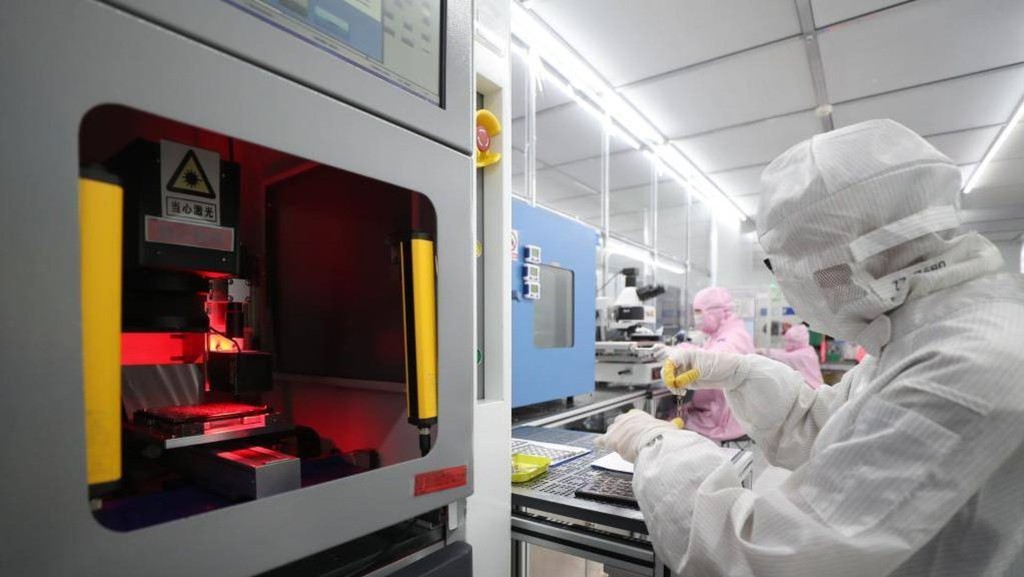
REUTERSIndia is getting, clockwise from above, a helping hand with its think-big ambition to replace China as the factory of the world from Rising Stars Mobile India, a unit of Taiwanese giant Foxconn Technology, in Sriperumbudur, Tamil Nadu; a push into th