Read More






HK movie producer Raymond Wong Pak-ming convicted of insider dealing
22-05-2026 17:10 HKT
Swire Properties wins compulsory auction for $2.02b Quarry Bay property
22-05-2026 20:36 HKT
The Hong Kong administration should cut non-essential expenditures, such as the old age allowance and extra allowance of social security subsidies, a lawmaker said, amid a structural fiscal deficit and an aging population.
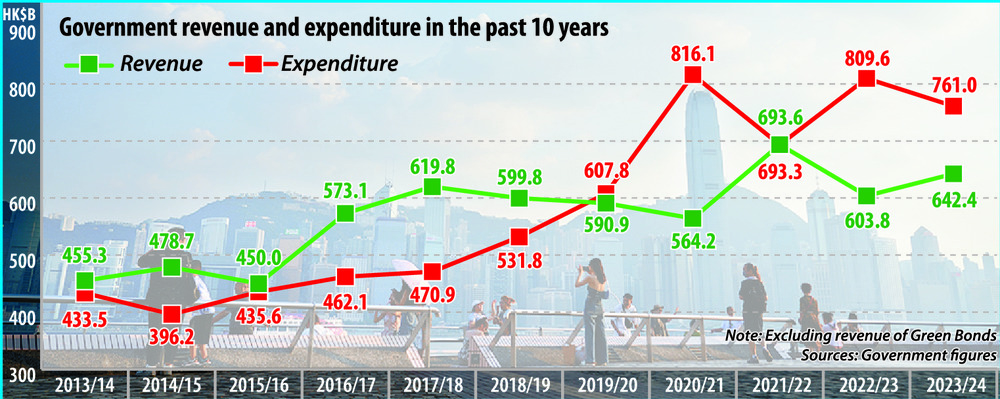
It comes after Financial Secretary Paul Chan Mo-po had said the government deficit will exceed HK$100 billion, well over the original estimates of HK$54.4 billion, citing a slow economic recovery and a drop in land sales and stamp duty revenue.
According to government figures, the expenditure has increased 75.55 percent in the past decade, from HK$433.5 billion in the 2013/14 fiscal year to HK$761 billion in 2023/24.
Medical expenditure went up the most by 132 percent due to the pandemic, closely followed by social welfare, which went up 110 percent in the past 10 years.
The Social Welfare Department was the top spender, with its budget increasing from HK$51 billion in 2013/14 to HK$109 billion, or 114 percent, in 2023/24.
The social security allowance scheme that provides subsidies to the severely disabled and the elderly, cost the most, as the number of applicants increased by 70 percent to 1.36 million in the current fiscal year.
Simon Lee Siu-po, honorary fellow at the Chinese University's Asia-Pacific Institute of Business, said the SAR's fiscal discipline has been weak, as it failed to assess the mid- to long-term impacts on the treasury, while increasing recurrent expenditures.
"Hong Kong has been maintaining a low tax regime. Government revenues rely on real estate and stamp duties, which has always been unstable and vulnerable to a volatile market," Lee said.
He said it was theoretically contradictory that while the government maintains a low tax regime, it spends a large amount on social welfare benefits.
Election Committee sector lawmaker Peter Koon Ho-ming said that admitting the current fiscal deficit is a "structural problem" is the first step in solving the problem.
He said Hong Kong's demographics have already changed, and the aging population will greatly affect the government's medical and social welfare expenditures.
"The government continuing to call the current fiscal deficit a periodical one will be a mistake. It is time to slash non-essential expenditures, for example charging more for public healthcare and stopping the extra allowance of social security subsidies," Koon said.
Last year, the administration announced that it would give a one-off subsidy to eligible Comprehensive Social Security Assistance scheme and Old Age Living Allowance recipients equivalent to half of their monthly subsidy in a bid to alleviate the grassroots' burden.
"A responsible government should tell society the truth. I believe citizens will understand," Koon added.
Election Committee sector lawmaker Wendy Hong Wen said the administration and pro-establishment camp used social welfare as a way to garner support, but this is very "unhealthy" to the treasury under a low-tax regime.
"There will be a huge problem if it is not rectified," Hong said.
But social welfare sector lawmaker Tik Chi-yuen opposed cutting social welfare expenditures.
"Most Hongkongers have failed to enjoy the benefit of the city's economic development and social welfare is their final safety net, as it redirects resources to the grassroots."
Instead of slashing social welfare expenditures, Tik said a sensible move is to review the tax regime.
michael.shum@singtaonewscorp.com