Read More
The president and vice president of the UK Supreme Court have submitted their resignations from Hong Kong's highest court as Britain said their presence is no longer tenable.
ADVERTISEMENT
SCROLL TO CONTINUE WITH CONTENT
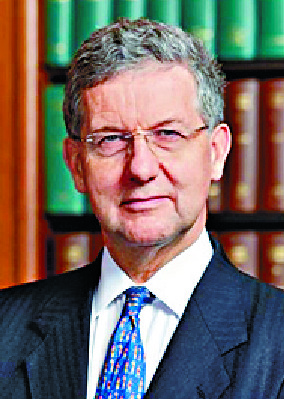
In a statement yesterday, Robert Reed, who heads Britain's top court, said he and fellow judge Patrick Hodge - vice president of the Supreme Court - would leave their roles as non-permanent judges on the Hong Kong Court of Final Appeal with immediate effect.
Reed has been serving in Hong Kong since 2017 and Hodge since 2020. Reed succeeded Brenda Hale as president of the UK Supreme Court in 2020.
Chief Executive Carrie Lam Cheng Yuet-ngor last night expressed "regret and disappointment" over their resignations. Her administration also expressed regret that the UK government withdrew from the agreement to deploy British judges to sit in Hong Kong's Court of Final Appeal.
She said the SAR government "has no choice but to acquiesce" to their decision. She "vehemently refutes" claims that their resignations have anything to do with the national security law or the exercise of freedom of speech and political freedom in Hong Kong.
And a spokesman for the Office of the Commissioner of China's foreign ministry in Hong Kong last night expressed "strong dissatisfaction" and firmly opposed the UK's move, saying that the UK was trying to manipulate the SAR's politics, but their effort will only be in vain.
The office therefore called on the UK to stop the "ridiculous political show" immediately.
In his statement, Reed said: "I have concluded, in agreement with the government, that the judges of the Supreme Court cannot continue to sit in Hong Kong without appearing to endorse an administration which has departed from values of political freedom and freedom of expression."
Britain's Foreign Secretary, Liz Truss, said she "welcomes and wholeheartedly supports" the withdrawal of serving UK judges from Hong Kong's top court. "We have seen a systematic erosion of liberty and democracy in Hong Kong. Since the national security law was imposed [in June 2020], authorities have cracked down on free speech, the free press and free association," Truss said.
"The situation has reached a tipping point where it is no longer tenable for British judges to sit on Hong Kong's leading court, and would risk legitimizing oppression," she added.
In response, the SAR government expressed "vehement opposition" to the UK parliament for the "unfounded allegations" against the national security law and the legal system of Hong Kong, while politicians "deliberately vilified it by applying double standards.
"The promulgation of the national security law is in line with the international practice of safeguarding national security and the exercise of the sovereign rights of our country," a government spokesman said last night. "Indeed, the fact that there would be a debate in the UK Parliament may well have influenced the resignation of the two serving UK judges. This is clear evidence of external political pressure on judges of an otherwise independent judiciary."
Hong Kong's Chief Justice Andrew Cheung Kui-neng expressed regret over the resignation of Reed and Hodge, as he said they have made valuable contributions to the work of the court, for which Hong Kong is grateful.
Cheung also reiterated the Judiciary's commitment to upholding the rule of law and judicial independence in Hong Kong. The commitment is unaffected by the departure of the two judges.
Both professional legal regulatory bodies expressed deep regret at the resignations.
Chan Chak-ming, president of the Law Society, said their resignation "disappointingly falls short" of the general support among the citizens and Hong Kong's legal community for the participation of overseas judges in the work of the Court of Final Appeal.
He added the overseas non-permanent judges from other common law jurisdictions in Hong Kong's top court helps to enforce and preserve rights and freedom under the Basic Law.
"Any interference with the participation of the overseas non-permanent judges in the Court of Final Appeal is a far cry from supporting the rule of law and judicial independence," Chan said.
"I sincerely appeal to the UK judges to reverse course and all overseas non-permanent judges to continue to sit in Hong Kong's Court of Final Appeal."
Victor Dawes, president of the Bar Association, said the move was a "political boycott" of the central government, adding that he does not think the resignations are related to Hong Kong's rule of law and judicial independence.
In a blog post last night, Secretary for Justice Teresa Cheng Yeuk-wah said the judicial system will remain stable and steady, as she said designating judges to hear national security cases will lower the risk of judges wrongly applying the law.
The former director of public prosecutions, Grenville Cross, said the resignations were a great pity and a big loss, but not a total surprise as there have been a lot of political pressures applied to them by British politicians since 2019.
"Reed and Hodge should be congratulated for standing up to the political pressure for so long, but as both the ruling and opposition party in the UK wanted them to quit, they were clearly left with little choice," Cross said.
Barrister Anson Wong Yu-yat said it was a pity to hear of the resignations, and believed it could hinder the development of Hong Kong's common law system.
Implementation of the national security law prompted two other overseas non-permanent judges to leave Hong Kong's top court. Australian judge James Spigelman left in September 2020 and British judge Brenda Hale in July last year.
But Jonathan Sumption, also a non-permanent judge, opposed calls for British judges in Hong Kong to quit, as he said democracy has never existed in Hong Kong before and after the handover, but rule of law has and still does.
Five British judges will remain among 10 foreign non-permanent judges in Hong Kong's Court of Final Appeal.
Editorial: Page 6
Patrick Hodge