
Read More
The growing trend of mainland Chinese women using student visas as a low-cost shortcut to give birth in Hong Kong and secure permanent residency for their children has sparked public discussion and legal warnings regarding the potential for immigration fraud.
ADVERTISEMENT
SCROLL TO CONTINUE WITH CONTENT
Exploiting the student visa pathway
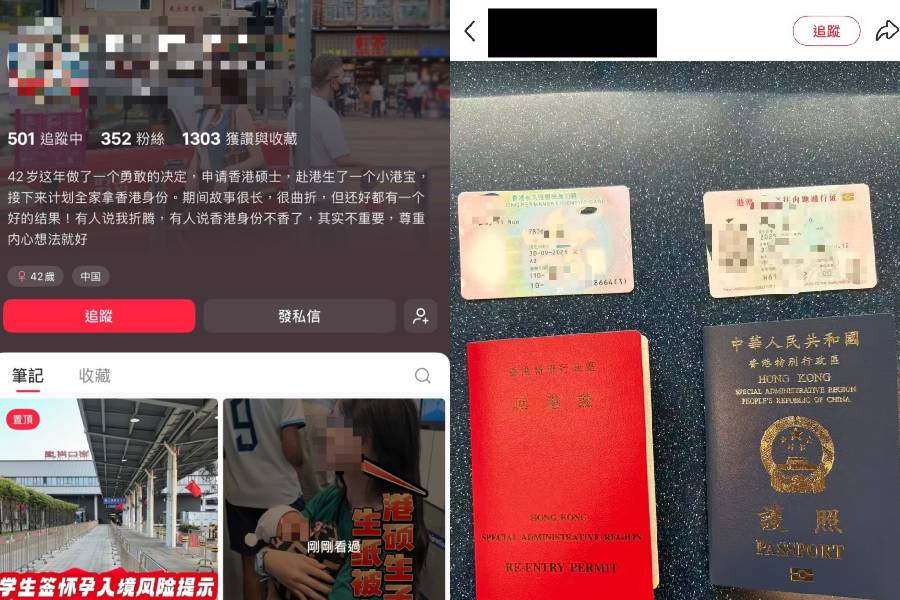
In recent years, mainland social media platforms, particularly Xiaohongshu, have seen a surge in "guides" on how to give birth in Hong Kong.
Among the various talent and study schemes available, applying for a Master's degree in Hong Kong is increasingly viewed as the most cost-effective method for acquiring permanent residency.
One prominent post details the experience of a 42-year-old mainland woman, already a mother of two, who successfully used this route. She claimed that compared to other talent programs, a Master's degree only costs around 350,000 yuan, which covers both tuition and living expenses.
Furthermore, graduates are eligible for a two-year "Immigration Arrangements for Non-local Graduates" (IANG) visa, a benefit she described as highly attractive.
"Bargain" births and public hospital strain
The woman revealed that she discovered her pregnancy before applying for the degree and was highly motivated by the fact that any child born while she was a student would immediately receive Hong Kong permanent residency.
She contacted an agency and managed to enter Hong Kong at 34 weeks pregnant, despite her pregnancy being visibly obvious.
She successfully gave birth via a Cesarean section at a public hospital in Hong Kong, paying only HK$550 for a five-day, four-night stay. Immediately after obtaining the child's birth certificate and Return Home Permit, she returned to the mainland.
The mother has since published multiple guides on Xiaohongshu detailing her experience, including tips on managing the risks of crossing the border while pregnant on a student visa.
Legal repercussions and immigration fraud
The trend has raised serious legal concerns. Barrister Albert Luk Wai-hung explained to the media that the legality of these cases hinges entirely on the individual's "true intention" for entering Hong Kong.
If a person's primary goal is to give birth and they use studying as a mere pretext to deceive the Immigration Department, they could be charged with making a false representation.
Under Hong Kong law, this offense carries a maximum penalty of 14 years in prison.
Luk clarified that if a person's genuine intention is to study, and they happen to become pregnant and give birth during their studies, they have not broken the law, as "the law does not forbid people from having children or getting pregnant."
However, packaging a birth-tourism trip as a legitimate educational pursuit is illegal.
Despite the potential for criminal charges against the parents, Luk noted that according to Article 24 of the Basic Law, any child born in Hong Kong is entitled to permanent residency, regardless of the legality of the parents' entry or motives.
Government response to "birth tourism" concerns
The issue has caught the attention of lawmakers. Last October, Election Committee constituency lawmaker Lee Hoey Simon submitted a written inquiry to the Labour and Welfare Bureau regarding the alleged misuse of talent admission schemes for "birth tourism."
The Bureau responded by reiterating the strict penalties for making false representations to the Immigration Department.
They assured lawmakers that a rigorous approval mechanism is in place to ensure only qualified individuals with a genuine intent to contribute to Hong Kong's development are granted residency.
At the time, the Bureau stated they had not observed any widespread phenomenon of individuals using talent schemes solely as a pretext to give birth in the city.