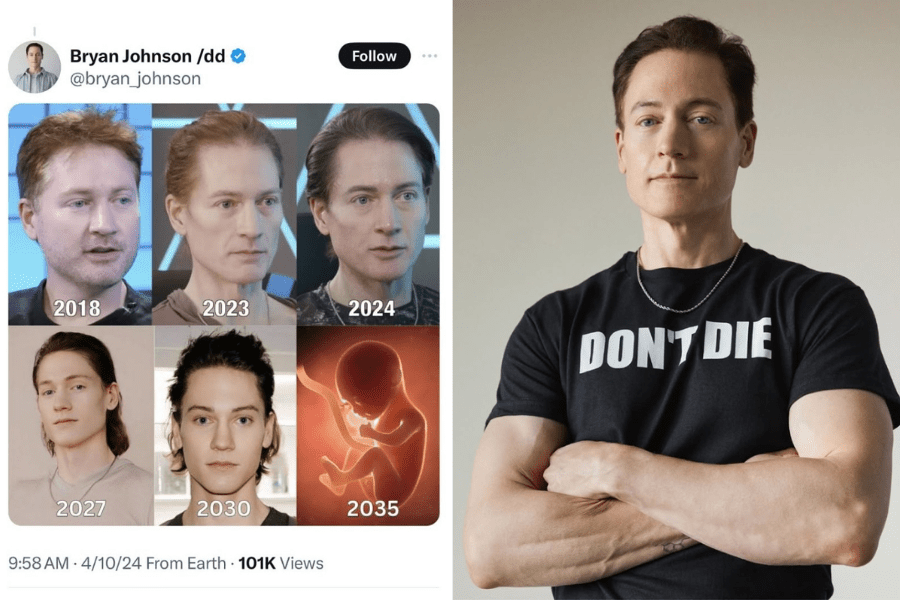
In the relentless race against time, US tech entrepreneur Bryan Johnson is pouring US$2 million (approximately HK$16 million) annually into his quest for eternal youth, utilizing unproven treatments and technologies.
The 48-year-old billionaire’s journey toward rejuvenation includes controversial procedures, coupled with a disciplined routine of rising at 5 am, fasting after 11 am, following a strict vegan diet, and taking over 100 supplements each day in an effort to turn back the clock on aging.
Despite skepticism from the medical community, Johnson has successfully branded himself as an anti-aging influencer, amassing over 4 million followers on social media.
Johnson’s method is often described as “fantastical.” He previously attempted plasma exchange therapy to rejuvenate his organs by swapping blood with his 17-year-old son but abandoned the approach due to a lack of results.
His routine also incorporates regular full-body MRIs and monitoring of dozens of biological markers, alongside experimental gene therapies.
According to his medical team, he now has the heart of a 37-year-old, skin of a 28-year-old, lung capacity of an 18-year-old, and gum inflammation of a 17-year-old, with an aging rate of just 0.69—meaning he ages only eight months for every year that passes.
Before his pursuit of immortality, Johnson was a typical Silicon Valley entrepreneur who founded the payment processing platform Braintree in 2007.
Notably, his company was recognized as one of the fastest-growing firms by Inc. magazine within four years.
He later acquired the mobile app Venmo for over $26 million and eventually sold both companies to PayPal for $800 million, becoming a billionaire by the age of 36.
Johnson’s anti-aging quest with blueprint
The billionaire later launched Blueprint in 2022, offering a range of proprietary supplements, including a US$370 "longevity mix," US$264 cold-pressed olive oil, and a US$3,100 “longevity protocol” aimed at reversing aging.
The success of Blueprint's products is largely attributed to Johnson’s active social media presence, where he shares personal health data—including intimate details—with his followers.
Through frequent discussions about the concept of “immortality,” the promotion of Blueprint's products has successfully turned his personal philosophy into a lucrative business.
The Netflix documentary “Don't Die: The Man Who Wants to Live Forever” further amplified his profile, attracting followers to buy related products, some of which have sold out due to high demand.
Additionally, Johnson has held "Don't Die Summit" events—described as a "longevity Disneyland"—featuring his speeches and product tastings, along with showcases from over twenty anti-aging companies.
At the last summit in Singapore in September, he attracted over a thousand attendees, with ticket prices ranging from US$179 to US$599.
Despite the buzz surrounding Blueprint, the company reportedly loses over $1 million monthly, and experts are questioning the effectiveness and safety of its supplement combinations.
Meanwhile, the Blueprint website states that its products are not evaluated by the FDA.
Anti-aging market—the next big investment?
Johnson's venture is just one piece of the booming anti-aging market, which has seen substantial growth as advancements in biotechnology and genetic engineering capture the attention of Silicon Valley billionaires.
For instance, Altos Labs, founded in 2022 and focused on cell rejuvenation research, has attracted funding from Amazon founder Jeff Bezos.
Meanwhile, PayPal co-founder Peter Thiel has pledged US$3.5 million to the Methuselah Foundation to support scientific research aimed at “making 90 the new 50 by 2030.”
OpenAI CEO Sam Altman is backing longevity startup Retro Biosciences, while Coinbase CEO Brian Armstrong has cofounded a genetic reprogramming startup, New Limit, which recently raised US$130 million in Series B funding.
While the timeline for humanity to conquer death remains uncertain, the global anti-aging market is projected to exceed US$270 billion by 2032, highlighting the lucrative potential of this emerging industry.
(Phoebe Poon)