
Read More
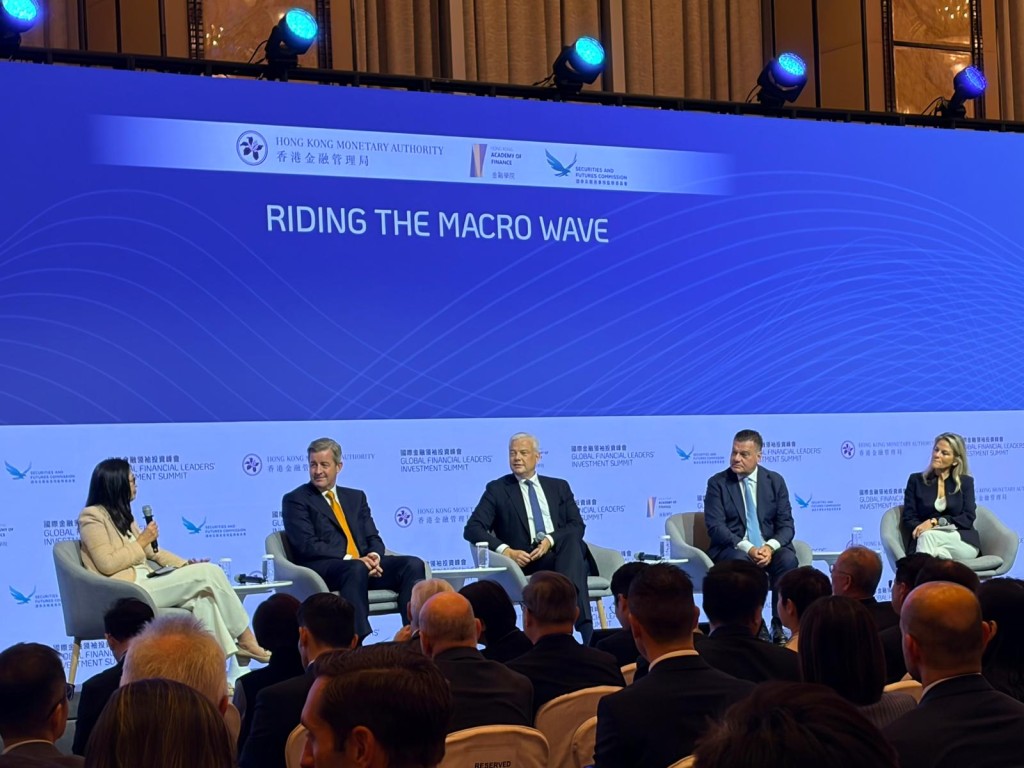
Major factors driving global stock market liquidity have subsided over the past year, said Julia Leung Fung-yee, Chief Executive of the SFC, at the “Riding the Macro Wave” forum at the 5th Global Financial Leaders' Investment Summit, citing rise in global sovereign debt, evolving artificial intelligence cybersecurity threats, and potential AI spillover effects.
ADVERTISEMENT
SCROLL TO CONTINUE WITH CONTENT
Leung pointed out that the continuous rise in global sovereign debt has raised questions about debt sustainability, seeing soaring food and oil prices worsening sociopolitical instability worldwide which can further prolong high borrowing costs, as countries lack monetary and fiscal policies.
Furthermore, Leung highlighted that despite the AI investment boom, the major PHP security vulnerability incident over the past week indicates that flaws revealed by AI could evolve into global cybersecurity threats, leading to calls for slowing down AI development.
Schroders chief executive: the need to consider whether AI investment yields returns in time
In response, Schroders chief executive Richard Oldfield explained two different global models in the field of AI, where the US is trying to take leadership in that advanced model, whereas China is the only country with a national AI strategy, which brought opportunities to investors.
Speaking on asset diversification, he suggested that one considers Chinese fixed income, which is decoupled from the others with a different consistency cycle.
While acknowledging that the market currently has differing opinions on AI, Oldfield maintains that AI has a positive impact on the economy, but reminds that it is necessary to consider whether the current investment can generate sufficient returns to satisfy investors within a specific time frame.
Robeco chief executive: China as an increasing value and stock selection opportunity
Robeco chief executive Karin van Baardwijk emphasized that Asia is a source of portfolio diversification in 2027, expecting continued international capital inflows into Asia.
“In equities, we see China increasingly as a value and stock selection opportunity, balancing high growth story and collective value,” Baardwijk asserted.
However, Baardwijk believes fixed income in China brings a different dimension, seeing differentiated monetary and inflation cycles from those in the US, Europe, and Japan, leading the market to perceive lower returns and relatively weaker performance for related Chinese products.
AllianzGI chief executive: China will become an asset class of its own
Allianz Global Investors chief executive Tobias C. Pross, a long-term bullish China investor, is confident that China will become an asset class of its own, as the country is actively catching up in AI transformation, open-source models, human-machine collaboration technologies, and manufacturing.
"China will become, as it has two years ago, will become, mark my words, asset class for technological leaders," he asserted.
He added that he has seen a significant flow of investment and funds into Asia and China, making China an important part of overall asset allocation and composition.
Lazard Asset Management chief executive: Chinese tech companies provide opportunities
Lazard Asset Management chief executive Chris Hogbin stated that current market asset allocation still largely favours the US, and asset diversification will take long to achieve, meanwhile, Chinese companies in technology, robotics, healthcare, and biotechnology are providing investors with numerous opportunities.
While Hogbin expressed great anticipation for AI, he emphasized the need for cautious deployment in this sector, as technological advancements are unpredictable. AI capital expenditures reach trillions of US dollars annually, and "demand for compute is far outstripping supply," Hogbin said.
However, the development of AI still faces uncertainties, including how to structure its revenue and business models, making it "really hard to find the anti-AI trade."