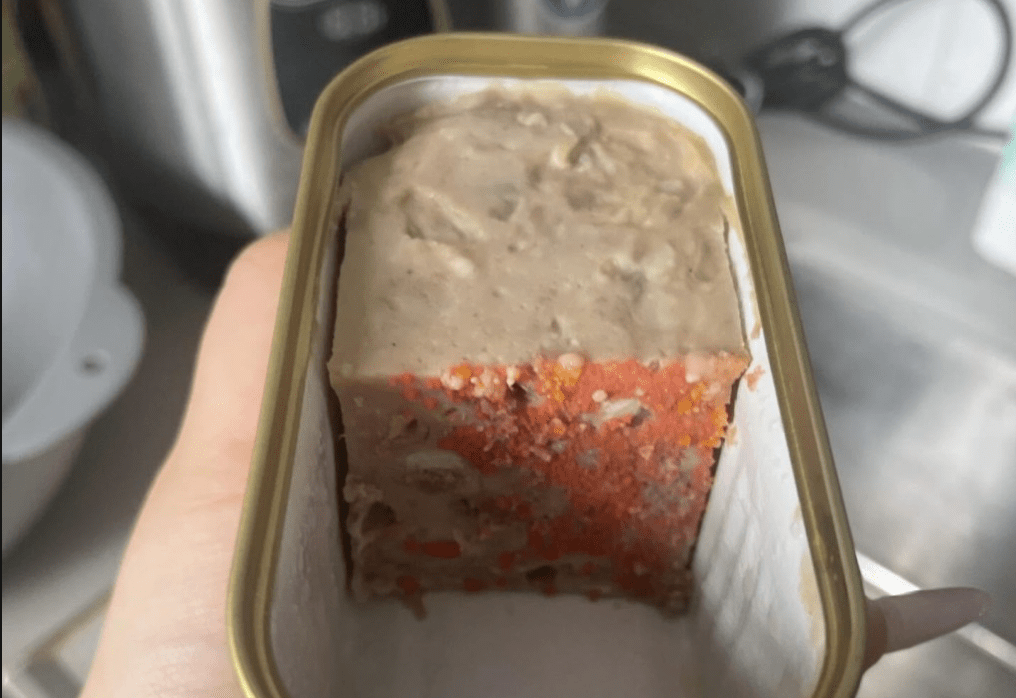
Canned food has always been a pantry staple in Hong Kong households. Whether it's luncheon meat, sardines in tomato sauce, or corn kernels, they are extremely popular. Many people mistakenly believe that once canned food is placed in the refrigerator, it won't spoil, leading to food safety risks. Recently, a netizen posted on Threads that they had leftover luncheon meat stored on a lower shelf of the refrigerator for "a month or two." When they took it out, the surface of the luncheon meat was covered in a large number of pink, granular bacteria resembling mentaiko (pollock roe), exclaiming, "I've never seen this color before." The image was extremely shocking.
The photo immediately sparked heated discussion among netizens, who were horrified. Some speculated that it was highly likely Serratia marcescens. This bacterium easily grows in humid environments and produces a red pigment called prodigiosin. Family doctor Dr. Lam Wing-wo stated in an interview with Sing Tao Headline that putting uneaten luncheon meat directly back into the refrigerator in its original can is a practice that does not comply with food safety standards and poses health risks. Based on appearance, this storage method can cause the food to secrete Serratia marcescens. This bacterium makes the food surface appear red or pink with coarse particles. However, specific confirmation would require bacterial culture.
In fact, this bacterium is widely found in humid environments such as bathrooms, kitchens, or hospitals. Placing opened luncheon meat directly into the refrigerator can also allow such bacteria to grow. During the process of opening the can, the food may have already been contaminated by the environment, introducing bacteria into the luncheon meat, which then rapidly multiply over time. Additionally, citizens should regularly clean the inside of their refrigerators to maintain food hygiene.
Lam added that while this bacterium generally does not cause severe illness, if it enters the human body, it can still cause gastrointestinal discomfort or urinary tract infections. Therefore, he advises that when storing food, after opening, it must be properly transferred to a clean, sealed container before refrigerating. On the other hand, toxicology expert Tan Dun-ci emphasized on the Taiwanese program 57 Health Club that once a canned food is opened, it completely loses its "sterile" property. If stored improperly, it is essentially ingesting bacteria and can lead to food poisoning at any time.
4 Key Points for Proper Storage of Opened Canned Food
Many citizens mistakenly believe that canned foods contain a lot of preservatives. In fact, canned food relies on thorough high-temperature sterilization during production and vacuum sealing to extend its shelf life. Therefore, once the can is opened and exposed to air, the food is immediately at risk of bacterial contamination.
Key Point 1: Must Transfer to Airtight Container
Never simply put the lid back on the opened can and shove it into the refrigerator. Most cans are made of iron. Although the inner layer has an anti-rust coating, once opened, the iron edge is exposed. Combined with the humidity inside the refrigerator, it easily rusts and contaminates the food. The correct practice is to pour the leftover food into a glass airtight container or a sealed bag. When transferring, only scoop out the solid food, discarding excess liquid or oil, as these generally have very high salt, sugar, or fat content.
Key Point 2: Shelf Life After Opening is Only 3-5 Days
The 1-2 year shelf life printed on the package applies only to the "unopened" state. Once opened, the shelf life shortens to 3-5 days. Especially for beans or other high-moisture foods, consume them as soon as possible. If the refrigerator stores multiple opened food items, it's a good idea to label each container with the opening date to avoid accidentally eating expired, spoiled food.
Key Point 3: Only Take What You Need, Avoid Cross-Contamination
If you plan to consume the canned food over multiple meals, each time you must use a completely clean, dry pair of chopsticks or a spoon to take out the desired portion. Immediately seal and return the rest to the refrigerator. Do not be lazy and use chopsticks that have been in your mouth, as the bacteria from saliva will remain inside the container, accelerating spoilage.
Key Point 4: Minimize Time Food Spends Coming to Room Temperature
When taking food out of the refrigerator, follow the principle of "take only what you will eat." The longer food sits at room temperature, the more the rising ambient temperature encourages bacteria to rapidly multiply. Paying attention to these everyday food hygiene details is the only way to truly eat with peace of mind.
Sources: Threads, YouTube @57 Health Club