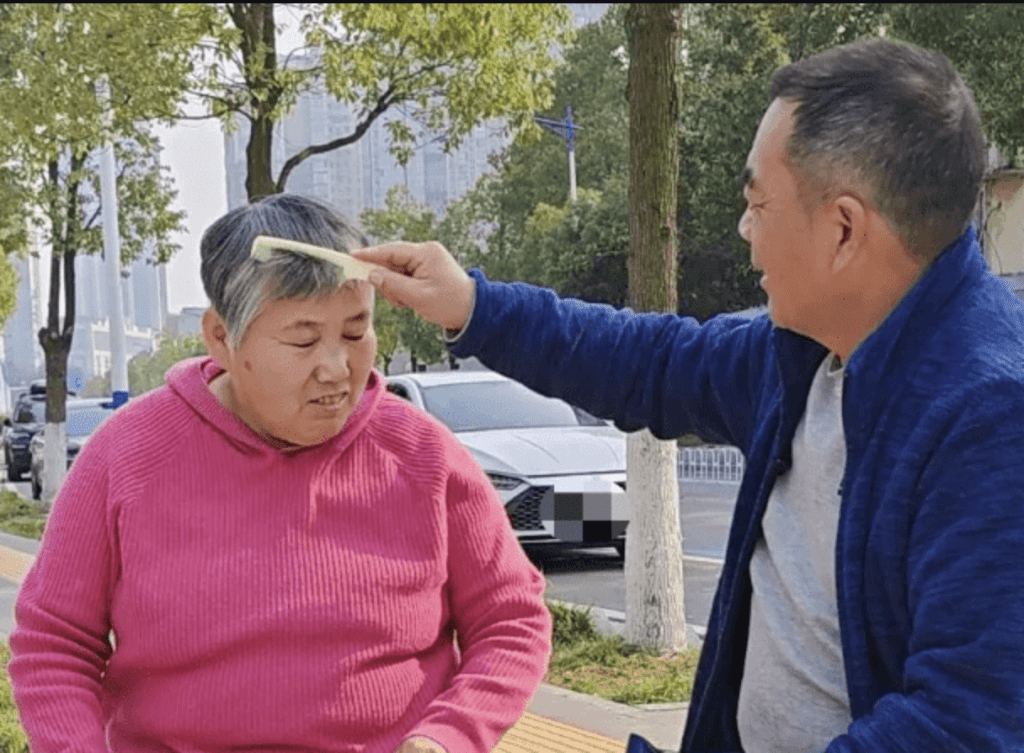
A 60-year-old ride-hailing driver in mainland China has dedicated himself to caring for his wife after she was diagnosed with dementia. His wife has lost the ability to care for herself and is gradually forgetting even her closest family. Refusing to send her to a nursing home so he could provide round-the-clock care, he resolutely transformed the passenger seat of his car into his "wife's special seat" and brought her along while he worked. For ten years, he has remained devoted, stating, "She walked half my life with me. Now it's my turn to take care of her."
According to comprehensive mainland media reports, 60-year-old Master Huang is a ride-hailing driver in Changsha. His wife, Zhou Chun-yan, always sits in his passenger seat, dressed in a pink sweater with bright eyes. When a reporter got into the car, she sat quietly looking out the window without turning around. Master Huang pointed to a note inside the car that read: "Dear passenger, hello! My wife has Alzheimer's disease and cannot care for herself. No one is at home to look after her, so she has to come along with me and take a seat. Thank you for your understanding! Wishing you safe travels and good health!" He lowered his voice and said, "She can't be left alone. I have to bring her." Music played in the car, one song after another. When "Where Is Spring?" came on, Zhou quietly began to hum along. Though off-key, her hands tapped to the rhythm in time with the music. Master Huang turned to glance at his wife and said gently, "She's always been someone who loves joy." But such joyful moments are rare. More often, Zhou just sits quietly, her vacant gaze fixed somewhere unknown.
Master Huang and his wife met when they were young. They fell in love and married at the age of 19, sharing over 40 years of life's ups and downs together. Twenty years ago, they moved from their hometown to Changsha to build a future. Starting as bricklayers in the construction industry, they built a small, warm home for themselves with their own hardworking hands. According to Master Huang, his wife began frequently forgetting things in 2016. Going out to buy groceries would take half the day; she would ask the same question again right after it was answered. At first, he didn't think much of it, assuming it was just age-related memory decline. Later, her condition worsened significantly. On one occasion, after he briefly stepped out, he returned home to find the house in complete disarray. Zhou rushed toward him, trying to hug him, but accidentally tumbled down the stairs, covered in bruises. In tears, she looked like a child who had done something wrong but didn't know what it was. Eventually, a hospital diagnosis confirmed she had Alzheimer's disease. As her condition gradually advanced, she went from forgetting daily small matters to being unable to recognize loved ones, eventually requiring full-time, hands-on care for basic needs like eating and dressing.
Unwavering Commitment Through Hardship: "She Walked Half My Life with Me – Now It's My Turn"
Later, Master Huang's business failed, and he switched to driving for a ride-hailing platform. With his wife requiring constant care, some suggested he place her in a nursing home. But Master Huang never wavered in his determination to care for her himself. "Caring for her myself is safest. No matter how good outside care might be, it can never compare to family. She is my life partner, the mother of my children. This is my responsibility, and more than that, it's my deepest feeling for her." So, he began bringing her along while he worked, letting her sit in the passenger seat. This has been their routine for over a year. At first, he worried passengers might mind or complain, so he posted the note. He admitted, "When I put up the note, I didn't know how people would react." But after more than a year, he found passengers to be very understanding. After learning about his situation, they were willing to squeeze into the back seat. Master Huang said gratefully, "Last year, the Beijing Red Cross gave me 8,000 RMB in aid. The platform assigns me consecutive orders – before one ends, another arrives. They've been very accommodating." Most passengers, upon seeing the sign, nod silently to show their understanding. Some even offer kindness: handing him hot water, leaving snacks, or sending a tip after the ride with a message like, "Driver, life is tough for everyone. This is a small gesture. Please take good care of your wife." These small acts of kindness have become a source of light that keeps Master Huang going.
His days run like clockwork. He starts driving around 5 AM, while his wife is still asleep – he can't bear to wake her. He drives until around 9 AM, then returns home to feed her, help her wash up, and tidy the house. After noon, he heads out again, this time with her in the car. Sometimes, he drives far and doesn't finish work until 11 PM. A full day's work earns him a little over 200 yuan. During breaks at traffic lights, Master Huang often glances toward his wife in the passenger seat. He reaches his hand over but doesn't touch; pulls it back, then reaches again, gently touching her hand as if to confirm something. Master Huang says, "She likes going out, looking at the flowers and trees along the road, and chatting with passengers. When kind passengers chat with her, she'll smile." He admits that caring for someone gradually forgetting the world is harder than caring for a baby.
On March 12, Alibaba Public Welfare's "Daily Positive Energy" initiative, in collaboration with Xiaoxiang Morning News · Morning Video, awarded Master Huang a "Daily Positive Energy Special Award" to encourage him. Surprised by the award, Master Huang said he would use the over 10,000 RMB award money entirely on his wife: "To buy her favorite foods and take her to see more of Changsha's scenery." In his view, caring for his sick wife is simply his duty: "She walked half my life with me. Now it's my turn to take care of her."
Dementia: Early, Middle, and Late Stage Symptoms
According to the Hong Kong Hospital Authority, dementia (also known as neurodegenerative disease) is caused by the deterioration of brain nerve cells, leading to the decline of brain function. Patients' memory, comprehension, language, learning, calculation, and judgment abilities are affected. Some may also experience changes in mood, behavior, and perception.
Early Stage (Years 1-2): At this stage, family and friends often mistake symptoms for normal aging. Symptoms include:
- Loss of short-term memory
- Difficulty expressing or understanding abstract concepts (e.g., expressing physical discomfort or feelings)
- Unpredictable mood swings or behavioral changes
- Difficulty learning new things or following complex instructions
- Reduced judgment. Basic self-care activities are manageable but may require reminders.
Middle Stage (Years 2-5): As the condition progresses, early difficulties become more pronounced. Symptoms include:
- Confusion between long-term memories and current reality; occasional trouble finding the right words
- Personality and behavioral changes; prone to emotional instability
- Need for assistance with daily self-care activities.
Late Stage (After Year 5): The patient becomes almost entirely dependent on others and unable to care for themselves. Symptoms include:
- Severe memory loss, even forgetting familiar people and things
- Decline in physical activity and mental state
- Inability to express themselves or communicate effectively
- Inability to manage daily life, requiring long-term care
- Disrupted circadian rhythms (sleep-wake cycle)
Source: Hospital Authority (Hong Kong)
𝗗𝗼𝘄𝗻𝗹𝗼𝗮𝗱 𝗧𝗵𝗲 𝗦𝘁𝗮𝗻𝗱𝗮𝗿𝗱 𝗔𝗽𝗽 ↓