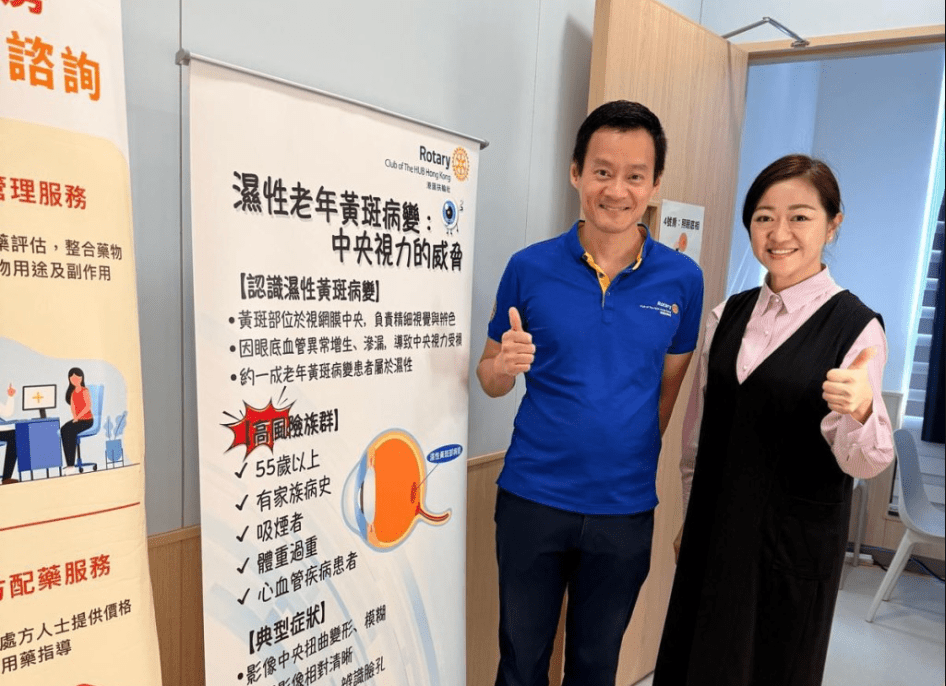
As Hong Kong's population ages rapidly, common eye conditions among the elderly, such as glaucoma and cataracts, are drawing increasing social attention. To enhance community health awareness and practice the principle of "prevention is better than cure," the Rotary Club of Hong Kong Harbour launched an innovative elderly eye care program late last year. Combining portable AI-powered fundus cameras with professional ophthalmology collaborations, the program provided immediate screening services for over 100 elderly individuals and diabetic patients, with plans to expand the service to more communities.
The program collaborated with the Department of Ophthalmology and Visual Sciences at The Chinese University of Hong Kong (CUHK), St. James' Settlement, and other organizations, utilizing AI fundus cameras and OCT scanning machines to conduct on-site screenings for 104 elderly individuals aged 60 or above or those with diabetes. In contrast to traditional eye exams that rely on ophthalmologists to analyze images one by one, the AI system can automatically analyze fundus images within 20 minutes, instantly identifying and assessing potential risks such as glaucoma and macular degeneration, thereby significantly enhancing screening efficiency and convenience.
Results from the program showed that among the 104 participants, the AI system identified 23 individuals at very high risk, who were immediately referred to ophthalmology specialists for further follow-up. Dr. Jason Chan Leung-kwai, President of the Rotary Club of Hong Kong Harbour and a cardiology specialist, stated: "Many elderly people have insufficient awareness of eye diseases and often seek medical help only when the condition is advanced. We hope to use technology to lower the threshold for screening, bringing health services out of hospitals and into the community."
Chan expressed special gratitude to Professor Carol Cheung Yim-lui of the Department of Ophthalmology and Visual Sciences at CUHK for her contributions and support for this program. He explained that the ophthalmology team, the staff assisting with screenings, and the screening equipment used all came from CUHK. St. James' Settlement assisted with promotion and invited suitable citizens to participate, benefiting more people. Members of the Rotary Club of Hong Kong Harbour not only helped with operational flow but also learned about participants' physical and eye conditions before screening, recording specific medical histories to facilitate subsequent screening work.
The program is still ongoing, with recent activities including a public eye health talk inviting screening participants and other members of the public. Chan also noted that the Rotary Club of Hong Kong Harbour will establish a case follow-up mechanism and plans to expand to other communities, aiming to provide screening services to more elderly individuals and diabetic patients in need by next year.
Cross-Sector Collaboration Promotes Scientific Philanthropy
Chan joined the Rotary Club of Hong Kong Harbour in 2017 and served as President for the 2025-2026 term. As a cardiology specialist, he firmly believes in the importance of "holistic health," emphasizing that the eyes are a window to quality of life, and early intervention can significantly reduce the risk of blindness. When asked why he chose ophthalmology rather than cardiology for community service, Chan explained: "While heart health is certainly important, community service needs to respond to the most urgent, hidden needs. The prevalence of eye diseases among Hong Kong's elderly is high, yet often overlooked due to a lack of obvious symptoms, leading to irreversible vision damage."
From Treatment to Prevention: An Extension of Medical Mission
Regarding his dual roles as a doctor and club president, Chan describes them as complementary journeys. He believes community service allows him to see the "social context beyond the disease," such as the technological gap and loneliness experienced by the elderly. These perspectives have, in turn, enriched his empathy as a physician. On his charitable path, Chan expresses special gratitude to his wife, Queenie Chu, for her support in the field of mind-body-spirit wellness.
The mindfulness experience event (forest therapy) held by the Rotary Club of Hong Kong Harbour in January 2026 at Tsz Shan Monastery, and the upcoming "Daydreaming Day" meditation event in April, both originated from his wife's suggestions. Chan believes that health encompasses not only the physical aspect but also overall mental and spiritual balance, and that charity is a natural extension of one's life values.
Chan hopes that the Rotary Club will continue to serve as an "advocate" and "innovator" for community health, integrating medical warmth into the social fabric. From the operating room to the community, from doctor to father, he consistently believes: "Whether introducing a new technology or screening the elderly for eye diseases, it's all about practicing the same belief—the power of expertise must ultimately be transformed into actions that protect lives."