Read More





HK movie producer Raymond Wong Pak-ming convicted of insider dealing
22-05-2026 17:10 HKT
Swire Properties wins compulsory auction for $2.02b Quarry Bay property
22-05-2026 20:36 HKT
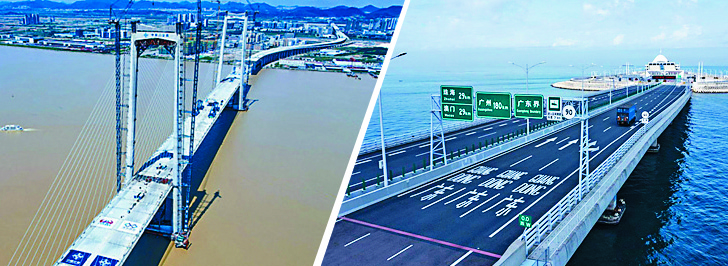
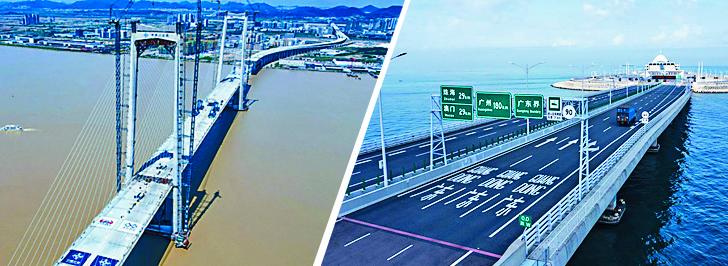
The ambitious Shenzhong Link connecting Shenzhen and Zhongshan across the Pearl River estuary reached a major milestone yesterday with the final section of the immersed tunnel firmly set in place to make the structure one of the world's largest of its kind.
The sea crossing spans a total of 24 kilometers and consists of two artificial islands, two suspension bridges, an underground interchange and the immersed tunnel.
When the entire link is opened to traffic next year, the corridor is expected to reduce the travel time between Shenzhen and Zhongshan from two hours to 20 minutes. Before that time, motorists have to travel 30km to the north to cross the river via the bottleneck of Humen Bridge.
Big as the project sounds, it is not as huge as the Hong Kong-Zhuhai-Macau Bridge 38km to the south.
Although both sea crossings have similar features - including artificial islands, suspension bridges and immersed tunnels - the bridge linking us to Macau and Zhuhai is much bigger both in size and building cost.
The question is: is being big always beautiful?
It would be ironic if the latecomer becomes fitter than its bigger peer.
Like some of our other local high-profile projects, including the expensive cruise terminal at Kai Tak, the Hong Kong-Zhuhai-Macau Bridge has become a multi-billion-dollar white elephant as it is badly under utilized.
When the Y-shape mega bridge was conceived, it was projected to shorten the distance to tap Hong Kong's cargo-handling capacity in order to radiate the manufacturing base then concentrated around the estuary to the western coastal regions.
It was more ambitious than the Shenzhong Link.
To meet the projected ambition, some local industrialists, including Gordon Wu Ying-sheung, proposed including a railway on the bridge.
That, however, failed to win backing from the governments concerned, probably due to budget constraints.
Since its opening in 2018, the mega bridge has been struggling for traffic. Prior to the pandemic, it logged just hundreds of trips per day.
Starting next month, Hong Kong motorists can apply to travel north and this will likely increase traffic on the bridge. However, this will be of limited effect unless there is an increase in persistent traffic demand for the crossing.
Such a conceived demand has not yet materialized.
Contrary to its sister bridge in the south, the Shenzhong Link starts from the Shenzhen airport to provide a corridor to Nansha, Qianhai, Cuiheng and Hengqin regions.
After its opening in 2024, motorists will be able to drive straight from Shenzhen to Zhongshan without having to travel in a big circle via the Humen Bridge that has become a chronic bottleneck.
A demand for the Shenzhong crossing has existed in the market and it is anticipated that it can also improve traffic along the circular route.
Making reliable forecasts is vital to the success of any expensive project. Conversely, bloating the demand can easily turn a major infrastructure into a white elephant.
Worse still, maintenance requires major regular expenditure.
So, is being big always beautiful? It could be obese.