Read More





Beyond the boardroom: showcasing Hong Kong’s unique charm to the world
21-10-2026 05:30 HKT

Office lottery dispute leads to High Court lawsuit over $33m prize
26-10-2026 17:24 HKT


Taiwan’s opposition parties Kuomintang and the Taiwan People’s Party have found themselves caught in a delicate balance between China and the United States before the much-anticipated summit between President Xi Jinping and his counterpart Donald Trump on May 14-15.
After months of stalling, Taiwan’s two parties on May 8 finally approved a “pared-down” version of the ruling Democratic Progressive Party proposal of a US$40 billion (HK$312 billion) special defense spending bill, cutting it down significantly to US$25 billion exclusively for US government-to-government arms sales.
The US State Department welcomed the passage of the budget, seeing it as a move to strengthen Taiwan’s deterrence, but stated that further delays in funding would be a “concession to the Chinese Communist Party.”
China’s Taiwan Affairs Office has previously criticized the DPP for willingly “acting as a cash cow for the US military-industrial complex” and “begging for unreliable protection from external forces,” warning that it would “plunge Taiwan into a more dangerous situation and bring profound disaster to the people of Taiwan”.
The approval of the bill has also exposed the internal rift between the more pro-Beijing faction and the pro-US faction within the KMT, which may also impact the upcoming presidential election in 2028.
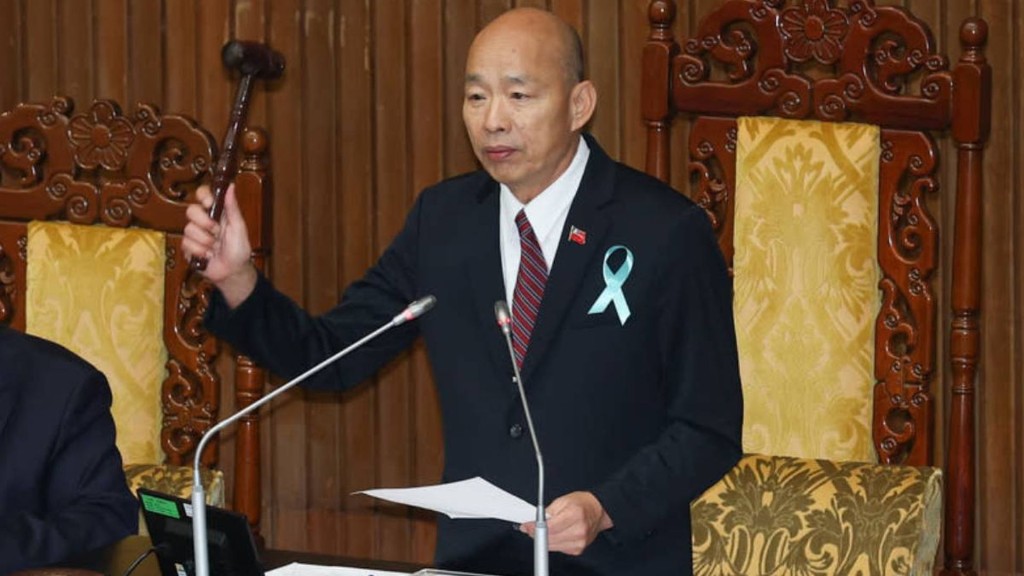
While party leaders such as Legislative Yuan president Han Kuo-yu and Taichung mayor Lu Shiow-yen, a leading potential presidential candidate, pushed for the larger US$25 billion compromise to align with US demands, KMT chairwoman Cheng Li-wun preferred a much smaller US$12 billion version.
Cheng has recently concluded her landmark visit to the mainland on April 7 to 12, during which she met Xi and echoed his call against the island being a “chessboard for external interference.”
But the party establishment led by Han has maintained its longstanding “pro-US, friendly to Japan and reconciliatory with China” strategy, satisfying Washington’s security expectations ahead of the critical Xi-Trump summit.
Trump has reportedly stalled a US$13-14 billion arms package that had already received informal bipartisan approval from Congress in January, which includes Patriot air-defense missiles and other medium-range munitions.
Media have interpreted Trump’s move as being done to avoid jeopardizing his China trip, as Xi specifically urged Trump to handle Taiwan arms sales with “extreme caution” and prudence.” Some media also suggested Trump might use the arms sales as a bargaining chip for trade concessions.
The KMT approval of the special defense spending bill could buy goodwill with Trump, signaling the island’s commitment to meet US security expectations and convincing the US security apparatus to push for the approval of the arms sales in Washington.
It will, however, upset Beijing, which sees the Taiwan question as a red line issue and aimed at undercutting the military exchanges between the island and the US.
Nevertheless, Trump’s transactional approach on foreign policy suggests that a bargain over Taiwan remains possible, with Trump appearing to be in a weaker position going to Beijing, with the US military being entangled in a conflict with Iran, in which China has emerged as a key broker between Washington and Tehran.
Besides Iran, Trump’s long wishlist of China buying US soybeans, energy, Boeing aircraft and semiconductors and granting market access for US companies could potentially strengthen Beijing’s hand in the Taiwan bargain.