Read More

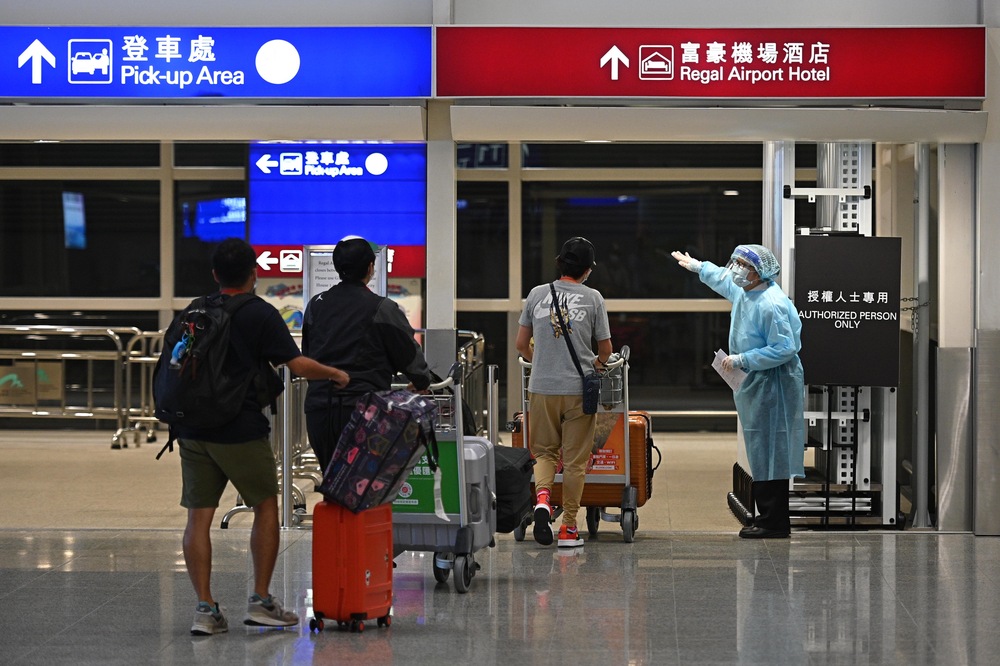
A frustrated returnee has questioned why Hong Kong is still forcing international arrivals with 14-day hotel quarantine when most Covid patients and close contacts are now allowed to go free after seven days of home isolation.
However, in a reply to The Standard, the Food and Health Bureau said it is necessary to keep the city safe against imported cases, adding: "Shorter hotel quarantine or home quarantine are, as of now, not an option for these inbound travelers."
The British expat, in her early 40s, who identifies herself as Jean, is undergoing quarantine at a hotel on Hong Kong Island for HK$1,000 a day after going to the UK in early December for a Christmas family visit.
Jean, a 10-year Hong Kong resident, had originally planned to return to the SAR in early January, but stayed in the UK after Hong Kong banned flights on January 5 from nine countries, including the UK, to keep the fast-spreading Omicron Covid variant out.
"At the time this was understandable as the nature of this variant was still relatively unknown," she said.
But she added: "As I found out by contracting Omicron at Christmas, for me, having been triple vaccinated, it turned out to be no more than a common cold."
Eventually the Omicron variant hit Hong Kong and triggered mass outbreaks with five-digit infections and hundreds of fatalities reported every day.
While people who have been in the nine countries for the past 14 days are also banned from flying to the SAR, Jean stayed in Austria between February 20 and March 6 before boarding a plane to Hong Kong via Dubai and landing at Chek Lap Kok on Monday.
"So, to enter Austria, a simple showing of your vaccine certificate and wearing of masks are all you need to do. Taking a PCR test is not even required here now," she said, adding Austria is seeing 30,000 infections a day.
Having paid HK$28,000 on hotel expenses to return to Hong Kong, including HK$14,000 for accommodation in Austria, Jean questioned the SAR's border policies and demanded authorities allow overseas returnees, if vaccinated and with negative PCR test results, to observe home quarantine, or at least shorten hotel isolation to seven days.
"Perhaps the Hong Kong government is so overwhelmed with the current situation it has forgotten to consider its people who are stuck overseas and wanting to return?" she asked.
"Why, when close contacts of the people who have contracted the virus are now being asked to self-isolate at home for seven days instead of 14?"
Authorities last month announced that at-home Covid patients who are jabbed twice and tested negative in rapid tests on the sixth and seventh days after infection can also go free.
"For all the expats and local people who are in one of the countries currently in the grip of flight bans this quarantine situation is becoming ever more ridiculous," she said.
"Many of my friends here with families have had enough and are leaving, mostly for good."
Jean's frustration echoed expats' complaints in online forums, with many saying they are moving to countries adopting the "live with virus" approach, like Singapore.
However, the bureau said it will stick to existing stringent border control measures.
"Imported cases, as well as local cases who get infected by imported cases, would put further pressure on our medical system, thin out our limited treatment resources, and possibly deprive local patients of their chance to get proper medical care," it wrote in a reply to The Standard's inquiry.
It said although Hong Kong is suffering from significant outbreaks, risks from inbound travelers have not decreased.
At a press conference yesterday, Chief Executive Carrie Lam said she knows a lot of citizens and tourists wish to fly to Hong Kong but she plans to lift flight bans only after city-wide testing. She said would also press for mainland border reopening when outbreaks are contained.
Respiratory specialist Leung Chi-chiu said it is reasonable to keep current measures because inbound travelers could carry new Covid variants that could be even more infectious than Omicron and trigger a new wave of outbreaks.
"Many overseas countries are easing measures and living with the virus, which creates a more favorable environment for virus mutation and it's likely new variants will be more powerful and contagious," he said.
Infectious disease expert Wilson Lam Wai-shun from the Hong Kong Medical Association agreed the different policies between local patients and international arrivals are inconsistent.
"They may not make sense scientifically but they are two systems that were not meant to be consistent," he said.