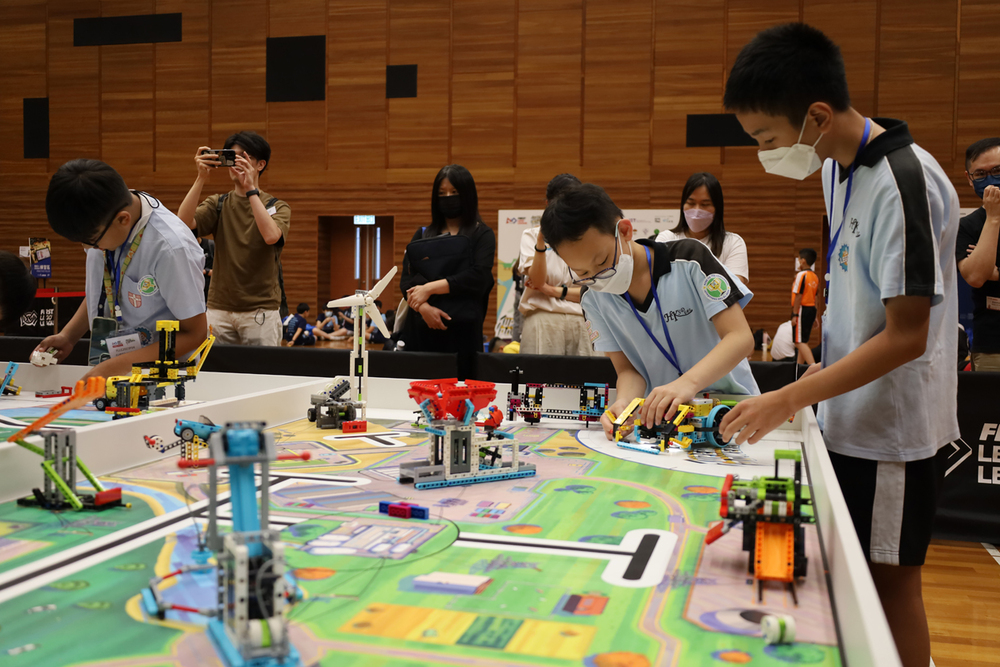
As most people know, Lego is not just a plaything for children - it can also serve as an effective tool for learning and development. The First Lego League competition, with its finals on July 21 and 22, offered an excellent opportunity for students to engage in STEAM learning while enjoying the creative world of Lego.
STEAM is science, technology, engineering, arts and mathematics.
With the support of Lego Education and hosted by Trumptech, the STEAM competition in Hong Kong drew 85 schools and 149 teams, making it the largest one since the pandemic.
This year's competition theme, Superpowered, encouraged students to concentrate on sustainable energy resources.
At the concluding competitions, a total of 22 teams from primary and secondary schools were honored with awards.
The winners were selected by the judging panel based on four criteria: robot design, innovation project, robot game and core values.
Teams had to construct a robot using the Lego parts provided and try to score points by accomplishing 15 tasks within 2 minutes.
In the finals for primary schools, a primary five team from Chun Tok School won the Robot Performance Award Champion with 285 points.
The team of four students - Heily Tse, Thomas Chan, Sunny Wong and Charlotte Chan - also won the overall 1st runner-up prize.
They said they didn't expect to win at all.
"Every team here is so talented, we couldn't believe it when we learned that we won two major prizes," said Tse.
They achieved their result through hard work.
For two months leading up to the final competition, they dedicated almost three hours every day after school to prepare for it.
"We feel like it's a rare opportunity that allows us to learn STEM and especially coding," said Tse.
"Because I know we're going to get coding classes in secondary school, I wanted to start ahead and learn some coding in the competition."
During the robotcompetition, the team completed six tasks, ranking second among all the primary school teams, with the most challenging part of the competition being to control the robot to deliver some resource packs made of Lego parts to the center of the table.
Thomas Chan said: "We needed the robot to detect a back line on the table and stop at the designated location. But because there were other black lines, the robot often made mistakes."
The problem was eventually resolved by making adjustments to the robot's sensors.
"At first we failed a lot of times, and we had to think a lot and fix the problems," said Chan. "It felt amazing when we could finally complete the tasks."
The most fun part was moving the toy dinosaur from one side of the table to the other.
To complete the task, they needed to place the Lego dinosaur on the robot, get the robot to transport it to the opposite side of the table, and carefully set the dinosaur down in the assigned spot.
"The task itself is not difficult, but it requires all of us to work together to complete it under the time limit," said Sunny Wong.
The winning teams of First Lego League 2022-23 have the chance to take part in the world competition representing Hong Kong.
The competition's success sets the stage for a strong foundation in the development of innovation and technology in Hong Kong.
disu.dang@singtaonewscorp.com