The annual release of Ivy League admission results (Ivy Day) was announced on March 26, marking a moment when thousands of students learn whether they have been accepted into America’s eight elite universities.
For many Hong Kong families targeting Ivy League admission, Ivy Day 2026 provided a clear sign that students can no longer rely solely on polished applications.
In an interview with The Standard, Jiang said many Hong Kong students were still too focused on “packaging” rather than on candidacy development, a theme explored in his new book, Classroom CEO, published this month.
Drawing on 13 years of coaching experience at Crimson Education, Jiang argues that an entrepreneurial mindset has become more relevant to Ivy League admissions and to teenagers preparing for an uncharted future.
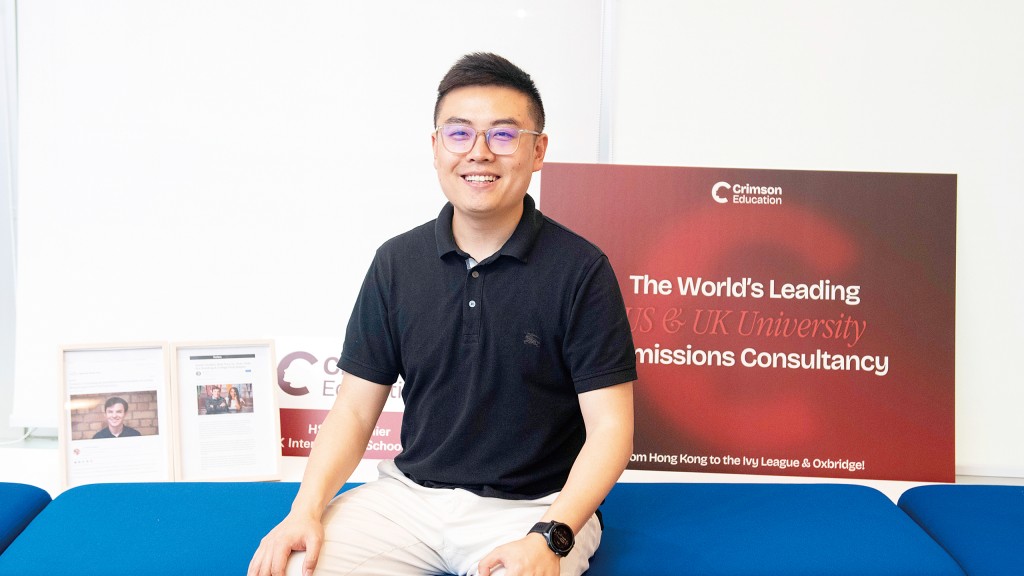
Crimson Education co-founder Fangzhou Jiang says Hong Kong families should focus less on “packaging” but more on helping children build genuine strengths over time.
Advice amid US policy uncertainty
Under the possible tightening policy towards international students, Jiang urged Hong Kong families not to overreact to possible policy changes in the US following Donald Trump’s re-election.
While acknowledging broader uncertainty, he said families should remain calm and avoid narrowing their choices too early. Hong Kong students are also recommended to apply across a wider range of destinations, including the US, the UK, Hong Kong, Singapore, Canada and Australia.
“There’s no material evidence that it’s much harder for Hong Kong students to enrol in university, or to get a visa and OPT after graduation. At the undergraduate level, this has not been really impacted,” he said, adding that students should remain flexible while preparing applications suited to different systems.
What this year’s Ivy Day means for Hong Kong families
Reviewing the latest Ivy Day, Jiang said top universities were increasingly rewarding students who exhibited a distinct area of strength as opposed to those who simply appeared broadly accomplished.
“Colleges increasingly reward students with a defined hook or depth. A few years ago, you could still get into a good school if you were a well-rounded student. I don’t think that is the case any longer,” he said.
In particular, Jiang expects students with a “T-shaped” profile that combines breadth with depth to fare better in the admissions process.
There are three trends families should watch, namely the growing importance of strong academic performance across all four years of high school, the rising number of students submitting art portfolios or research proposals, and the increasing use of video essays to assess oral communication skills.
For families preparing for the next admissions round, students should start earlier, think more strategically and focus less on polishing an image at the last minute.
“At Crimson, students begin crafting application materials from March, taking six to eight months to brainstorm and polish their narratives,” he said.
US admission trend: from “packaging” to candidacy development
Jiang said a common misunderstanding among Hong Kong families was the belief that a strong application could be assembled late in the process through careful presentation alone.
“The issue is that packaging does not fundamentally change who you are as a person, or how strong you are as a candidate,” said Jiang.
Nonetheless, he said Crimson advocates a longer-term approach focused on candidacy development to help students build genuine strengths. In Classroom CEO, mindset, execution and outreach are identified as the three pillars of an entrepreneurial mindset.
“Mindset is about being able to challenge norms or write your own rules. Execution is about pursuing excellence relentlessly, managing your time well and being consistent while avoiding burnout. Outreach is about leveraging what is around you and telling a good story with depth.”
For him, these qualities are useful not just for entry to top universities, but for helping students prepare for a competitive and uncertain world. And he said: “I see Crimson’s mission as getting students into a top university and helping today’s teenagers get ready for the future.”
How to cultivate an entrepreneurial mindset
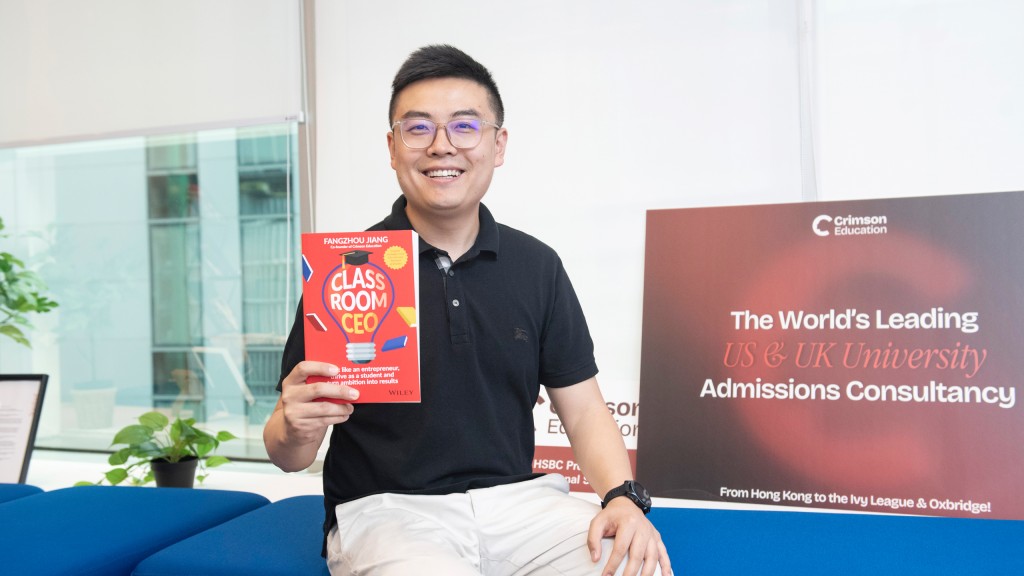
Jiang’s new book, Classroom CEO, was published by Wiley on April 1. In the book, he argues that an entrepreneurial mindset is as crucial as academic credentials for students dreaming of admission to elite universities.
“Think like an entrepreneur, thrive as a student, and turn ambition into results,” the book offers a framework for students to create their own path to success. Adaptability, creativity, leadership and resilience are the core insights the book conveys, while also sharing practical strategies on anxiety management.
Driven by a passion for education, Jiang wrote the manuscript over intensive 12 hours days, every weekend from January to March.
“I want students to learn not just through abstract theory, but also from my own experiences at Stanford and Harvard,” he added. “That’s why I decided to write the book.”
Jiang’s new book, Classroom CEO, draws on his experience advising students aiming for elite universities.
From immigrant student to co-founder
Jiang’s own journey helps explain why he sees education as having had a lasting effect on his life.
He emigrated with his family to Auckland from a small city in Shaanxi province in northwestern China at the age of 15, arriving with little English and no local connections. His parents sold their home to fund his final three years of high school in New Zealand.
He later realised he would need to finance his own university studies. He went on to become dux of Rangitoto College, won a full scholarship to the Australian National University and later secured fellowships to pursue joint degrees at Harvard’s Kennedy School and Stanford Graduate School of Business.
He then faced a dilemma: whether to accept a job offer from a top investment bank or build a company with classmate Jamie Beaton, now chief executive and co-founder of Crimson Education.
“I got a job offer from a top investment bank, but at the same time Crimson had grown rapidly, with more families seeking professional admissions consultancy for their teenagers,” he recalled.
Crimson Education has since grown into a global admissions consultancy valued at US$1bn, with offices in more than 20 countries and backing from investors including Tiger Global and Icehouse Ventures.
But as with most aspiring entrepreneurs, expanding across markets has not been straightforward for Jiang. “Localisation is one of the biggest challenges as every market has its own idiosyncrasies,” he said.
He added that the work remained deeply meaningful because education had changed the course of his own life.
“Education has been transformative, as I was born and bred in a very small town in northwestern China. Getting to do something impactful in education has been very fulfilling.”