After a long and arduous journey which saw 64 school teams fighting for the top spot in the Grand Final of the English debating section, Diocesan Boys’ School reclaim their seat as champions at the 41st Sing Tao Inter-School Debating Competition.
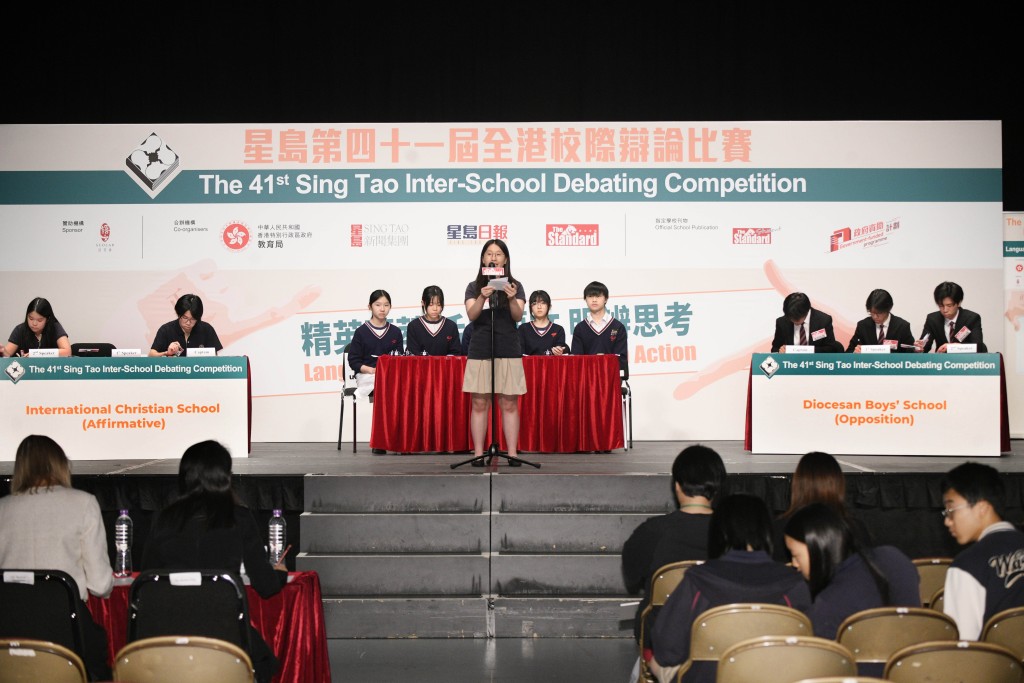
On 5 May, the final two teams of the 41st Sing Tao Inter-School Debating Competition (English section) went head to head at Queen Elizabeth Stadium.
Diocesan Boys’ School (DBS) and International Christian School (ICS) were both worthy finalists and stark representations of the competition’s ongoing efforts to foster students’ talents by helping them improve their analytical skills and enhance their awareness of socio-political affairs. Ultimately, Diocesan Boys’ School emerged as the victors this year. It was the school’s first finals appearance since getting knocked out in the semi-final round in 2025, and their second championship in three years, winning it back in 2024.
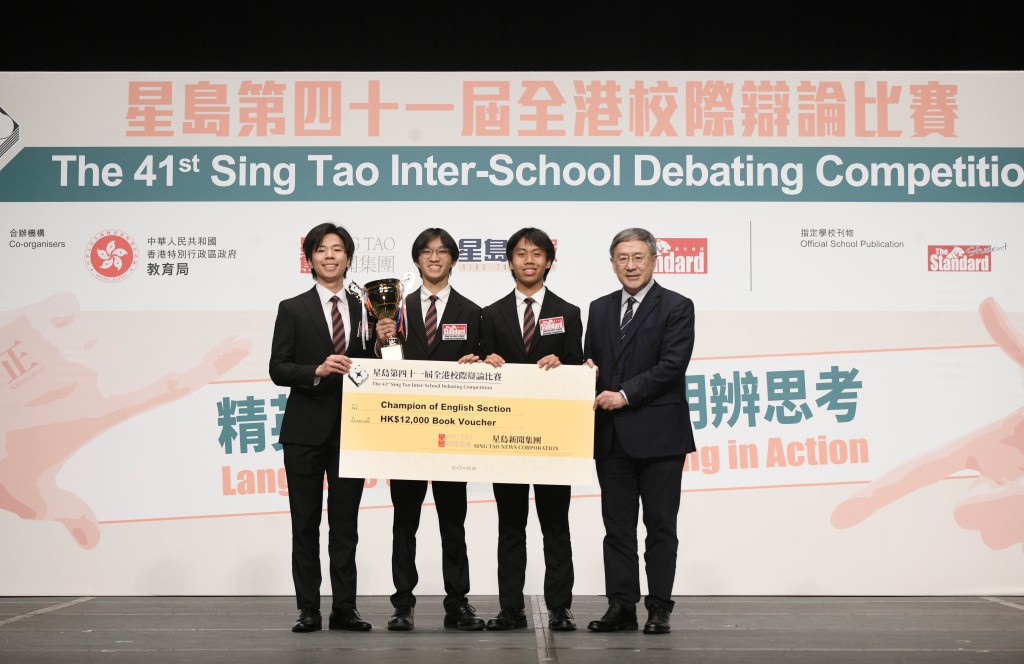
Diocesan Boys’ School is the Grand Champion of the 41st Sing Tao Inter-School Debating Competition
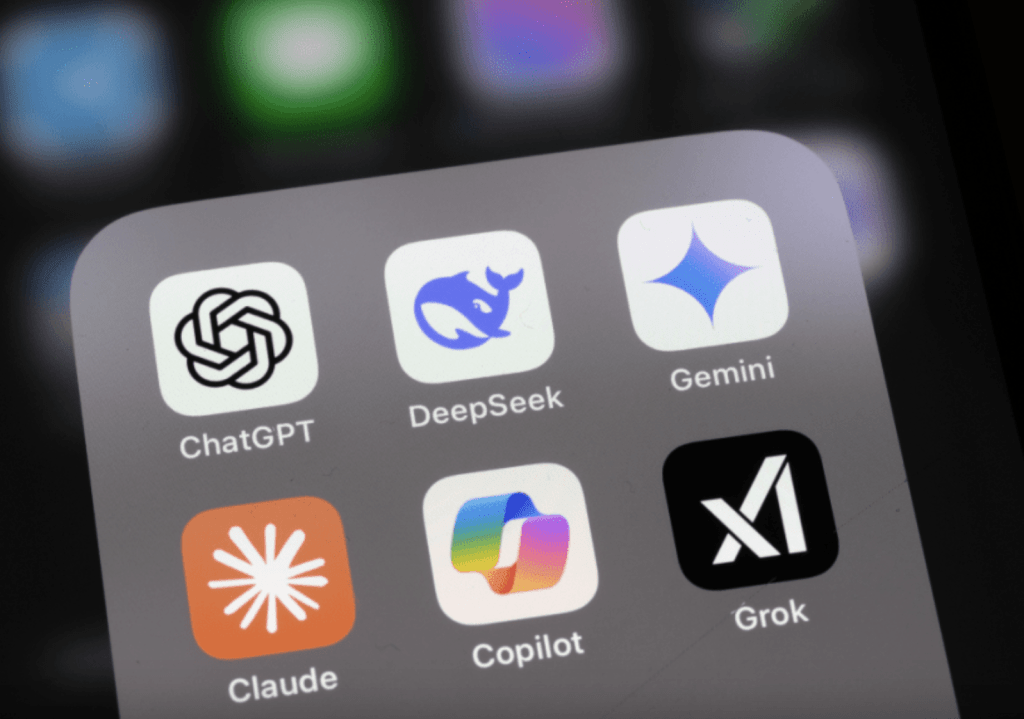
In the Grand Final debate, the motion was ‘The proliferation of Generative Artificial Intelligence undermines human creativity.’ Generative artificial intelligence (GenAI) is an artificial intelligence (AI) subfield that creates text, videos, audio, or software code by learning from patterns in data. GenAI use has recently been the centre of many contentious ethical and moral debates, as it continues to advance in the next decade.
Harbinger of doom or Tool of the future
First time finalist, International Christian School represented the affirmative side of the debate
Gabriel Choy Sze-ching, captain of International Christian School, kicked off the debate with their opening argument representing the affirmative side. “One in every nine people on our planet uses ChatGPT weekly. That’s over 900 million humans outsourcing their thinking to machines,” Choy stated.
Their argument proposed that when using GenAI becomes the default over human thinking, human creativity suffers. The team defined ‘proliferation’ as the widespread normalisation of GenAI, which then leads to increased dependency on AI and a “skyrocketing” usage rate of GenAI. They also defined ‘undermining human creativity’ as “weakening” the capacity of original ideas and solutions. Choy argued that AI undermines human creativity by “removing the creative learning process” and “weakens the creative muscle,” especially among the youth. He cited an MIT study that indicated participants who used ChatGPT in their essays showed the steepest decline in creativity, compared to those that did not.
The opposition team, however, was not convinced by their opponent’s argument. Captain Adrien Li Yu-cheng of Diocesan Boys’ School stated their team line – “Generative AI forces open the creative door, giving a spark to millions more.” Their argument centred on the idea that GenAI is a tool for human creation, not a shortcut. Li defined creativity as the “genesis of our ideas, stemming from our aggregate knowledge.” Since GenAI produces work that is “homogenous and regurgitative”, users still need the creativity to curate prompts to get desired results. Li also cited an American study that surveyed car designers who found GenAI too limited, thus only using it as a collaborative tool and not a shortcut for their work. He then closed his argument by explaining how AI use can lead to more jobs in the creative industry – because when menial tasks like data entry are eventually replaced, employers will be in need of candidates who possess both AI skills and individual creativity.
A clash of ideas and values
Diocesan Boys’ School represented the opposition side of the competition
“The human soul cannot be replicated by GenAI,” said the first speaker of the affirmative side, Jeannie Lam Sum-yi. Lam refuted Li’s claims by saying that GenAI undermines human creativity because of two crucial points, “the difference in process of GenAI and humans, and the economic fallout.” Her argument was that the process of human creativity comes from learning our mistakes, and by depending on GenAI, that process is lost. She also explained that GenAI harms people economically because it is fully replacing them in creative industries, uses the original work of artists without compensation, and slows down the creative progress by removing the incentive for artists to compete with GenAI. “If everyone is super, then no one is,” said Lam.
Marcus Lee Shing-hei, the first speaker of the opposition side, defended his captain’s position by reiterating his points on how GenAI makes creative expression accessible for everyone. Lee described the creative process as “tedious,” “disincentivises” creative thoughts, and requires “practical skills and training.” GenAI is merely the tool that breaks these barriers down, and allows people from all levels to express their creativity.
The second speaker of the affirmative side, Clara Lau Hei-yin, contested Lee’s points by saying they were “operating under the flawed assumption that because a machine can be trained, it can also be inspired.” In her rebuttal, she explained that the overreliance on machines turns the “landscape of ideas” into an “echo chamber where progress is replaced by repetition and human creativity is undermined.”
Lastly, the second speaker of the opposition side, Marvis Leung Ching-for, rejected the affirmative team’s case altogether, because they did not “understand creativity.” He explained that regardless of whether aspects of ideas were “inspired” by AI, as long as humans “synthesise” those ideas, it will always be part of human creativity. So when AI provides people with information, humans can be inspired to create even more ideas.
Rebuttal round
In the floor and free debate section, both teams continued to challenge each other’s arguments, while defending their own stance with conviction.
In response to a question asking how the opposition can support the proliferation of AI when it systemically destroys the livelihood of the creative class, DBS answered confidently. They cited examples of countries who already have signed industry regulations that protect artists’ jobs from AI, such as in Hollywood or the music industry. Moreover, they reiterated that AI as a tool allows independent emerging artists to be on an “equal playing field” as large corporations with unlimited resources.
Later, the affirmative team was asked what reasons people would choose to create art without AI. ICS remained firm on their position; saying that the process of trial and error is what breeds true human creativity, and without depending on GenAI, people can learn how to overcome other challenges outside of creating art.
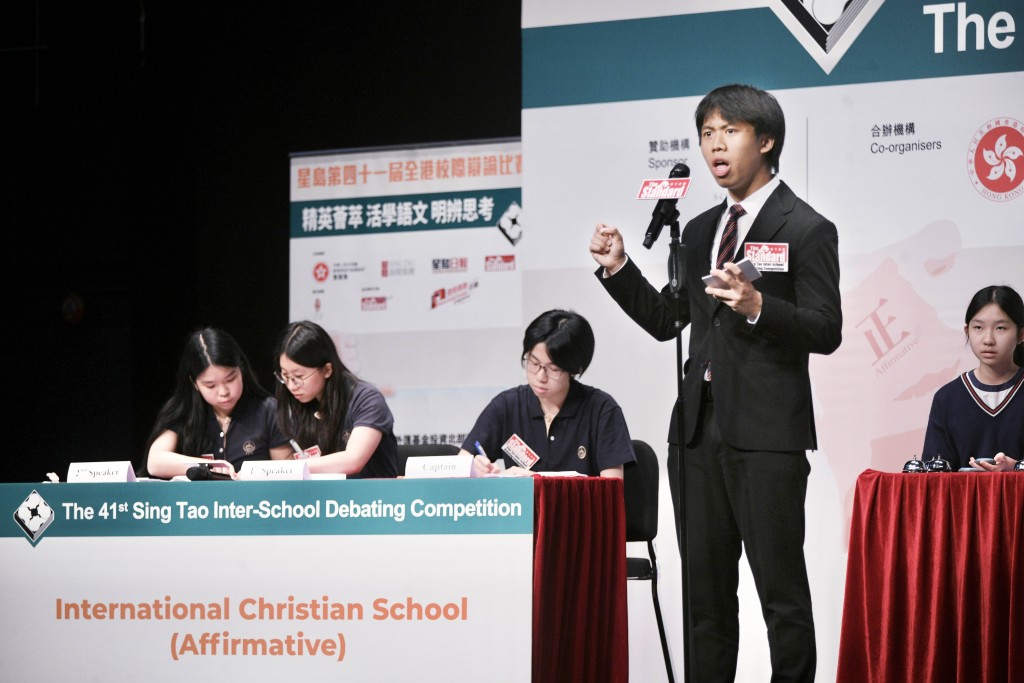
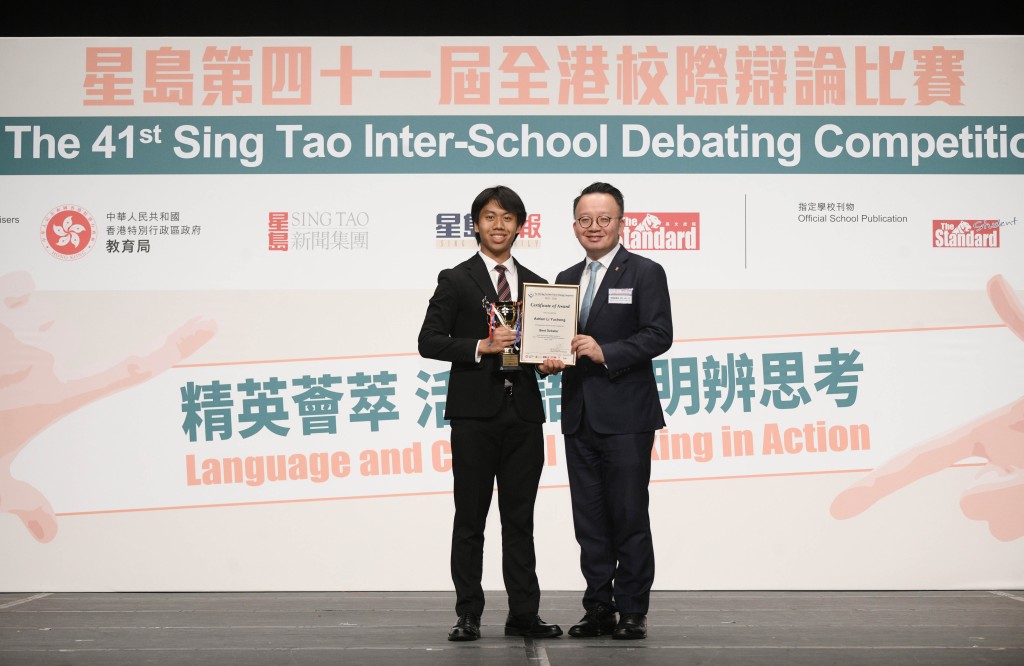
DBS team captain Adrien Li Yu-cheng was named the Best Debater for the English Debate Grand Final
In the end, the opposition team was persistent on hammering their stance, unwavering in the moment. They believed they had given sufficient arguments to support the idea that the “trial and error process” of human creativity was also inherent when crafting AI prompts. “The cognitive struggle exists on both sides of the house, it is not exclusive to their side,” said DBS captain Li, believing that the genesis of an idea overrules the process in determining the value of creativity.
Feedback from the judges
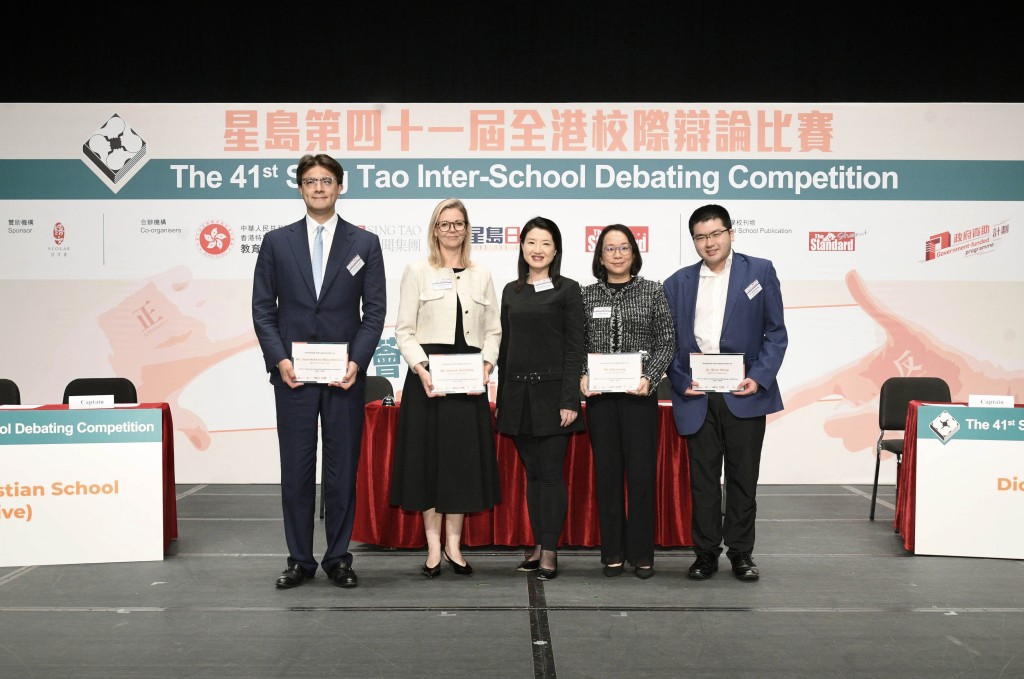
Judges (L-R) Mr José-Antonio Maurellet S.C., Ms Hannah Standring, Ms Bonnie Chen, Ms Ella Leung and Dr Brian Wong
José-Antonio Maurellet S.C., the chairman of the Hong Kong Bar Association, represented the panel of adjudicators from the English section at the 41st edition. He began his comments by praising both teams on their exceptional performance, noting that the result was extremely close.
For instance, he said that both teams made use of effective analogies such as comparing photography with painting, which made it easier for the judges to follow their line of reasoning, and backed information up from credible sources.
However, the judges noted that both teams tend to repeat their previous arguments. This took up the speakers’ time in each of their turns, Maurellet explained, leading some to speak too fast to the point judges could not hear their arguments clearly. “If you cut out the repetition, you may have more time. Otherwise, it’s hard for the panel to absorb [too many points at once].”
One of the judges also observed that some speakers criticised the other side during the competition. Maurellet reminded everyone to focus on the points the other team makes, instead of the opposition speakers themselves.
He concluded his speech with one final tip for the teams: while body language and gestures liven up students’ delivery in debate, too many gestures or exaggerated facial expressions can be distracting.
In a post-match interview, Maurellet revealed that he also liked to use broad gestures in the law court yet sometimes they would distract the judge. To combat this, he practises coordination to synchronise his hand movements.
Training for the intellectual mind
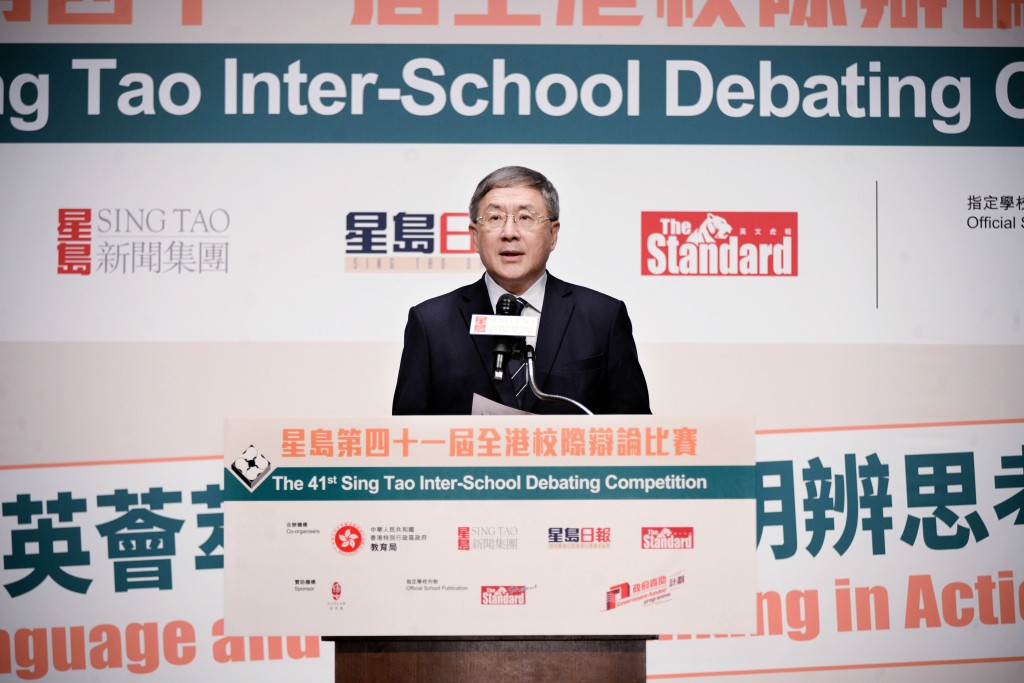
Guest of honour Mr Cheuk Wing-hing commends schools and teachers for supporting students’ language development through debating
Cheuk Wing-hing, the Deputy Chief Secretary for Administration, served as the guest of honour and congratulated all finalists. In his speech, he thanked schools and teachers for nurturing students’ language proficiency beginning from an early age.
“Today’s competition proved an excellent opportunity for young people to hone their Chinese and English abilities beyond the classroom while applying classroom learning of knowledge, skills, positive values, and attitudes.
“More importantly, it offered students the chance to conduct in-depth research about controversial topics in society, which enhances critical thinking and problem solving,” he said.
Then, he spoke on the merits of structured debate, “each time students research arguments and form their position, it is training for their intellectual mind; while presenting arguments on stage and responding to opposing viewpoints cultivates linguistic precision and the ability to improvise.”
Especially in today’s ever-changing world, Cheuk stressed that it is even more important to think clearly and formulate reasoned responses under pressure – all qualities that thoughtful debate could help develop.
Interviewing the champions
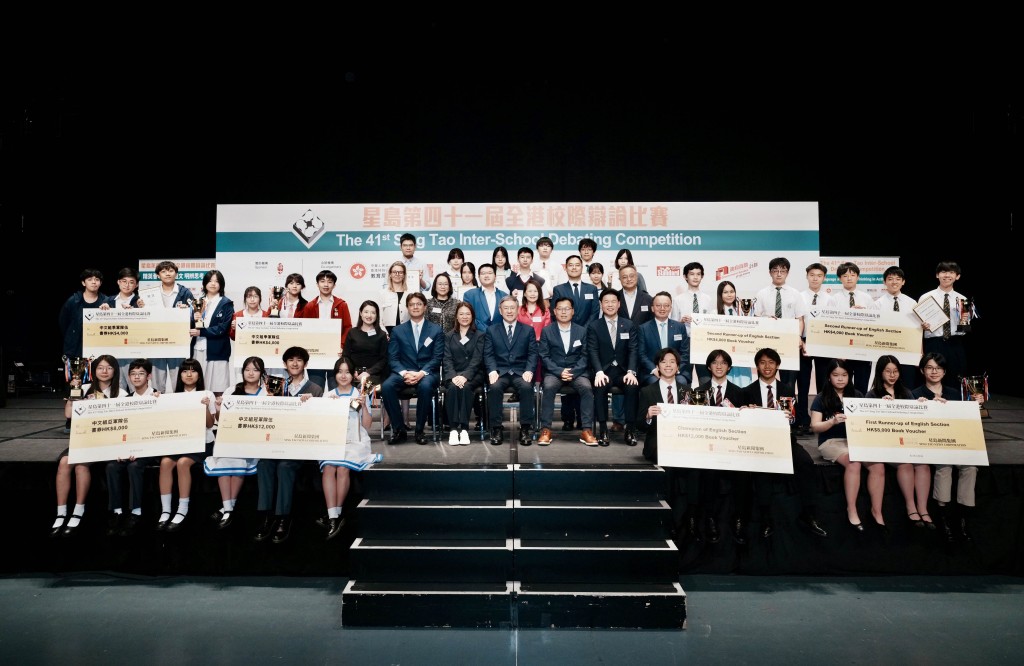
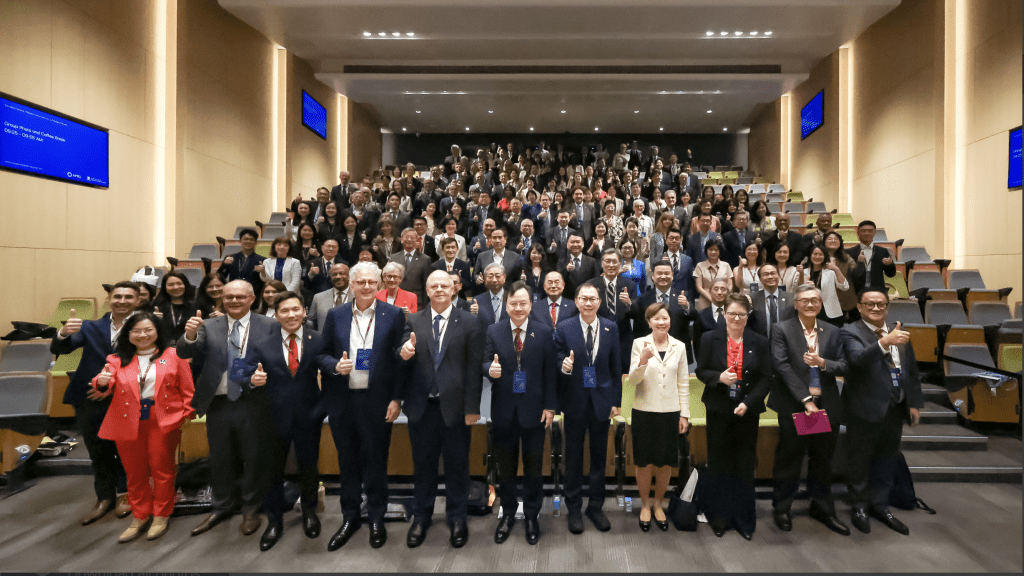
Congratulations to all winners of the 41st Sing Tao Inter-School Debating Competition
Securing their return to the championship since 2024, the Diocesan Boys’ School debate team beamed with pride yet remained humbled and grateful for the honour. “There are only six debaters debating today yet behind them it’s really a big support network of everybody who has talked to us and supported us through these past two weeks to a year,” said Adrian Li Yu-cheng, the captain.
When asked about their winning strategy, Marvis Leung Ching-for, the second speaker, gave an insightful reply: “Be completely ready to throw away the entire case no matter when it is before the competition, whether it is one day, two days, or a week. Because at the end, it doesn’t matter how long we prep on the case if it means we stick to it and it’s a wrong case and we lose.”
The team’s coach and teacher-in-charge, Joan Cho, recounted how she took students out to interview Chinese medicine practitioners during the preparation of the quarter finals as they had been unfamiliar with the little details associated with the case. “We go out of our way to find information… I think that’s part of the strategy, just talk to more people and get their viewpoints.”
Even though the entire team thought they got the less favourable side of the motion, members took the challenge in their stride. “The process of preparing for the motion was a living example of the motion itself… we were able to prove to ourselves that we could use AI in a way that magnifies our creative side and the spark of debate that we all have,” maintained Daniel Wong Pak-ching, the first floor speaker.
Snippet of the Chinese section
In the Chinese section, Tsung Tsin Christian Academy edged out rivals from Hong Kong University Graduate Association College to claim victory, marking a triumphant comeback to the top. Similar to DBS with the team’s captain Tsang Sze-tung receiving the ‘Best Debater’ award.
The debate centred on whether government use of the Exchange fund for large-scale infrastructure projects in the Northern Metropolis Area would bring more harm than good.
Tong Man-lung, the President of the Law Society of Hong Kong, praised both teams for their extensive preparation and giving references to many legal provisions. He was particularly impressed by Tsang who structured her summary speech clearly and displayed remarkable grace towards her opponents.