Kwai Chung Estate was in the spotlight again last week, but this time it had nothing to do with Covid-19 but with a new facility.
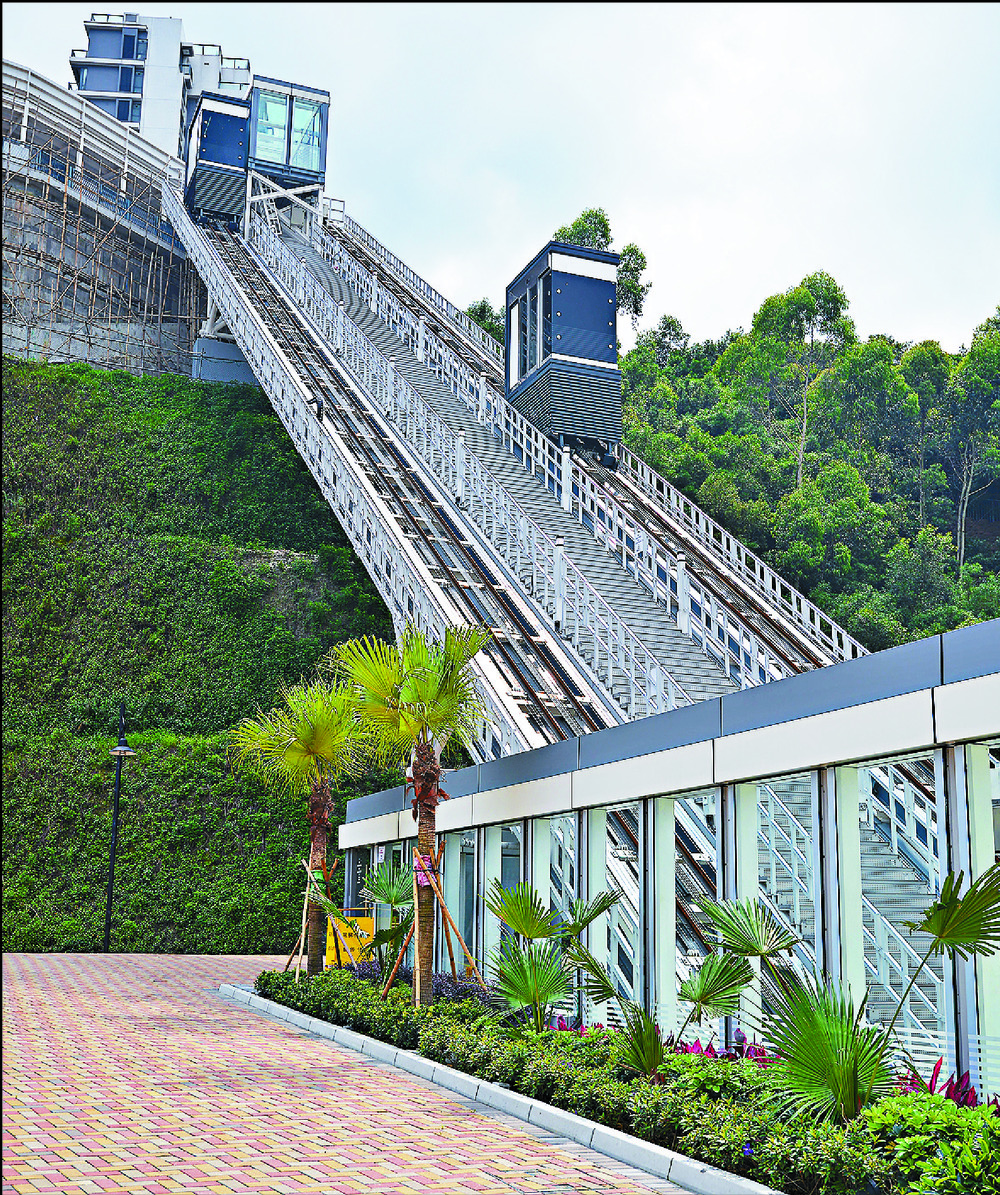
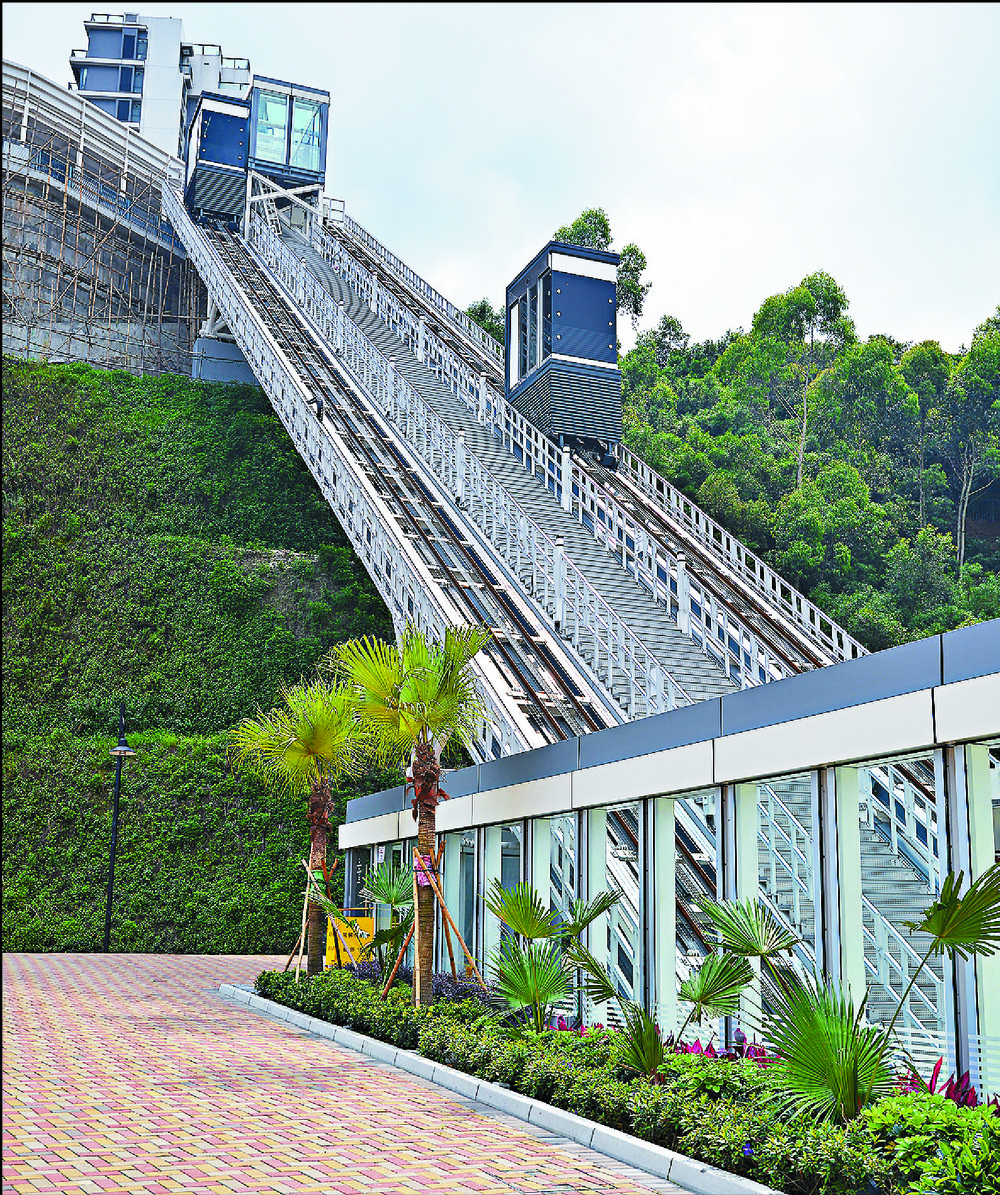
Its long-suffering residents have needed a convenient link to the public transport interchange located on the lower level of the district, and now a inclined lift system, commissioned this month, should alleviate their access problems.
It's common for housing estates on hills to use a vertical lift tower system.
However, the consulting engineer, working in close collaboration with the Highways Department, went for an inclined lift system in place of a conventional vertical lift.
Inclined lifts are not new to Hong Kong.
They had been in service at Discovery Bay and Po Fook Hill for many years.
In technical terms, the lift climbs a slope of 20 meters, with two lift cars each carrying 24 passengers.
With a travelling speed of 1.5 meters per second, the journey takes about one minute.
The system as installed has two lift cars pulled by cables and balanced by a counterweight similar to a conventional vertical lift.
This is to minimize use of energy when the lifts are running at light load, and they should consume far less electrical power than escalators.
For those who wonder why conventional systems such as vertical lifts or long ride escalators were not used in this application, let me try and explain the relative advantages of an inclined lift system.
First, as an inclined lift is installed parallel to the slope of the hill, no heavy foundation is needed.
This obviously saves costs and also shortens the time for installation.
It has been estimated that there is at least a 5 percent cost reduction and at least six months in saving on installation time.
Compared to a vertical lift system with a tower the visual intrusion is far less too.
Second, the estimated volume of passenger traffic does not warrant the installation of an escalator system.
The peak is usually in the morning when residents go to work.
There is a conventional staircase for those who wish to go downhill in a hurry to catch public transport, significantly augmenting the throughput.
For those who can wait for the lift cars it should not take more than a few minutes as the frequency of a lift is less than a minute.
The fixed staircase also serves as an emergency back-up in the remote event of failure or routine maintenance.
Third, unlike escalators an inclined lift allows easy wheelchair access, making it convenient for the handicapped.
Also, as the lift and the rails are installed in a semi-weatherproof enclosure, corrosion and maintenance issues are far easier to control, and access for repair is open.
We all look forward to seeing this novel inclined lift system working efficiently to serve residents reliably, and preliminary indications are that it will.
Once again, this demonstrates that engineers need not follow convention in designing systems.
Quite often, an alternative system exists that can be proven to be superior.
Some innovative thought, courage to try out new systems and ability to refine the operation can produce pleasant and effective solutions.
Veteran engineer Edmund Leung Kwong-ho casts an expert eye over Hong Kong's infrastructure
The inclined lift system in Discovery Bay.