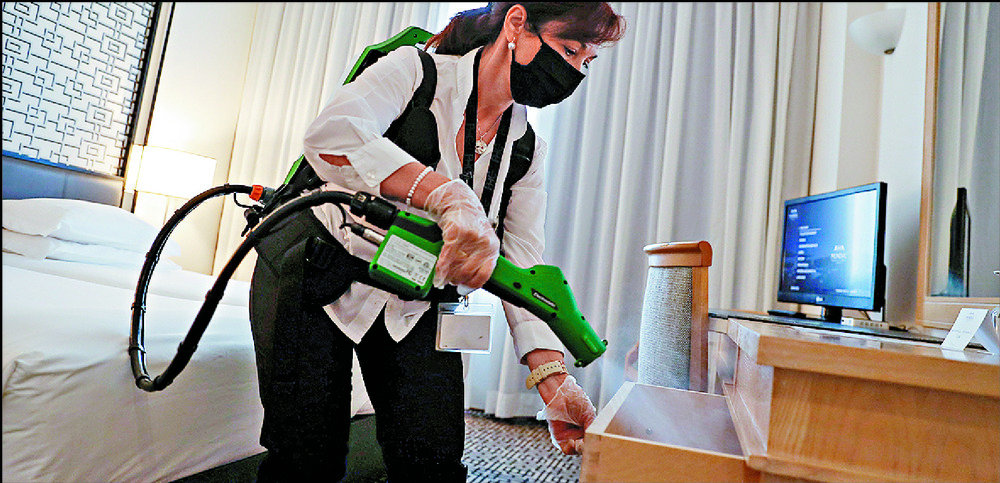
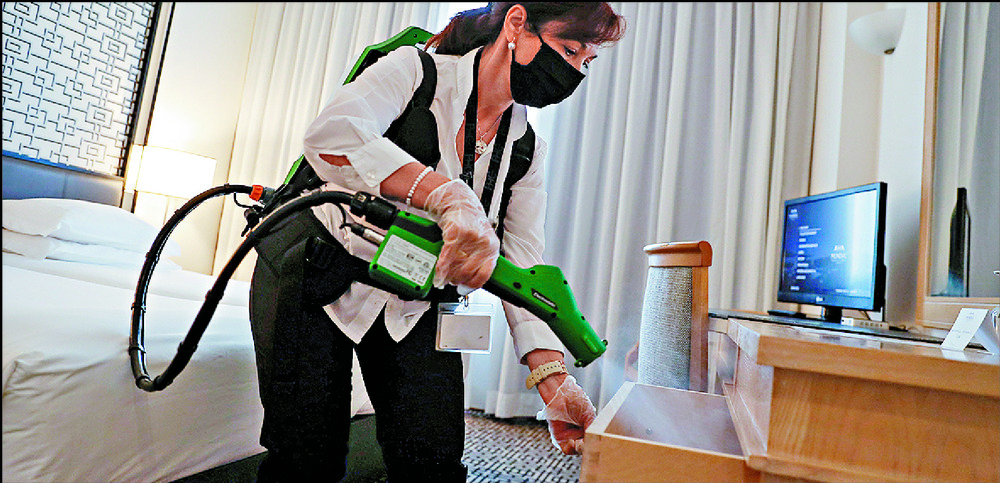
Whether due to staffing shortages, out of respect for social distancing or perhaps just to save money, one primary amenity that sets hotels apart from homes - daily housekeeping - is disappearing.
The days of returning to a wrinkle-free duvet are likely gone. Forget fresh towels, and accept that your trash might never get taken out during your stay.
The trend of no more daily housekeeping, while largely initiated by Covid-19, has become the norm at many hotels. During the pandemic's early days in the US, when transmission was more of a mystery, many hotels cut the service to reduce contact between strangers. More than two years later housekeeping still hasn't returned.
Marriott's policies vary by property, but housekeeping is usually offered only upon request, with all rooms cleaned automatically every sixth night. Hilton's default is no more daily cleanings at most properties unless requested.
Walt Disney World reduced service to light housekeeping every other day. That entails towel replacement and trash removal but doesn't necessarily include services you might expect, like getting your bed made.
Others have schedules like Hotel Solares in Santa Cruz, California: three-night stays or fewer don't get service, while six nights or fewer get one cleaning. It recommends you leave trash outside the door.
Those cuts aren't always welcome.
"Guests don't want to have to ask every time they need their trash emptied or dirty towels replaced,'' says Unite Here, a US and Canada hospitality workers' union. "Without cleaning, what stops a hotel from being just a more expensive Airbnb?''
In many cases, cutbacks may be more about money than safety. For some hotels there's not enough money to cover costs. For others, it's chance to make more money.
In the US, the nationwide labor and materials shortage has hit hotels particularly hard. For instance, the leisure and hospitality industry lost 8.2 million jobs in March and April 2020, a jobs decline of 49 percent.
While there has been rehiring hope (travel-related jobs are among the fastest-growing sectors), the industry is still 1.5 million jobs short of pre-pandemic levels.
Supply chain and inflation issues continue. Hotels reported 79 percent cost rise for cleaning and housekeeping supplies.
Other hotel operators have explicitly stated it's about money.
"The work we're doing right now in every one of our brands is about making them higher-margin businesses and creating more labor efficiencies,'' Hilton CEO Christopher Nassetta said last month. "When we get out of the crisis those businesses will be higher margin and require less labor than they did pre-Covid.''
Most high-end hotels are notably absent from the trend. Some Hilton brands - Waldorf Astoria Hotels & Resorts, LXR Hotels & Resorts and Conrad Hotels & Resorts - still offer daily housekeeping. Most Four Seasons offer it twice daily.
But that's not always true. Disney's Grand Floridian Resort & Spa - frequently deemed Walt Disney World's most opulent resort - offers housekeeping only every other day, like all Disney resorts.
Of course, booking high-end hotels might be an unrealistically expensive solution. But here's a trick that can work at even budget hotels: ask nicely.
Be polite, and staff might take pity. After all, they don't want odors of days-old seafood takeout emitting from rooms. And the beach sand you tracked in could easily spread if not promptly vacuumed anyway.
Some economists have pegged a new word to the phenomenon where, rather than raise prices, companies cut services previously provided: skimpflation.
Skimpflation could mean reduced staff, thus longer lines or phone hold times. It might be the end of free headphones on planes or restaurant bread. For many travelers, skimpflation in no more daily housekeeping has become a particularly unpleasant and - quite literally - messy trend.
NERDWALLET/ASSOCIATED PRESS