Like all countries with a long history of civilization, China depended on agriculture in its earlier era, which in turn depended on the effective irrigation of soil for farming.
The outskirts of Chengdu - where the Minjiang feeds into the Yangtze River - suffered from both droughts and floods in ancient times.
But over 2,000 years ago, a government official called Li Bing made history by controlling the river flow of Minjiang.
We must pay tribute to him for his ingenious method of fighting floods and turning Sichuan province into a fertile agricultural region. I never cease to be amazed by his ingenuity, especially during a period long before modern technology made a difference.
Noticing that floods occurred often, causing damage to property and life, Li devised a dyke system to divert water when it flooded, while maintaining adequate water flow to farmland at all times.
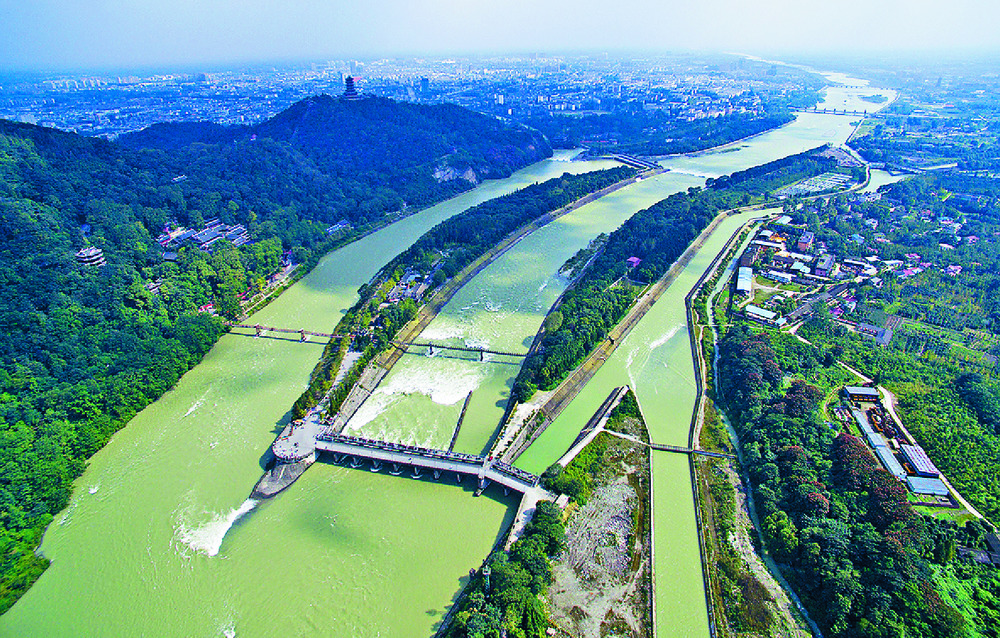
He directed a team of workmen to build an artificial island at a crucial point of the river - where the riverbed was shallow and water flow was rapid at a turn - susceptible to frequent flooding. He used long, sausage-shaped baskets of woven bamboo filled with stones to form the foundation of the artificial island.
The upstream front end of this newly formed bund in the river was shaped like a fish head, called yuzui, or fish mouth. It diverts water flow to both sides of the new riverbed structure, separating the water flow into outer and inner streams.
For the outer stream, a V-shaped cross-section was formed to facilitate smooth flows with increasingly large flow volume, allowing torrents of floodwater to be led downstream without flooding the farmland on the inner side.
For the inner stream, a baopingkou, or bottle-neck channel, to the irrigation system limits the maximum water flow and a weir, feishayan, was formed to allow excess water to flow over it and prevent flooding the irrigation plains.
Due to the judicious location of these features, under normal weather conditions, 60 percent of the flow volume is directed to the feishayan side for effective irrigation. However, during times of high flow with torrential rain upstream, only 40 percent of the water flow is led to the inner stream, freeing up the much wider western leg of the river to divert the flooding water.
The location of these features also allows silt to accumulate on the outer stream, to be excavated during droughts to maintain the right hydraulic conditions.
How Li was able to design and construct the Dujiangyan with such an ingenious and effective hydraulic system long before technical knowledge on fluid mechanics was available and without the aid of computers remains a mystery to us, but the results have proven to work for centuries, allowing Sichuan to become one of the most fertile provinces of China in modern history.
The robust but simple artificial island has withstood many natural disasters, including floods, droughts and earthquakes. It survived a huge earthquake in 1933 and another one more recently in 2008 with minimum damage - it looks like the system will be able to continue to serve its duty for the next few centuries, with regular maintenance.
Now, who says China lags behind in technology?
Veteran engineer Edmund Leung Kwong-ho casts an expert eye over Hong Kong's iconic infrastructure
The Dujiangyan irrigation system is an engineering feat of ancient China that has survived the test of time. Xinhua