Now that the floods and torrential rains are behind us for this year, it may be a good time to re-examine our storm drainage system.
Those of us of previous generations are familiar with floods, as echoed in the children's rhyme that begins with "When heavy rain comes, the streets are flooded"
Indeed, I have vivid memories of wading through floodwater on the way to school and being barefoot in classrooms while my socks and shoes were hung up to dry. That was normal life!
Such floods are no longer tolerable as they not only cause damage to goods in shops but also put lives at risk.
In the 1980s, the Drainage Services Department was set up to combat floods and dispose of sewage.
So we now have a comprehensive system that collects and sends wastewater and sewage to treatment plants before discharging to the ocean.
But rainwater can come in torrents. It is collected by a system of underground drains and then discharged to the ocean.
River training works in the New Territories had minimized flooding in low-lying villages during heavy rain.
Other improvement works include constructing embankments to direct floodwater away from low-lying villages, collecting surface runoff in holding ponds and then discharging it by pumping it to nearby drainage channels.
Typical works in urban areas include building underground drains.
But the huge volume of rainfall collected from the main part of the city requires much larger facilities to swiftly discharge it to the sea.
Over the years, we used drainage channels to lead surface water to the sea.
These have now been decked over and used as highways in To Kwa Wan and Waterloo roads in Kowloon, and Canal Road on the Island.
The growth of our city has changed some of the natural terrain, and new and smart drainage systems became necessary to ensure effective drainage.
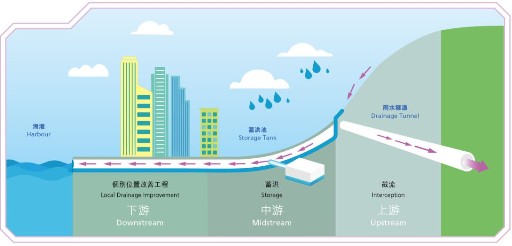
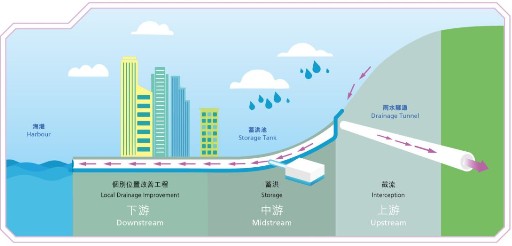
To cater for this, four tunnels, which together add up to 20 kilometers, intercept and divert rainwater to the sea: Tsuen Wan, Lai Chi Kok, Hong Kong West and the Kai Tak drainage tunnels.
We may not be able to see these huge tunnels, with diameters of four to more than seven meters, but they do the job.
In addition to these facilities, which mainly rely on gravity discharge of rainwater, there are still some areas in the city that are susceptible to flooding.
Stormwater storage tank systems were also built in Tai Hang Tung, Happy Valley, Sheung Wan and On Sau Road to alleviate these areas' notorious floods.
During torrential rain, they store the sudden surge of surface water, allowing the drainage system to operate continuously by avoiding overloading the downstream drains, preventing backflow and the resulting floods.
Thanks to the city's flood prevention strategy and effective drainage infrastructures, the extent of the flooding during the last black rainstorm was generally manageable and normality was quickly restored.
The process of continuous improvements to our drainage system continues and hopefully, with suitable flood resilience measures, flooding will soon be a thing of the past.
Veteran engineer Edmund Leung Kwong-ho casts an expert eye over features of modern life
Lai Chi Kok drainage tunnel.