Read More
Wallis Wang and agenciesAuthorities are also scrapping virus tests to enter most public venues - a big change in national strategy meant to quell discontent and to fire up the economy.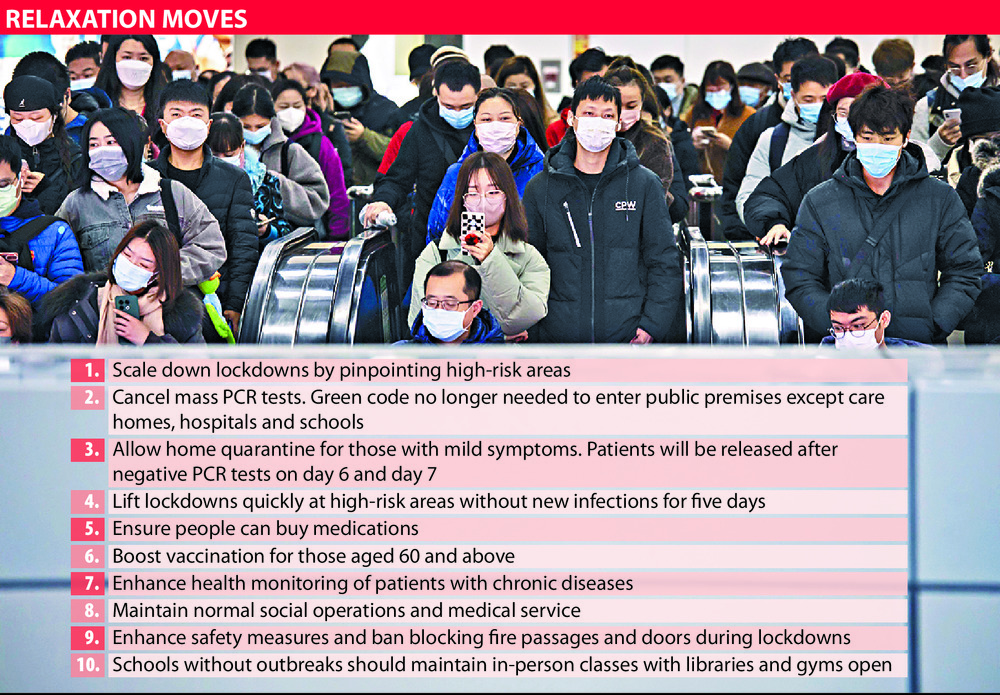
After three years of firm rules, China yesterday eased Covid restrictions, announcing 10 measures that include allowing asymptomatic and mildly symptomatic virus sufferers to quarantine at home rather than in camps.
ADVERTISEMENT
SCROLL TO CONTINUE WITH CONTENT
China will accelerate the vaccination of the elderly, long seen as an obstacle to the relaxation of the zero Covid strategy.
Citizens cheered the prospect of a shift that could see China slowly emerging back into the world.
The announcement soared to the top most viewed topic on Weibo, with many hoping for normality.
"It's time for our lives to return to normal and for China to return to the world," wrote one Weibo user.The measures issued by the National Health Commission include accelerating vaccination among the elderly and stopping local officials from designating large areas such as entire housing compounds as high risk, leading to lockdowns.
Local authorities can only designate specific units, floors and buildings as high-risk areas and not expand to larger areas.Any form of temporary lockdowns are also banned. And lockdowns of high-risk areas without new infections for five days should be lifted immediately.
A green health code on a contact-tracing smartphone app is no longer needed for domestic travel or to enter most venues except for care homes for the elderly, medical institutions, kindergartens and schools.Mainlanders traveling across the country no longer need to present a green health code and negative PCR test results. A need for travelers to be tested upon arrival at a destination is scrapped.
The new rules mean "asymptomatic infected persons and mild cases [can generally be] isolated at home or they can voluntarily choose centralized isolation for treatment," the commission said."If a patient's CT value in a PCR test is higher than 35 on the sixth and seventh days following infection they will be free to leave their premises. Those whose conditions worsen will be sent to designated hospitals."
Close contacts of patients can also observe a five-day home quarantine.On vaccinating the elderly, the commission said authorities will improve services with green lanes and setting up more temporary sites and mobile units.
Monitoring of Covid patients with chronic diseases will be heightened.Asked about authorities easing measures later than other countries, top epidemiologist Liang Wannian said it takes time for a nation with a population of 1.4 billion and many elderly and chronically ill people to make changes.
Mi Feng, a spokesman for NHC, said the relaxation applies only in the mainland, though authorities will gradually speed up improving its anti-pandemic border measures.Tam Yiu-chung, Hong Kong's outgoing deputy at the National People's Congress Standing Committee, said the mainland will control domestic outbreaks before considering reopening its border with the SAR.
But a reverse quarantine plan where Hongkongers undergo quarantine before traveling to the mainland will no longer be necessary.Similar measures now going in place in the mainland have already been implemented in Hong Kong.
People who have received at least two doses of a vaccine and who test positive can quarantine at home. And unlike mainlanders who have to undergo PCR tests, Hongkongers who test negative in rapid tests on the sixth and seventh days following infection can leave isolation premises.Although Hong Kong did not launch a whereabouts-tracing health code system like in the mainland, it requires people to follow the vaccine pass arrangement.
Asked if the mainland will launch similar measures to the vaccine pass, Zheng Zhongwei, an NHC official heading a Covid task force, said Beijing will not make inoculations mandatory.Zheng added that the vaccination rate among mainlanders is already very high, with 97.5 percent of youngsters aged three to 17 and 95 percent of people aged 18 to 59 receiving at least one shot.
Also yesterday, Hong Kong authorities said they had over 24 hours recorded 11,981 cases - the highest in six months. They included 11,278 local and 703 imported cases. There were also 22 deaths.People who received a fourth jab six months ago can get a fifth on starting on Friday. And people can choose the new BioNTech bivalent shot for their third, fourth and fifth jabs.
wallis.wang@singtaonewscorp.comEditorial: Page 8