Read More
Hong Kong is gearing up for its annual battle against dripping air conditioners by deploying a powerful new weapon: the third-generation AI Dripping Air Conditioner Investigation System. The government will conduct large-scale operations from May to September, targeting over 300 known blackspots to tackle the perennial summer nuisance.
ADVERTISEMENT
SCROLL TO CONTINUE WITH CONTENT
According to a spokesman for the Food and Environmental Hygiene Department (FEHD), the system can automatically detect dripping locations and accurately identify the source, significantly shortening the time required for observation and evidence collection.
It can operate effectively despite low-light conditions during night-time or early morning hours, overcoming the constraints on enforcement posed by the difficulties of pinpointing dripping sources during specific times.
In anticipation of the summer heat, the FEHD has also escalated its publicity and education efforts to foster a greater sense of public responsibility.
Over the past two weeks, from April 16 to 30, officers conducted a series of outreach activities. These included closely liaising with District Offices, District Councils (DCs), and local committees to encourage the public to proactively address and resolve the problem.
The FEHD also actively collaborated with property management companies to facilitate the distribution of promotional leaflets and the display of posters on building premises and housing estates.
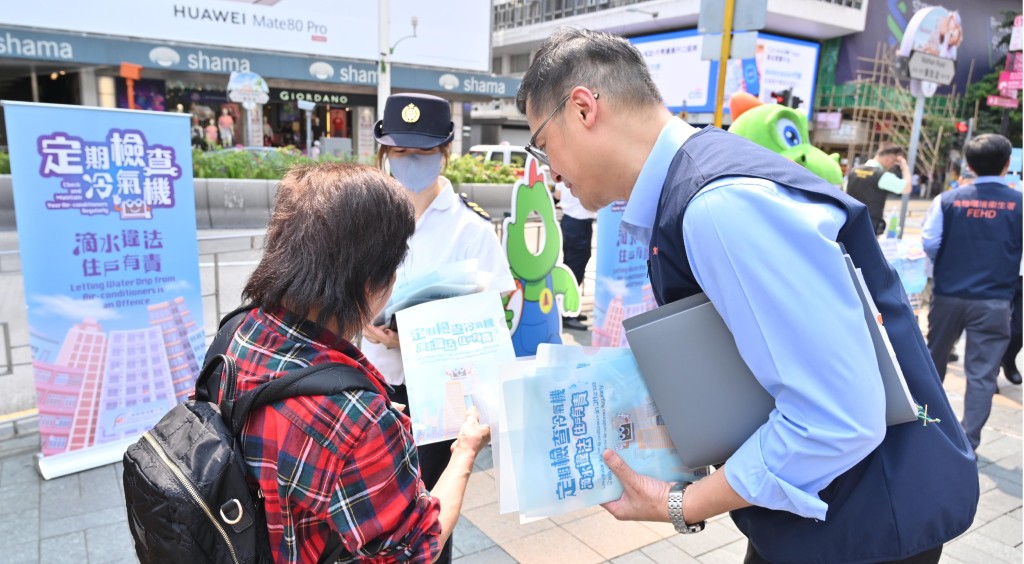
Additionally, the FEHD set up promotional booths at popular public spots and on streets with high pedestrian flows to promote public knowledge of proper air conditioner maintenance and preventive measures against dripping.
Throughout this period, approximately 15,000 related leaflets and posters were distributed across nearly 390 locations.
Authorities have reiterated the legal ramifications for offenders. Under the Public Health and Municipal Services Ordinance, allowing an air conditioner to discharge water in a manner that creates a hygiene nuisance for others is an offense.
If a nuisance is proven, the FEHD will issue a Nuisance Notice to require the owner or occupier of the relevant premises to stop the nuisance within a specified period.
Failure to comply can lead to prosecution. Upon conviction, the offender is liable for a maximum fine of HK$25,000, plus a daily fine of HK$450 for as long as the nuisance continues.
𝗗𝗼𝘄𝗻𝗹𝗼𝗮𝗱 𝗧𝗵𝗲 𝗦𝘁𝗮𝗻𝗱𝗮𝗿𝗱 𝗔𝗽𝗽 ↓