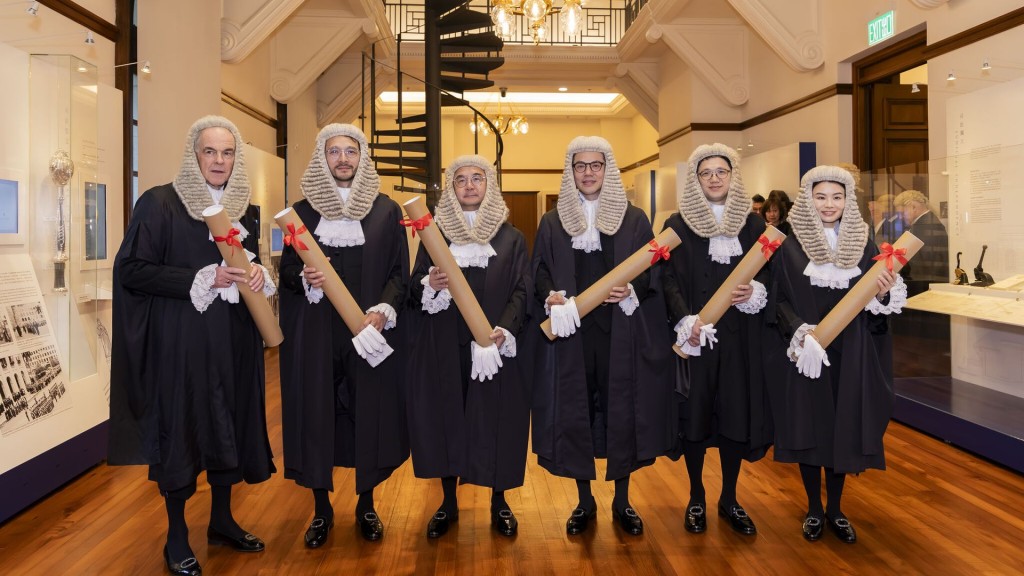
"Can we go to the court and listen to the case?" It's a question friends and family members have often asked me and one that has both surprised and worried me.
How is it, I have wondered, that people do not know our magistracies and higher courts are open to the public? What, I ask myself, can be done to make the criminal legal system more open to the public it serves?
So news that cameras are to be allowed into Hong Kong's courts is hugely welcome, and I have no doubt it will mark the start of a golden age of public engagement with the legal system.
Although the judicial system will itself benefit the biggest beneficiary by far will be the public because people will be able to see justice as it is done.
The public, of course, have always had the right to attend court hearings, but until now most people's knowledge of the courts has been limited to what they read in the media, and only a tiny percentage of the population have first-hand experience of a courtroom.
I believe cameras in court will reveal a huge public appetite to know more about justice, and that will be a truly beneficial development. The rule of law and public confidence in the justice system will both be enhanced, and allowing cameras into the courts will build faith and confidence in justice. People will be able to see justice in action and understand better the complex decisions judges must make.
In recent years many jurisdictions have also permitted such broadcasts.
Britain, Canada, Australia and of course the United States now allow cameras in their top courts, and their experiences have been universally favorable.
When Britain began its discussion about cameras in its courts there was much opposition and a fear it would lead to an "Americanization" of proceedings. But such fears have proved groundless.
There were also fears that loquacious barristers would "showboat" or grandstand and play to the cameras.
But British viewers will initially only be able to see judges delivering sentences, and broadcasters are not permitted to film any other people in the courtroom. Contracts with broadcasters stipulate that court proceedings must not be used for political reasons, advertisements, promotions, "light entertainment or satire."
Anyone who wishes to see the British system in action can view judges delivering sentences online. For example, Britain's first such broadcasted sentencing can be seen at youtube.com/watch?v=8TcLSzDL2OY as judge Sarah Munro imprisons Ben Oliver for life over the manslaughter of his grandfather.
Also worth watching is the sentencing of London police officer David Carrick for 49 offenses and his admissions of 71 instances of sexual violence against 12 victims committed over a period of 17 years.
The judge details the "irretrievable devastation" in the lives of those abused and their families. This includes lost relationships, with one of a parent with a "daughter who self-harms" because of Carrick's abuse of her mother.
Munro takes great care to explain how the reduction for Carrick's delayed guilty pleas worked on a sliding scale and how life sentences were justified by the gravity of the offenses and the risk he continued to pose. It can be found at https://www.youtube.com/watch?v=Pbqw-SojBs0
The first broadcast of the sentencing of a woman defendant in the United Kingdom, Jemma Mitchell, by judge Richard Marks for the barbarous murder of Mitchell's friend Chong Mee Kuen and the dumping of her headless body to inherit a large sum of money can be found at youtube.com/watch?v=Pbqw-SojBs0.
To watch it is truly to experience justice in action.
Cheng Huan is an author and a senior counsel who practices in Hong Kong
The life term handed down to Jemma Mitchell for Chong Mee Kuen's murder was a first on TV.