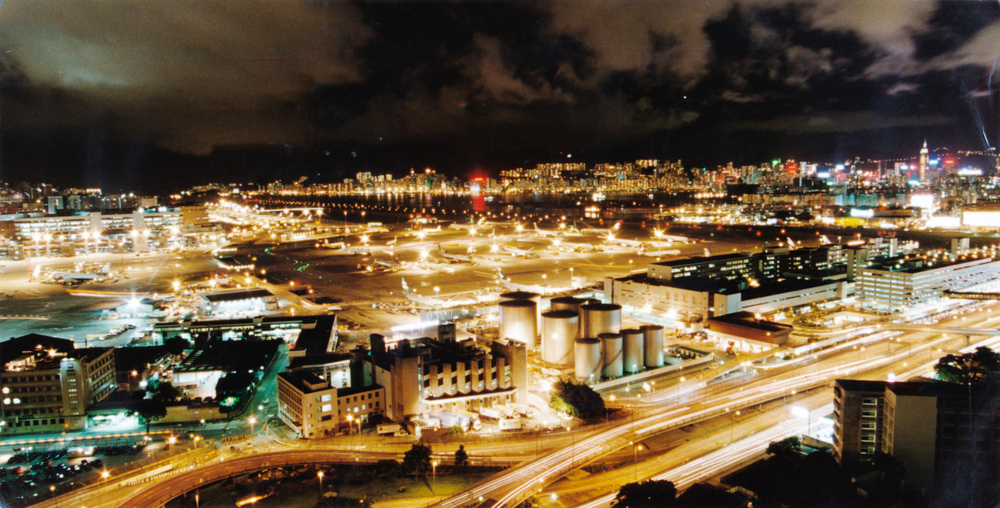
My last article described markings on airport runways and taxiways, and now we advance on the subject with some illumination.
For in adverse weather or at night the markings are not readily visible, so to ensure safety runway lighting assists in guiding a pilot in safe landings and takeoffs. This is especially important for modest-sized airports and small private planes that do not have an automatic landing system.
Runway lighting serves to provide additional visual information to a pilot -vital for when an automatic system fails to operate.
To enable a pilot to find an airport in an emergency, a system of beacons projects an alternating green and white searchlight beam to indicate its location. The white searchlight can be seen through clouds, and by following the direction of the searchlight to descend below cloud a green light in the alternating lighting welcomes a plane to an airport.
The approach system with sequenced white flashing lights before runways guides pilots to steer planes toward them.
With this indication, pilots should see the runway edge lighting, which are white lights outlining the edges of the runway.
Yellow lights are used at the end part of the runway to warn a pilot how much more runway length can be available, and threshold lights in red shows the area aircraft must not enter.
Pilots are also informed by approach path indicators whether their planes are approaching runways at suitable angles.
These indicators are arranged in a horizontal group of four lights seen as white or red by pilots depending on the approach angle.
Two red lights out of four tells a pilot the plane is approaching at the correct angular range. Three red lights and one white light indicate it is too low while one red light and three white lights means too high, so a pilot is warned quickly to adjust the height of approach.
Like the touchdown zone markings there are lights to guide pilots to land safely in the appropriate zone.
Once an aircraft touches down runway centerline lights direct a pilot to stay at the center of the runway while decelerating before being guided to enter a particular taxiway by taxiing lights.
The centerline lights are white, but the lights for taxiways are green along the centerline and blue along the edges.
The pilot will not be confused with the numerous lights in the airfield as the lights are directional in nature and each series of lights is set to be seen only at certain intended range of positions.
Runway and taxiway lighting are inset in the pavement to avoid damage to the lighting system and to an aircraft.
Elevated mounting of lighting in those parts of pavement outside the normal path are deliberately installed in a light structure, so they can break easily without causing damage to an aircraft in the unlikely event of accidental contact.
Safety is vital as a plane can carry a lot of passengers and travel at high speed. And landing an aircraft is a critical activity and require additional safety measures.
Runway markings and lighting are there to provide clear and unambiguous directions to pilots.
Although modern airports already provide detailed and accurate directions to aircraft for automatic landing they do not totally rely on these automatic systems, and additional devices help to guide pilots even in the unlikely event of control system failure for the total safety of the pilot and the passengers.
Air travel in the modern day is extremely safe and statistically far safer than road or sea travel.
Veteran engineer Edmund Leung Kwong-ho casts an expert eye over features of modern Hong Kong