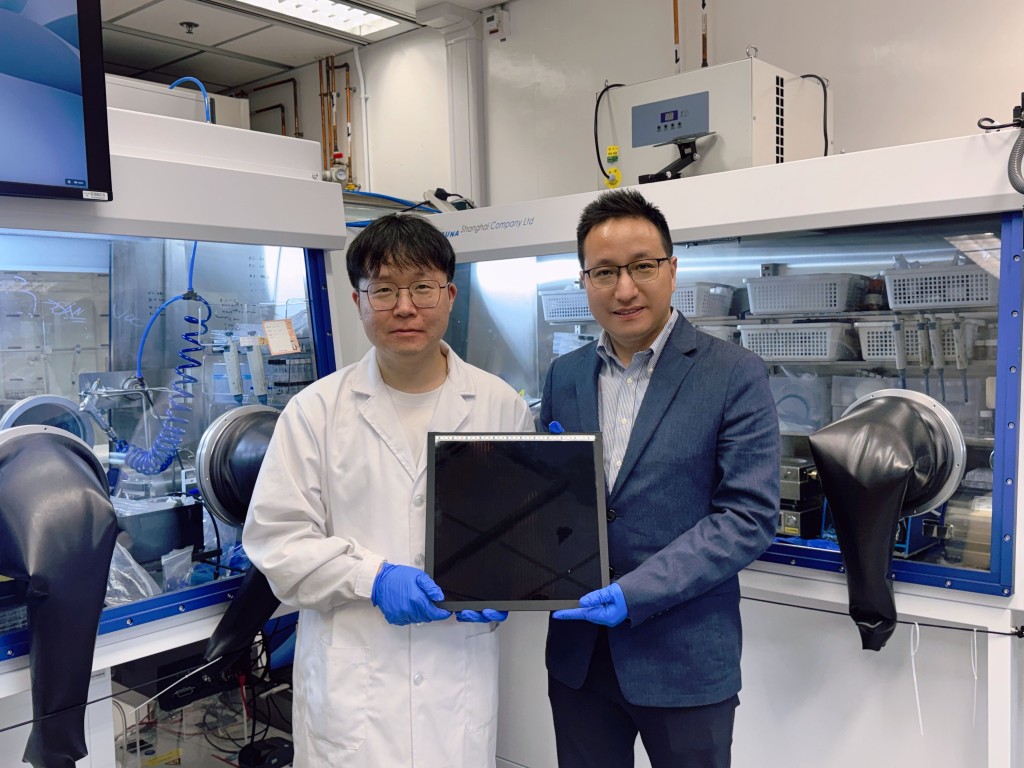
The Hong Kong University of Science and Technology (HKUST) researchers developed Trans-Interface Engineering (TIE), a technology that builds nanoscale link networks within perovskite solar cells, to break one of the field's bottlenecks of interfacial damage, boosting stability without eroding efficiency.
With perovskite solar cells, solar panels are promised to cheaply boost the energy generated by solar farms and rooftops, and could work better than silicon panels on satellites and electric cars. While laboratory-scale cells' power conversion efficiency has exceeded 27 percent, they have not been fully commercialized, as the stacked films inside are prone to warping and peeling apart under pressure and temperature swings, according to HKUST.
To solve the problem, HKUST researchers developed Trans-Interface Engineering (TIE). Instead of using a flat, weak bonding layer between materials like a Band-Aid, they built tiny vertical nano-links. They added special chemical molecules to the cell's key layers and used heat to create networks stitching the layers together, which resists stress from heat and squeezing, and also helps electricity flow better to boost performance, HKUST said.
Tests showed TIE-enabled perovskite solar cells hit a power conversion efficiency of 27.04 percent, with a certified reading of 26.67 percent and an open-circuit voltage of 1.22 volts. As the interfacial toughness nearly tripled, they also saw better longevity—92 percent held steady past 1,400 hours—versus regular control cells with highly variable lifespans spanning dozens to more than 1,800 hours. Under accelerated aging at 85 degrees Celsius and 85 percent humidity, they delivered better stability and consistent results as well, it added.
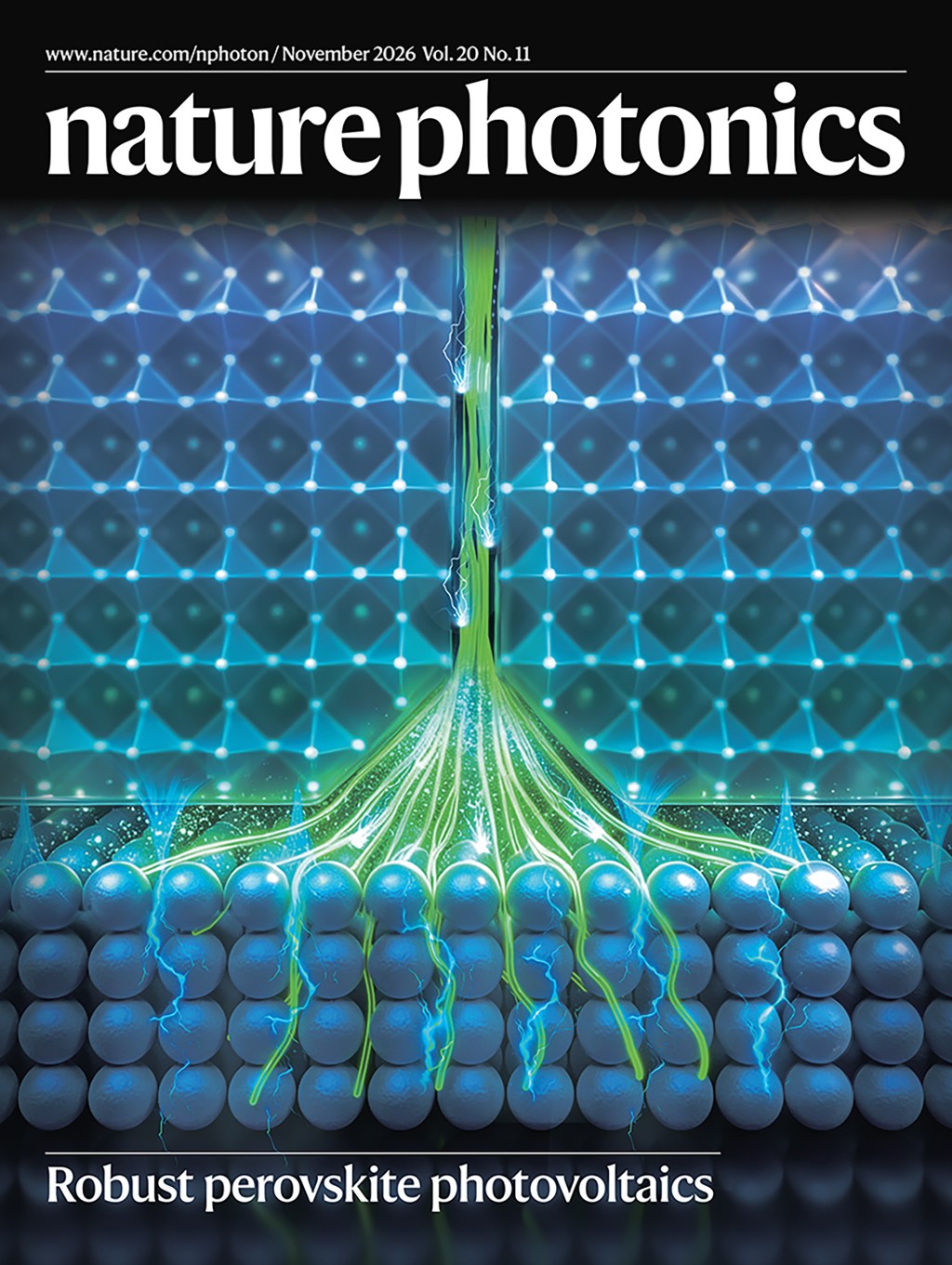
Zhou's study was published in the international journal Nature Photonics, which was also featured as the cover article of the journal in November 2026 (Volume 20, Issue 11). HKUST
The study was published in the international journal Nature Photonics, entitled "Trans-interface engineering for reliable perovskite solar cells with reproducible stability," and was featured as the cover article in November 2026 (Volume 20, Issue 11).
Zhou Yuanyuan, acting head and professor of the Department of Materials (MAT) at HKUST, who led the research and served as the sole corresponding author of the study, said, "Through trans-interface covalent linkages, we connect the perovskite and charge-transport layers together at the molecular level, substantially improving mechanical reliability and stability without compromising optoelectronic performance."
Guo Pengfei, a co-first author and former Postdoctoral Research Fellow in Zhou's group, said, "TIE not only addresses this long-overlooked issue but also opens a new avenue for interface design in multilayer optoelectronic devices."
This research was conducted independently by the HKUST team. The team has filed a patent for the TIE technology and secured support from China Merchants Group to further advance its commercialization potential and industrial applications.
Frank Feng