Read More











HK movie producer Raymond Wong Pak-ming convicted of insider dealing
22-05-2026 17:10 HKT

Swire Properties wins compulsory auction for $2.02b Quarry Bay property
22-05-2026 20:36 HKT
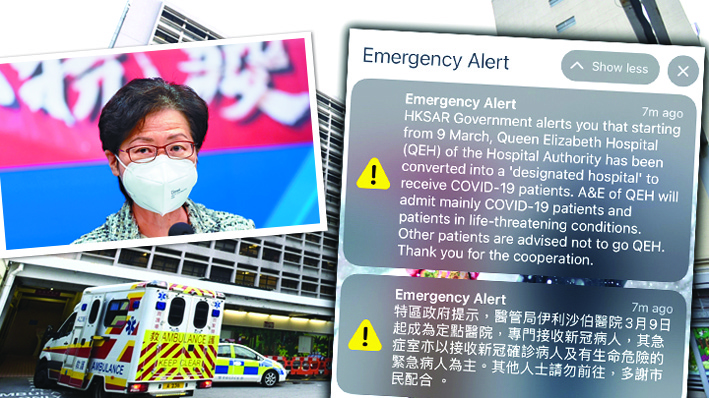
The freak phone sirens and buzzers set off by a HK$150 million emergency alert system may have proven its worth by scaring people out of their wits.
But it was a failure if the authorities' only objective was to let the public know that Queen Elizabeth Hospital was designated a Covid hospital and to advise patients suffering from other illnesses not to go there.
The bulletin was not urgent and in no way did it warrant the use of an emergency warning system.
Designation of the hospital as a Covid facility had been announced in the preceding hours by Chief Executive Carrie Lam Cheng Yuet-ngor during a high-level media conference that has since then become a daily occurrence.
What was the urgency, given that the information had already been reported and pushed by the media for awhile?
Unless, that is, someone wanted to use the occasion to test the system, which had not been used in a real situation since its launch in November 2020.
But if it was meant to be a drill, should not sufficient advance notice have been given to the public?
Not surprisingly, Lam admitted she was also a little astonished by the sudden burst of sirens and buzzers when she was busy working in her office.
Even so, she was quick to defend the use of the system.
It wasn't a fault with the system as similar warning systems are in place in other countries for emergency responses.
In the United States, for example, police rely on such systems to warn people to stay indoors during increasingly frequent shootouts and to keep away from windows as searches are underway.
That's the kind of emergency situation that requires an immediate response from the public.
But Hong Kong's dramatically noisy alarm, which happened at about 6pm on Wednesday, was a prime example of how far stupidity can stretch.
I wonder if the person who made the decision to set off the alarms can recall the tale of the boy who cried wolf?
If not, I will provide a brief synopsis for his or her future reference: a young boy thought it would be funny to raise the alarm among villagers by yelling that the sheep were being attacked by a wolf. After "crying wolf" two or three times nobody bothered to take any notice any more - and nobody reacted when the wolf actually came and killed the sheep.
Needless to say, a dire emergency demands immediate action and - in the event of an earthquake or tsunami, for example - early warnings can save many lives.
As Lam defended this stupid act, she may also forgive people for shaking their heads in disbelief after calming down when they realized the dramatic alert only related to the hospital.
Incidentally, the system also provides for a higher "extreme emergency alert" and I can't help but wonder what event might constitute such a higher alert.
A lesson to be drawn from this fiasco is that the public needs to be better informed about the system, including the various emergency levels.
Prior to the ongoing war, air-raid drills were held in major Ukrainian cities to familiarize residents with what to do when sirens went off.
Back in pandemic-beleaguered Hong Kong, some took the confusion as a comic relie. IKEA's swift and lighthearted Facebook posting of an "urgent reminder" that it was the last days of its sales may have raised eyebrows but it should not be criticized for trying to add a little color to a situation dulled by the pandemic.