Read More
With Pfizer, DiDi, and AutoFlight leading the sixth batch, OASES has delivered 124 firms, HK$73 billion in investment, and 25,000 jobs. The city must now shift from attraction to deep integration.
ADVERTISEMENT
SCROLL TO CONTINUE WITH CONTENT
A tipping point is achieved – but the narrative has shifted
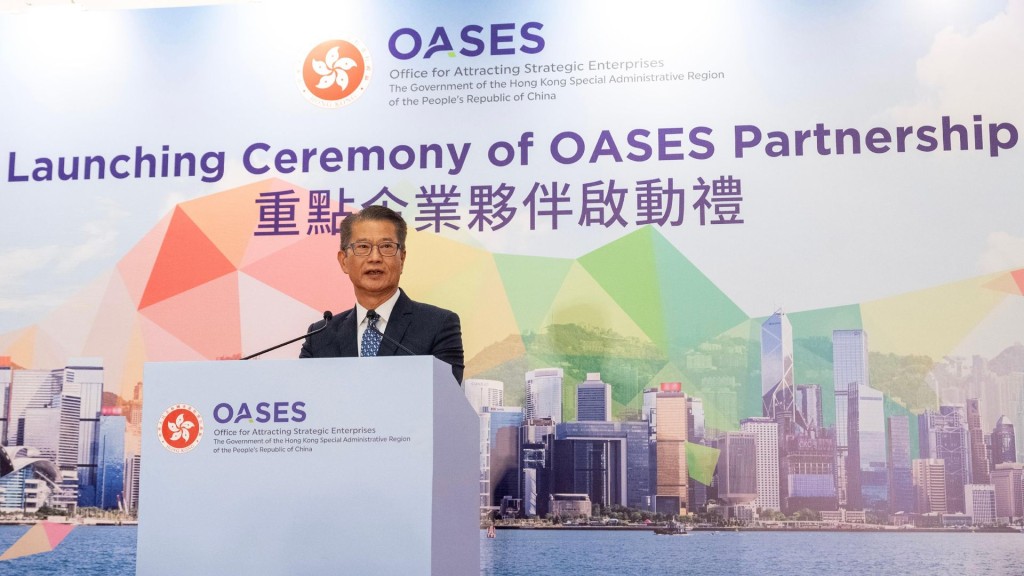
The Office for Attracting Strategic Enterprises, or OASES, has surpassed its original target. With the latest batch of 22 firms, the total stands at 124, not 100. Cumulative expected investment has reached HK$73 billion, and over 25,000 new jobs are anticipated.
The latest arrivals include pharma giant Pfizer, mobility platform DiDi, aircraft manufacturer AutoFlight, AI firm MiniMax, chip designer Hygon, and digital asset custody leader Cobo Fintech. Notably, five of the world’s top 10 pharmaceutical firms – Pfizer, AstraZeneca, Merck, GSK, and Roche – now have a foothold in Hong Kong.
Old criticisms of high costs, limited land, and a thin talent pool are no longer decisive. These companies are drawn by Hong Kong’s financial depth, legal credibility, regulatory speed, and gateway status to mainland China’s talent and market. Yet attracting firms is only the first step. Here is what must come next.
Convert headquarters into integrated ecosystems
Eighty percent of strategic enterprises have already partnered with local universities. That figure needs to reach 100 percent. The government should broker co-innovation agreements between these firms and Hong Kong’s eight major universities. Pfizer’s clinical trials could link to the new Drug and Medical Device Regulatory Centre, while AutoFlight’s electric vertical take-off and landing research could integrate with the University of Science and Technology’s aeronautics labs. Every enterprise must become a node in a dense local network.
Build regulatory sandboxes before competitors do
The sixth batch includes firms in artificial general intelligence, digital asset custody, stablecoin payments, and advanced chips – sectors where regulatory uncertainty is the biggest barrier. Hong Kong should launch dedicated, fast-track sandboxes for each field. A digital asset sandbox would allow Cobo to test cross-border settlement under live supervision. An AGI sandbox would permit MiniMax to deploy limited-scale models before full licensing. If Hong Kong hesitates, Singapore or Dubai will not.
Double down on ‘twin-engine’ financing
Fifty-two of the 124 firms are already listed. HKEX’s Chapter 18C must be actively marketed to the rest. Hong Kong already has a powerful tool: the Hong Kong Investment Corporation’s HK$30 billion Co-Investment Fund, but its potential remains underutilized. The government should direct the HKIC to launch a Northern Metropolis Later-Stage Co-Investment Facility focused on manufacturing, clinical trials, and data centers, matching private capital at a transparent ratio with a capped return.
Use the 124 as a talent-deepening weapon
Each strategic enterprise should sponsor local hires for research and management roles – not just expatriate secondments. Hong Kong should also launch a Strategic Enterprise Fellowship Program, embedding top local STEM graduates in these firms for two years, converting 25,000 jobs into a pipeline of locally trained professionals.
Enhance cross-border data pilots
Cross-border data flows for R&D remain cumbersome. The government should establish a dedicated cross-border data pilot zone in the Northern Metropolis for anonymized research data transfer between Hong Kong and mainland partner cities.
The ‘East Rising’ window is real – but it closes fast
Hong Kong has made its case to 124 strategic firms. But the next 124 will be harder. They will demand proof – of regulatory speed, talent depth, seamless data flows, and patient capital. The foundation is solid. Now comes execution. Hong Kong must move from destination to ecosystem – where enterprises do not just land, but grow, hire, partner, and stay for decades.