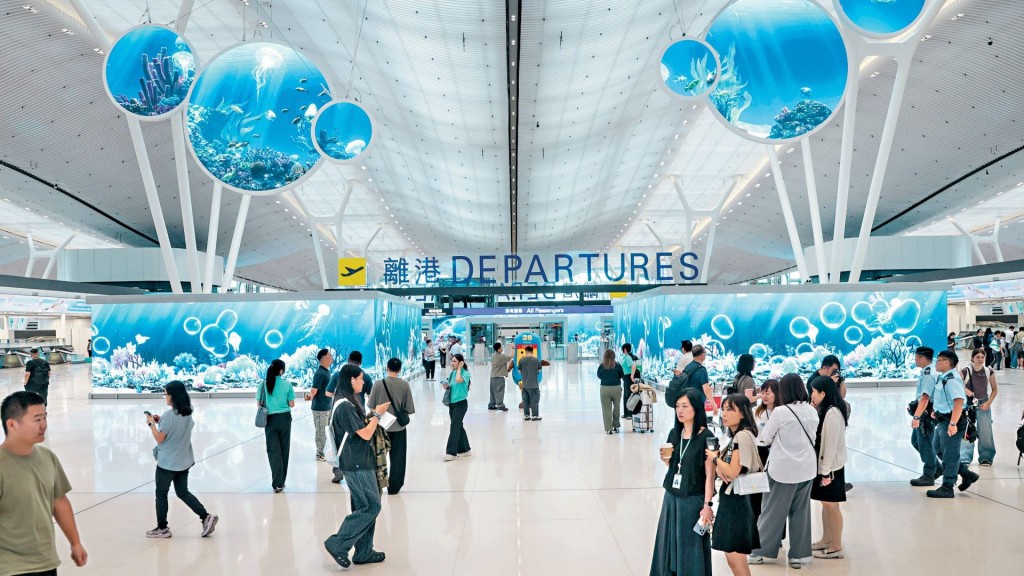
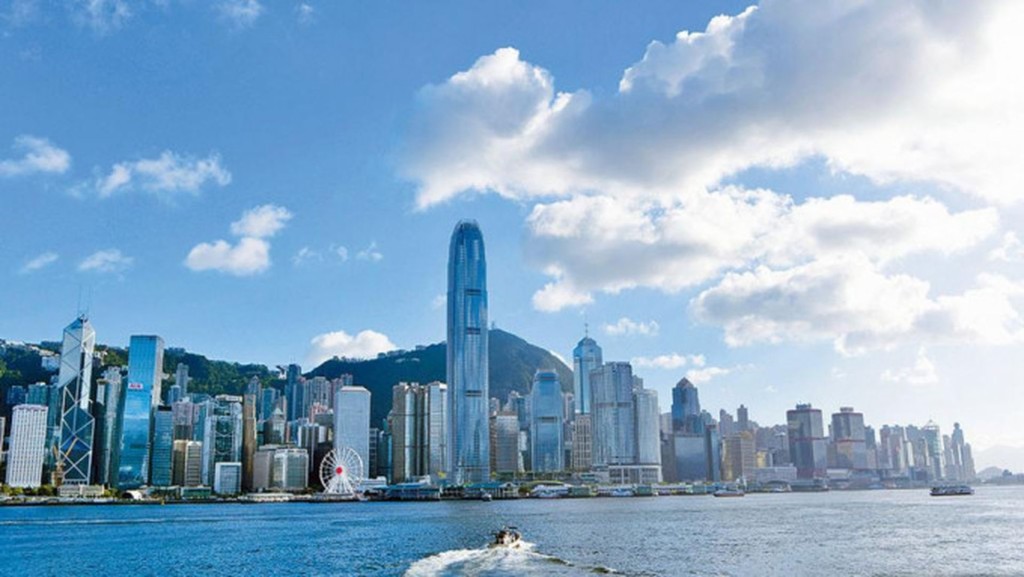
Hong Kong International Airport’s newly expanded Terminal 2 has opened at a perfect time, just as the city seeks to pull ahead in the fierce regional airport wars and consolidate its status as a global aviation hub.
The expansion of Terminal 2 is a critical pillar of the airport’s broader US$18 billion (HK$140.4 billion) Three-Runway System. This system will elevate the airport’s total capacity to 100 million travelers annually – and eventually 140 million – putting it on par with Singapore Changi’s 90 million, Seoul Incheon’s 106 million, and Guangzhou Baiyun’s 140 million.
The Airport Authority designed Terminal 2 to be one of the most technologically advanced terminals in the world. Built around the concept of “smart departures,” it features biometric facial-recognition e-Security gates, express self-bag drop counters, and heavily automated baggage handling systems. These upgrades are set to establish a new global benchmark for transit speeds – an area where HKIA already excels.
Hub for the Greater Bay Area
The most significant advantage HKIA enjoys is its immediate, multi-modal access to mainland China’s Greater Bay Area, feeding directly into the region’s 86 million residents via the Hong Kong-Zhuhai-Macau Bridge.
The upgraded Terminal 2 Coach Hall facilitates seamless land-to-air connections. Meanwhile, the integrated SkyPier ferry terminal allows air-to-sea passengers to transfer to other parts of the GBA seamlessly, without ever passing through Hong Kong immigration or customs.
While Singapore Changi uses “The Jewel” to attract early-arriving travelers, HKIA can convince transit passengers to book longer layovers by leveraging the adjacent 11 Skies complex – a massive 2.66 million-square-foot retail, dining, and entertainment hub. The indoor entertainment zone features the city’s first-ever 4D motion flying theatre, Greater China’s first KidZania, an immersive digital media art exhibition, and an electric karting track.
Geopolitical opportunities
An increasingly volatile geopolitical situation also provides Hong Kong with unique opportunities. Western and Japanese airlines remain banned from using Russian airspace, while airspace closures across the Persian Gulf have heavily disrupted major Middle Eastern hubs like Dubai and Doha.
Consequently, HKIA can position itself as a predictable, trouble-free alternative for travelers flying between Europe and the Asia-Pacific region. By utilizing Russian airspace, Chinese carriers operating out of HKIA can market shorter, cheaper routes that save international flyers up to three hours of flight time and thousands of dollars in fuel.
Amid ongoing trade tensions with the US and Europe, Asean has risen to become China’s largest trading partner. Although Western decoupling efforts have driven a manufacturing shift from China to Southeast Asia, China remains the primary source of raw components and the core of the regional supply chain. This allows Hong Kong to serve as a key node in the production chain between the two regions, acting as the primary logistics consolidation hub for the entire Asia-Pacific.
The growing economic strength of Asia means the flow of people and goods will only intensify over the long term. Hong Kong must continuously upgrade its logistical hardware to successfully defend its status as a premier global aviation hub.